

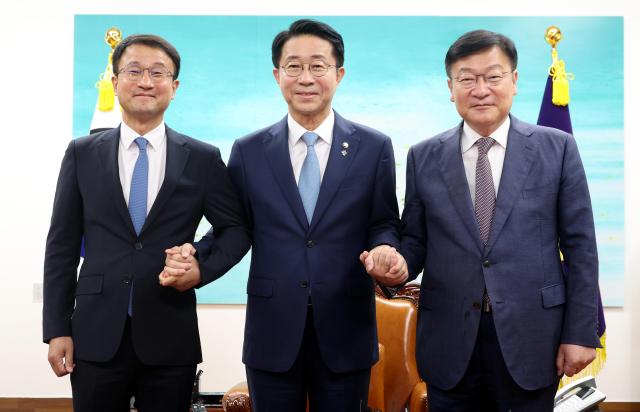
National Assembly Speaker Cho Jung-sik (center) poses for a photo with Democratic Party floor leader Han Byung-do (left) and People Power Party floor leader Jeong Jeom-sik in the National Assembly Speaker's office on June 11. [Photo=Yonhap News]
The Democratic Party submitted a request for an extraordinary session on July 3, following a full meeting of the Legislative and Judiciary Committee the previous day. This move aims to formally commence the second half of the 22nd National Assembly. The opposition People Power Party, which is boycotting the committee schedule in protest of the ruling party's unilateral selection of committee chairs, is expected to escalate its external protests.
National Assembly Speaker Cho Jung-sik announced, "A request for an extraordinary session has been submitted by Representative Han Byung-do and 160 others, and the 437th National Assembly (extraordinary session) will convene at 2 PM on July 6 at the National Assembly building."
Previously, Han Byung-do, the Democratic Party's floor leader, had pledged to convene the July extraordinary session to address pressing livelihood issues. The Democratic Party plans to hold meetings for the 11 standing committees where chairs have already been elected. The Legislative and Judiciary Committee held a full meeting the day before and passed the agenda for selecting a vice-chair.
On the same day, the Democratic Party attempted to convene a full meeting of the Finance Committee to address the vice-chair selection, but it was unsuccessful. According to sources from the Finance Committee, the meeting was canceled due to the absence of several members. It appears that the lack of a quorum was due to boycotting members from the People Power Party and some Democratic Party members also not attending.
While the Democratic Party is pressuring the People Power Party by operating a partial standing committee on its own, the opposition party remains steadfast in its hardline stance. During a party meeting the previous day, the People Power Party reached a consensus to not cooperate on committee composition and to escalate their protests. Floor leader Jeong Jeom-sik plans to gather more opinions over the weekend and may hold another party meeting next week to discuss specific protest strategies.
Within the party, there are suggestions to secure the remaining committee chairs and negotiate within the National Assembly. However, the prevailing opinion among first-term lawmakers is to pursue external protests. Specific proposals for external gatherings have reportedly emerged during party discussions.
Political analysts suggest that the ongoing standoff between the ruling and opposition parties could lead to a prolonged 'half-session' scenario, with both parties shifting blame onto each other. The People Power Party maintains that negotiations are impossible without the Legislative and Judiciary Committee, while the Democratic Party is unlikely to relinquish its claims to the committee.
One floor leader remarked, "We must not boycott even livelihood issues," urging the People Power Party to participate in the committees. However, critics within the conservative camp argue that the government and ruling party are selectively taking only the necessary committees, implying indifference to those related to livelihood issues.
A member of the People Power Party stated, "It seems they have chosen committees necessary for pushing policies through," predicting that if they take the Political Affairs Committee emphasized by President Lee Jae-myung, they are likely to introduce measures to curb household loans related to real estate policies.
As the likelihood of a prolonged 'half-session' increases, it is anticipated that both parties will experience significant fatigue. To pass any agenda in committees, a majority of the members must be present, which means that, as seen in the Finance Committee case, some standing committees may struggle to meet the quorum requirements.
National Assembly Speaker Cho Jung-sik announced, "A request for an extraordinary session has been submitted by Representative Han Byung-do and 160 others, and the 437th National Assembly (extraordinary session) will convene at 2 PM on July 6 at the National Assembly building."
Previously, Han Byung-do, the Democratic Party's floor leader, had pledged to convene the July extraordinary session to address pressing livelihood issues. The Democratic Party plans to hold meetings for the 11 standing committees where chairs have already been elected. The Legislative and Judiciary Committee held a full meeting the day before and passed the agenda for selecting a vice-chair.
On the same day, the Democratic Party attempted to convene a full meeting of the Finance Committee to address the vice-chair selection, but it was unsuccessful. According to sources from the Finance Committee, the meeting was canceled due to the absence of several members. It appears that the lack of a quorum was due to boycotting members from the People Power Party and some Democratic Party members also not attending.
While the Democratic Party is pressuring the People Power Party by operating a partial standing committee on its own, the opposition party remains steadfast in its hardline stance. During a party meeting the previous day, the People Power Party reached a consensus to not cooperate on committee composition and to escalate their protests. Floor leader Jeong Jeom-sik plans to gather more opinions over the weekend and may hold another party meeting next week to discuss specific protest strategies.
Within the party, there are suggestions to secure the remaining committee chairs and negotiate within the National Assembly. However, the prevailing opinion among first-term lawmakers is to pursue external protests. Specific proposals for external gatherings have reportedly emerged during party discussions.
Political analysts suggest that the ongoing standoff between the ruling and opposition parties could lead to a prolonged 'half-session' scenario, with both parties shifting blame onto each other. The People Power Party maintains that negotiations are impossible without the Legislative and Judiciary Committee, while the Democratic Party is unlikely to relinquish its claims to the committee.
One floor leader remarked, "We must not boycott even livelihood issues," urging the People Power Party to participate in the committees. However, critics within the conservative camp argue that the government and ruling party are selectively taking only the necessary committees, implying indifference to those related to livelihood issues.
A member of the People Power Party stated, "It seems they have chosen committees necessary for pushing policies through," predicting that if they take the Political Affairs Committee emphasized by President Lee Jae-myung, they are likely to introduce measures to curb household loans related to real estate policies.
As the likelihood of a prolonged 'half-session' increases, it is anticipated that both parties will experience significant fatigue. To pass any agenda in committees, a majority of the members must be present, which means that, as seen in the Finance Committee case, some standing committees may struggle to meet the quorum requirements.
* This article has been translated by AI.
Copyright ⓒ Aju Press All rights reserved.