

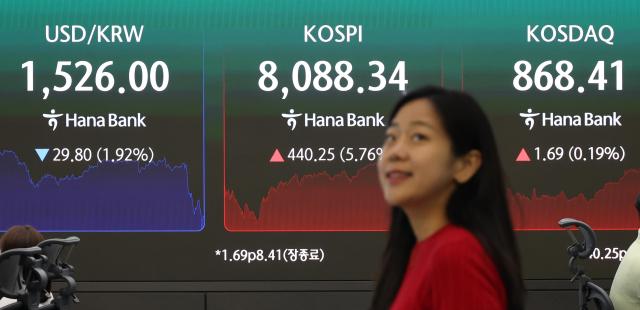
The South Korean stock market experienced significant volatility, initially plummeting due to concerns over a slowdown in artificial intelligence (AI) infrastructure investment, before rebounding the following day. Market attention is now shifting towards the upcoming second-quarter earnings season. Analysts suggest that fears regarding reduced AI investment may be overstated, but they anticipate continued volatility until Samsung Electronics releases its preliminary earnings and the U.S. Federal Open Market Committee (FOMC) minutes are made public.
On July 4, the Korea Exchange reported that the KOSPI closed at 8080.37, up 440.25 points (5.76%) from the previous trading day, recovering above the 8000 mark. The KOSPI had dropped 7.89% on July 2, falling to the 7300 range during trading, but managed to rebound the next day, driven by semiconductor stocks. Over the week from June 29 to July 3, the KOSPI fell 3.84%, while the KOSDAQ rose 2.00%.
Last week, concerns over reduced AI investment spread following reports that Meta is considering external sales of its AI computing resources, leading to a decline in major semiconductor stocks. This was compounded by end-of-quarter rebalancing, foreign selling, and volatility in leveraged products, significantly dampening investor sentiment.
However, many in the market view this adjustment as a valuation correction rather than a deterioration of fundamentals. There are no confirmed signs of a slowdown in long-term supply contracts or demand for high-bandwidth memory (HBM), and forecasts for domestic companies' earnings have actually been revised upward.
The KOSDAQ performed relatively well, buoyed by expectations of policy support. The Korea Exchange announced measures to revitalize the market and improve delisting regulations as it marks the 30th anniversary of the KOSDAQ, which helped support investor sentiment. In contrast, the KOSPI faced continued foreign selling, while individual investors began buying large-cap semiconductor stocks, providing support at the lower end of the index.
Next week will see significant events, starting with Samsung Electronics' preliminary earnings announcement on July 7, followed by the release of the FOMC minutes from June on July 9. On July 10, TSMC is set to announce its June sales, which will likely influence market perceptions regarding global AI investment and the semiconductor industry.
Analysts believe that Samsung Electronics' earnings will be a key factor in restoring short-term investor sentiment. If the results exceed expectations, confidence in the memory sector may strengthen, leading to renewed buying interest in semiconductors. Following that, TSMC's earnings and the AI investment plans of major global tech firms are expected to be critical variables determining market direction in the second half of the year.
Lee Jae-won, a researcher at Yuanta Securities, stated, "This adjustment is more about valuation derating due to noise rather than a fundamental deterioration. As upward revisions to earnings estimates for IT and semiconductors continue, it is advisable to focus on major events such as Samsung Electronics' preliminary earnings and SK Hynix's NASDAQ listing while employing a value-buying strategy centered on semiconductors, IT hardware, and finance."
Na Jeong-hwan, a researcher at NH Investment & Securities, noted, "Meta's entry into the cloud should be viewed as a strategy to enhance the profitability of already invested infrastructure rather than a sign of declining AI demand. The immediate catalyst in this phase is Samsung Electronics' preliminary earnings; if results exceed expectations, it could shift selling sentiment to holding and buying."
However, caution regarding short-term volatility remains. Shin Eul, a researcher at SangSang Investment & Securities, remarked, "Market leadership is shifting from geopolitical issues in the Middle East back to employment, inflation, and interest rates. As the earnings season begins, while AI momentum will continue, it is crucial to differentiate between stocks based on corporate performance and financial health rather than relying solely on liquidity-driven buying."
* This article has been translated by AI.
Copyright ⓒ Aju Press All rights reserved.