

<Education & Perspective> examines the crumbling public education system, declining school-age population, and the turbulent college entrance system while addressing pressing educational issues and challenges. It also seeks sustainable alternatives and occasionally offers a cold yet warm perspective on our society.
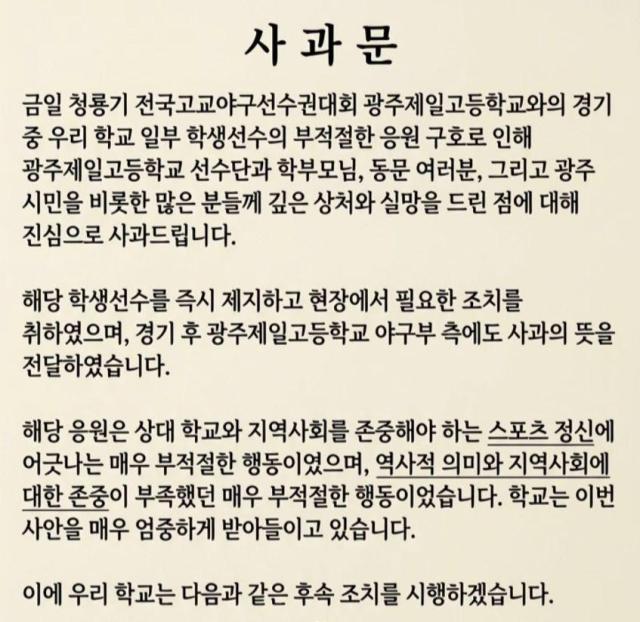
The controversy surrounding the Paichai High School baseball team's derogatory cheers has intensified, leading to social backlash and legal disputes. The so-called "Starbucks Gaya-ji" incident reflects the ideological conflicts in South Korean society spilling into high school sports.
As warnings about the seriousness of the situation resonate, this incident exposes the deeply rooted culture of mockery and hate in Korean society. What was once considered the domain of certain online communities has now infiltrated the daily lives of youth and school sports teams.
On June 29, during the 81st Cheongryonggi National High School Baseball Championship held at Mokdong Stadium, Paichai High School players organized cheers such as "Gaya-ji, Gaya-ji, Starbucks Gaya-ji" and "Tank Day" during their match against Gwangju Jeil High School. This behavior maliciously borrowed phrases from the Starbucks Korea controversy that arose on May 5, the anniversary of the May 18 Democratic Uprising, where phrases like "Tank Day" and "Desk's Tap" were used to mock historical tragedies. Recognizing the gravity of the situation, Shinsegae Group Chairman Jeong Yong-jin swiftly dismissed the Starbucks Korea representative who organized the "Tank Day" event and publicly apologized, stating, "All responsibility lies with me."
However, the grievous mistake that prompted a corporate leader to reflect on historical awareness has resurfaced as a weapon of mockery against a rival team just over a month later. As the fallout spread, the Korea Baseball Softball Association imposed an unprecedented six-month suspension on Paichai High School from competitions, resulting in an immediate forfeiture of their scheduled matches. The school hastily issued an apology, but it was later discovered to have been generated by AI, further fueling public outrage and distrust.
This incident transcends the notion of a few students engaging in impulsive "deviant behavior"; it symbolizes a complete abandonment of the ethical values that future leaders in sports should uphold. Where did it all go wrong? It is essential to examine the principles at play. The Korea Baseball Softball Association (KBSA), which oversees amateur baseball in South Korea, has outlined six policies and 24 practical tasks. Notably, to realize the policy of implementing clean baseball, it emphasizes "respect for sports rights and the implementation of various preventive education" as a key practical task. This underscores the importance of community values and human rights, which are fundamental ethical guidelines for student athletes. It explicitly states that values such as consideration for opponents and fair competition, or "sportsmanship," should take precedence over winning and losing.
However, high school players aspiring to become national representatives and professional athletes trampled these strict regulations and global standards on the field. While some in the legal community caution against hastily applying judicial standards to the immature slogans of high school students, the act of producing falsehoods and mockery by exploiting historical pain is a dangerous behavior that undermines the legislative intent of the May 18 Special Act and the significant consensus in our society. At the core of this issue lies the far-right culture of Ilbe, which thrives on historical distortion and hate.
What was once confined to the specific platform of "Ilbe" has now spread widely in the form of memes through short-form platforms like YouTube Shorts, TikTok, and Instagram Reels, which teenagers consume daily. Children, unaware of the deep wounds inflicted on specific regions and bereaved families, engage with it merely as an amusing and provocative "game." As hate speech becomes a trend and a form of play among peer groups, the moral defenses and sense of guilt among youth are crumbling, reflecting the current state of education in South Korea.
To break the cycle of mockery and distortion proliferating in online communities, urgent social and educational alternatives are needed. Experts unanimously call for a comprehensive strengthening of media literacy education, enabling youth to filter out fake news and distorted information. They also stress the importance of developing habits of cross-verification to ensure that information comes from credible institutional media or recognized academic sources.
Particularly, critical thinking training that separates fact from opinion must be systematically integrated into public education to prevent youth from being swayed by sensational headlines, manipulated images, and context-stripped videos. Schools should establish strong disciplinary standards against inappropriate behavior and hate speech to enhance effectiveness. Additionally, major portal sites, YouTube, and community platform companies should be legally mandated to enhance AI-based hate speech filtering systems and significantly strengthen self-regulatory responsibilities.
In response to the Paichai High School baseball team incident, both ruling and opposition parties, as well as the government, must focus on improving the digital harmful environment and developing educational measures. The obsession with victory cannot justify the disappearance of sportsmanship. It is disheartening that in a competitive arena where high school athletes should be protected and educated, discussions of legal actions related to violations of the "May 18 Special Act" are necessary.
* This article has been translated by AI.
Copyright ⓒ Aju Press All rights reserved.