

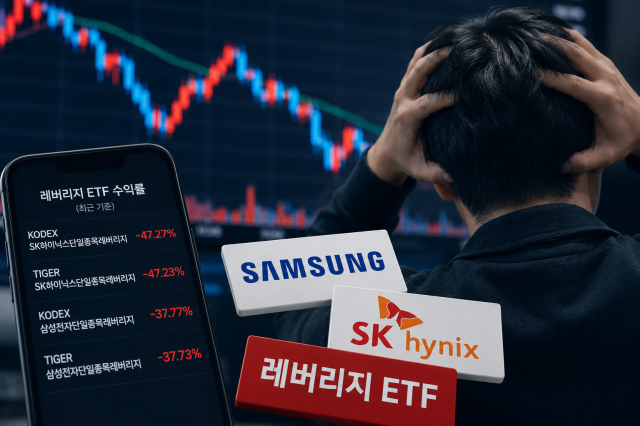
Despite the ongoing rollercoaster of market fluctuations, individual investors are increasingly betting on leveraged exchange-traded funds (ETFs) that track the daily returns of Samsung Electronics and SK Hynix, aiming for double the gains. However, aggressive buying has resulted in losses of 30% to 40% for these ETFs, leading to significant financial setbacks for investors.
According to the Korea Exchange, from June 26 to July 3, the KOSPI index exhibited extreme volatility, fluctuating between the 7600 and 8400 levels. On July 3, the KOSPI closed at 8088.34, up 440.25 points (5.76%) from the previous trading day, but the intraday difference between the high and low points reached 758.18 points, marking the second-largest fluctuation on record. Major semiconductor stocks also experienced dramatic swings, with Samsung Electronics rebounding 8.22% after a 9.06% drop the previous day, while SK Hynix rose 10.88% following a 14.57% decline.
Amid this volatility, individual investors have poured money into leveraged ETFs. According to Koscom ETF Check, the top inflow for the past week was KODEX SK Hynix Single-Stock Leverage ETF, attracting 787.8 billion won, followed by KODEX Samsung Electronics Single-Stock Leverage ETF with 617.5 billion won. Other notable mentions include TIGER SK Hynix Single-Stock Leverage ETF (408.3 billion won, sixth place) and TIGER Samsung Electronics Single-Stock Leverage ETF (265.1 billion won, eighth place).
The buying trend among individual investors has been particularly pronounced. During this period, individuals net purchased 1.6037 trillion won in KODEX SK Hynix Single-Stock Leverage ETF and 810.7 billion won in TIGER SK Hynix Single-Stock Leverage ETF. They also bought 683.5 billion won and 357.7 billion won in KODEX and TIGER Samsung Electronics Single-Stock Leverage ETFs, respectively, totaling a net purchase of 3.4556 trillion won across these four products.
However, despite the substantial inflow of funds, the performance has not met expectations. KODEX and TIGER SK Hynix Single-Stock Leverage ETFs fell by 47.27% and 47.23%, respectively, while KODEX and TIGER Samsung Electronics Single-Stock Leverage ETFs recorded losses of 37.77% and 37.73%. The aggressive bets have resulted in negative returns for all these funds.
Concerns are rising in the market that as more funds concentrate in single-stock leveraged ETFs during periods of high volatility, the inherent characteristics of these products could exacerbate losses and increase market volatility. Park Woo-yeol, a researcher at Shinhan Investment Corp., noted in a recent report that "given the high index weight of Samsung Electronics and SK Hynix in the KOSPI, the impact of single-stock leveraged products on the index is greater than in foreign markets." He explained that while the U.S. has hundreds of leveraged products, the index weight of Nvidia, the largest by market capitalization, was only 2-3% when its leveraged ETF was launched and is currently around 8%.
In contrast, Samsung Electronics and SK Hynix account for about 65% of the KOSPI index and nearly half of the MSCI KOREA (EWY.US) ETF, meaning that the increased volatility of these single stocks significantly impacts the index.
Jang Geun-hyuk, a senior researcher at the Capital Market Research Institute, also emphasized that "the structural characteristics of single-stock ETFs can further amplify volatility during rebalancing trades," urging the need for ongoing monitoring of the trends in total assets under management (AUM) and the impact of rebalancing trades during volatile market conditions.
* This article has been translated by AI.
Copyright ⓒ Aju Press All rights reserved.