

Human civilization stands at a significant turning point. The steam engine sparked the Industrial Revolution, electricity ushered in the era of mass production, and the internet connected the globe into a single network. Now, generative AI, physical AI, and humanoid robots are rewriting the new order of human civilization. We possess the most advanced technology in history, yet we face the most critical question: Where will technology lead humanity?
AI mimics human intelligence but cannot replicate human conscience. Algorithms can calculate but cannot love, and robots can replace labor but cannot serve. Technology can enhance efficiency but cannot create community on its own. Ultimately, the last force sustaining civilization is the human heart, built on trust and responsibility toward one another.
At this juncture, Sikhism has been preparing answers for humanity for over 500 years. Guru Nanak taught that faith is not just about prayer but also about honest work, sharing what one has, and dedicating oneself to the vulnerable. His teachings remarkably align with the ethical demands of the AI era.
Generative AI is democratizing knowledge. We now live in an age where anyone can access vast information and create new content. However, an increase in knowledge does not necessarily lead to an increase in wisdom. As information floods in, so does misinformation. The paradox of faster speeds leading to less reflection is evident. Thus, the world today has made AI ethics and digital trust central challenges of a new civilization.
Sikhism has long offered solutions. First, live with a constant remembrance of the Creator; second, engage in honest labor; third, practice sharing. These are not merely religious virtues but principles essential for maintaining a healthy society. In the age of AI, to avoid losing trust, ethics must come before technology, and community must take precedence over competition.
This is also why ESG management has become a core issue in the global economy. Management that emphasizes Environment, Social, and Governance stems from the recognition that businesses are part of the community. Sikhism has taught for centuries that labor is a sacred duty and that wealth gains meaning only when shared with society. The belief that businesses should be places that generate profit while also nurturing lives aligns perfectly with today’s philosophy of sustainable management.
Across the globe, Sikh communities are often the first to set up mobile kitchens and provide free meals in times of disaster. They do not view service as charity; rather, they believe service is an act of faith and the most sacred form of worship that upholds human dignity. A warm meal not only saves a hungry person's life but also restores trust in humanity.
In light of this Sikh spirit, one cannot help but recall the influential thinker Dasuk Yu Yeong-mo. He practiced the belief that "truth is one, and all people are one life" throughout his life. Rather than dividing religions, he sought to find the essence of life that transcends them. While studying Christianity, he also explored Buddhism, Confucianism, and Daoism, aiming to unify Eastern and Western wisdom into a single philosophy of life.
Dasuk spoke of a "God who exists without form." He described a presence that, though invisible, lives within all things, a God who acts through human conscience and life. This philosophy deeply resonates with Guru Nanak's teachings, which prioritize life over form. Sikhism also believes that God is not the deity of a specific nation or religion but the Creator of all humanity.
Dasuk further taught, "Take only what you need and share the rest with your neighbors." Greed can afflict humanity, but sharing sustains the community. This principle closely resembles the spirit of langar in Sikhism. The reason Sikhism provides free meals to everyone is not only to alleviate hunger but also to teach equality at the communal table.
The spirit of Hongik Ingan, which embodies the mission of "benefiting the human world widely," is also present here. The philosophies of Daejonggyo, Buddhism's compassion, Confucianism's benevolence, Daoism's naturalness, Sikhism's service, and Dasuk's philosophy of life may express themselves differently, but they all aim to preserve humanity and community. This is why Asian spirituality is so profound. Just as different rivers flow together to form one sea, religions and philosophies may differ, but their ultimate purpose is to love humanity and respect life.
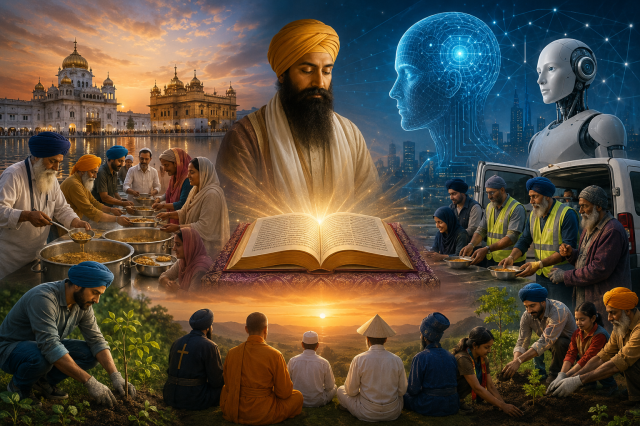
At the heart of Sikhism is the revered living teacher, the Guru Granth Sahib. This scripture, compiled by the fifth Guru, Guru Arjan, from hymns of various Gurus and poems of saints, was ultimately completed by the tenth Guru, Guru Gobind Singh. He declared, "From now on, human Gurus will end, and the Guru Granth Sahib will be the eternal Guru." This was a unique declaration in the history of world religions, emphasizing that the community's eternal teacher is not a specific individual's authority but the truth itself.
The Guru Granth Sahib contains hymns from Sikh Gurus as well as poetry and spirituality from Hindu and Islamic saints. Guru Nanak's belief that truth is not monopolized by any one religion is alive within this scripture. Sikh temples continue to honor this text as a living teacher, reciting it during worship and using it as a standard for communal life.
The Guru Granth Sahib constantly encourages humanity in three ways: first, always remember the Creator; second, work honestly; third, share what you have with your neighbors. Remarkably, these teachings remain as relevant today as they were 500 years ago. As AI and digital civilization advance, what humanity needs is not more information but a deeper conscience, making the teachings of this scripture resonate even more profoundly.
Today, AI can calculate faster and process more information than humans. However, AI cannot create its own conscience. Depending on the values inputted by humans, AI can become a tool that aids humanity or a technology that threatens it. Therefore, the key competitive advantage in the age of AI is not just technology but ethics. Ultimately, it is human spirituality that drives technology.
Sikhism tells us, "You are a believer not by how much you pray but by how much you serve." Dasuk advises, "Prove the truth through your life, not just your thoughts." Hongik Ingan calls for, "Widespread benefit to humanity." Despite differing eras and cultures, these three voices ultimately converge on a single truth.
Humanity will continue to create more powerful AI and develop more advanced robots. However, no matter how great the technology, if it cannot love people, civilization will not endure. Technology may advance civilization, but love and service sustain it. This is the truth that Sikhism has demonstrated through its history for 500 years.
Asia is the birthplace of world religions. From Hinduism and Buddhism to Zoroastrianism, Confucianism, Daoism, Shinto, Daejonggyo, and Sikhism, this continent has nurtured countless spiritual blooms. Born in different times and cultures, they have all walked toward the restoration of human dignity and community.
Thus, Sikhism is no longer just a religion of India. It is a humanism that must be rediscovered in the age of AI and a philosophy of civilization that nurtures community. Faith is stronger than the sword, love is stronger than faith, and service endures longer than love. The path of life that Dasuk Yu Yeong-mo sought throughout his life is also completed in the realm of service and love.
In this way, Sikhism transcends the mere history of religion and becomes an answer that Asian spirituality offers to humanity's future. Technology can change the world, but spirituality can change people. Only a civilization that changes people can ultimately change the world. This is why Sikhism remains alive in the 21st century and why we must once again heed the message of Asian spirituality.
Dasuk Yu Yeong-mo practiced the belief that "truth is one, and paths are many" throughout his life. The Guru Granth Sahib of Sikhism also did not confine truth within a specific religion. This scripture, which embraces the voices of both Hindu and Islamic saints, quietly testifies that true truth transcends boundaries and unites humanity.
* This article has been translated by AI.
Copyright ⓒ Aju Press All rights reserved.