

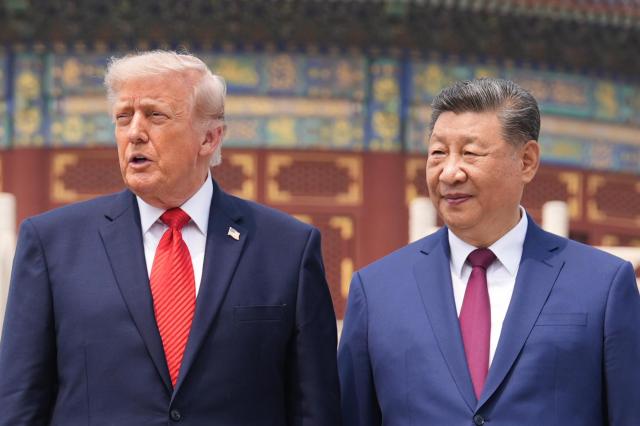
In May 2026, Beijing once again became the center of the world. U.S. President Donald Trump and Chinese President Xi Jinping walked side by side along the stone paths of the Temple of Heaven, framed by red walls and gray tiles, as early summer rain fell. Unlike Cold War-era summits, there was no palpable military tension, nor was there an overwhelming display of reconciliation. Instead, the scene captured the cautious exploration, vigilance, and calculated restraint of two colossal powers underpinning the 21st-century world order.
That evening, during a state banquet at the Great Hall of the People, President Xi made a significant remark: "The great rejuvenation of the Chinese nation and making America great again can coexist." This brief statement did not go unnoticed globally, as the current U.S.-China relationship transcends mere trade disputes or diplomatic conflicts, entering a vast historical flow of shifting global hegemony.
This brings to mind the concept of "Thucydides's Trap." The ancient Greek historian Thucydides analyzed the causes of war in his work, "The History of the Peloponnesian War," stating, "The growth of Athenian power and the fear that it instilled in Sparta made war inevitable." This insight remains relevant today, piercing the essence of international politics 2,500 years later.
The issue at hand is not merely a competition of military might but the structural fear that arises within the existing hegemon due to the rise of a new great power. Harvard political scientist Graham Allison has modernized this analysis, noting that many historical hegemonic rivalries have indeed led to war.
In today's world, the established hegemon is the United States, while the rising power is China. Since World War II, the U.S. has designed the global order based on the dollar system, naval power, advanced technology, financial systems, and alliances. In contrast, China has surged over the past 40 years at an unprecedented pace, advancing in manufacturing, trade, supply chains, artificial intelligence, semiconductors, electric vehicles, and rare earth industries. What truly concerns the U.S. is not merely the expansion of China's economic scale but the more fundamental fear that China could create a new civilization and economic sphere that operates independently of the U.S.-centric order.
China, too, does not view U.S. actions as mere competition. It perceives U.S. semiconductor export controls, AI chip regulations, supply chain restructuring, and alliance strengthening as a form of effective blockade. The issues surrounding Taiwan, the South China Sea, and the Indo-Pacific strategy further deepen mutual distrust between the two nations.
However, paradoxically, neither country can completely sever ties with the other. The U.S. consumer market is deeply intertwined with Chinese manufacturing, and the Chinese economy relies significantly on the dollar system and global financial markets. American companies find it difficult to abandon the Chinese market, while China cannot ignore U.S. advanced technology and financial networks. The semiconductor supply chain in the AI era is intricately connected among the U.S., South Korea, Taiwan, Japan, and China. In ancient Greece, hegemonic wars ended when one side was defeated. Yet today, a U.S.-China conflict could lead to mutual destruction. Nuclear weapons, global finance, and supply chains make such a scenario impossible.
Thus, the modern Thucydides Trap manifests in more complex forms than outright war. The semiconductor war, AI competition, financial sanctions, supply chain separation, maritime hegemony, energy corridor control, and currency and tariff wars are all occurring simultaneously.
In this context, Xi's mention of the "great rejuvenation of the Chinese nation" and Trump's "MAGA" are not mere political slogans. They represent declarations of national survival strategies envisioned by China and the U.S., respectively. MAGA focuses on restoring America's declining manufacturing sector and middle class, achieving energy independence, controlling borders, and protecting domestic industries. In contrast, the Chinese rejuvenation aims to end the century of humiliation following the Opium Wars and reestablish China as a central civilization in the world.
The problem is that both visions are rooted in nationalism. The U.S. seeks to restructure supply chains around itself, while China promotes technological self-sufficiency and the internationalization of the yuan. The U.S. is strengthening its alliance system, while China is expanding BRICS and the Global South, seeking a new international order.
So, is there truly no path to coexistence? While complete harmony may be difficult, managing conflicts for coexistence is possible. First, both nations need to separate and manage economic and security issues to some extent. They should enhance safeguards to prevent military incidents over Taiwan and the South China Sea while maintaining minimal cooperation in economic matters.
Second, they must acknowledge that complete decoupling in semiconductors and AI is realistically impossible. Excessive blockades and retaliations could ultimately plunge the global economy into recession.
Third, both leaders must maintain a balanced perspective between tough rhetoric for domestic politics and actual strategies. While a strong leader image is necessary, political rhetoric that leads to military miscalculations could plunge the world into irreversible danger.
Perhaps the most significant moment of the Beijing summit was not the joint statement but the walk in the Temple of Heaven. This site was historically where Chinese emperors offered sacrifices to heaven. The fact that the U.S. president and the Chinese president walked together there symbolically indicates that both nations have entered an era where they cannot deny each other's existence.
The global economy is also watching this summit closely. If U.S.-China tensions ease, global financial markets may stabilize, and sectors like semiconductors, AI, logistics, and energy could see relief. However, if tensions escalate again, supply chain disruptions and inflationary pressures could once more shake the global economy. The situation in the Taiwan Strait, in particular, poses a risk to the entire semiconductor industry.
South Korea's position is even more challenging. The country relies on the U.S. for security while being deeply connected to China economically. The semiconductor, battery, automotive, shipbuilding, and AI industries all stand at the center of U.S.-China competition. Therefore, South Korea must enhance its diplomacy as a middle power, equipped with both strategic balance and industrial competitiveness, rather than simply becoming a subordinate partner to either side.
History does not repeat itself. However, human fears do. What Thucydides observed was not merely a shift in military power but a shift in human psychology. When the anxieties of the hegemon clash with the confidence of the rising power, the world order trembles. Nevertheless, today's humanity possesses a far more complex civilization than that of ancient Greece. In a world interconnected by nuclear weapons, AI, global finance, and supply chains, total war would lead to mutual destruction.
Ultimately, the future of U.S.-China relations hinges not on who is stronger, but on who can exercise greater restraint. Trump's MAGA and Xi's Chinese rejuvenation are walking different paths.
However, at the very least, a coexistence order that does not lead to mutual destruction must be established. This may be the last wisdom that allows the 21st-century world to transcend Thucydides's Trap.
※ This article was generated using AI technology and has been reviewed by an editor.
* This article has been translated by AI.
Copyright ⓒ Aju Press All rights reserved.