
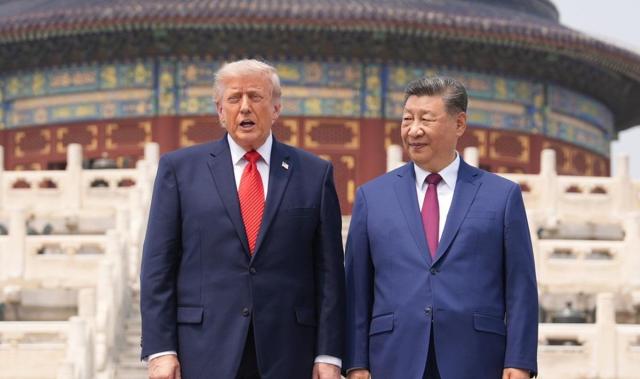
The U.S.-China summit held in Beijing in May 2026 appeared calm on the surface. President Donald Trump and Chinese President Xi Jinping presented a facade of cooperation rather than confrontation. Following the meeting, both nations issued a generic statement expressing their commitment to ongoing dialogue, which momentarily reassured the markets.
However, the essence of this summit was far from a mere diplomatic event. It marked the official beginning of a new era of hegemonic competition over artificial intelligence (AI), semiconductors, energy, manufacturing, supply chains, data, and platforms. Just as the U.S. and the Soviet Union faced off with nuclear weapons during the Cold War, the 21st century sees the U.S. and China clashing over AI and semiconductors.
A particularly symbolic moment from the summit was when President Trump unexpectedly brought Nvidia CEO Jensen Huang aboard Air Force One on his way to China. This was not just a trivial incident; it underscored that AI and semiconductors were the primary focus for the U.S. during the talks. While prominent figures from the U.S. tech industry, including Elon Musk and Tim Cook, were already part of the economic delegation, the last-minute inclusion of Huang signified that AI semiconductors have become a matter of national strategy.
Currently, the core of the AI power struggle hinges on who can secure the most AI chips, build the largest AI data centers (AIDCs), and provide the most extensive data training and inference services. AI is no longer just a software industry; it has evolved into a massive industrial revolution platform that encompasses power, semiconductors, cooling systems, networks, cloud computing, and manufacturing automation.
During the summit, President Xi stated, "The world has reached a new crossroads," referencing the so-called 'Thucydides Trap.' This was not merely a historical reference but a strategic warning to the U.S. China suggested that if the U.S. continues to exert military, economic, and technological pressure, both countries could ultimately be drawn into a significant conflict.
At the heart of this warning lies China's concept of the '3Ts': Taiwan, Trade, and Technology.
First, regarding Taiwan, China reaffirmed its stance of not backing down. The message was clear: if the U.S. deepens its involvement in Taiwan or considers military intervention, it could serve as a direct trigger for U.S.-China conflict.
Second, on trade, the U.S. has pressured China through tariffs and sanctions since Trump's first term. However, China is no longer just the 'world's factory.' It has begun to establish world-class competitiveness in electric vehicles, batteries, solar energy, drones, telecommunications equipment, and certain AI sectors. The more the U.S. attempts to push China out of the market, the more American companies risk losing access to the Chinese market.
Third is technology, which is the crux of the summit. The U.S. has sought to slow China's AI development through export controls on semiconductor equipment and AI chips. However, China is pursuing self-sufficiency much faster than anticipated.
A prime example is Huawei. Despite the U.S. imposing stringent sanctions to dismantle the company, Huawei has become a symbol of China's technological self-reliance. The company is now focusing on building a Chinese AI infrastructure with its Ascend chips and CloudMatrix system.
While individual chip performance still lags behind Nvidia's H200 or the next-generation Blackwell systems, with the U.S. leading in memory bandwidth, power efficiency, and software ecosystems, China has chosen a different path. Even if it falls behind in individual chip competition, it aims to cluster hundreds or thousands of chips to maximize overall system performance.
China's strategy can be summarized as "quantity over quality." Even if power efficiency is somewhat lower and more space is required, it is pushing forward with substantial capital and state support. Importantly, China is not merely targeting conversational AI like ChatGPT.
China aims to integrate AI across its entire manufacturing sector, a concept referred to as Manufacturing AX (AI Transformation). This involves connecting AI to automotive factories, robotics, logistics, ports, power grids, smart cities, and the defense industry. This is not just industrial innovation; it is the construction of a new industrial civilization.
Another concerning aspect is cost. Chinese AI models are beginning to establish a cost structure significantly lower than that of the U.S. By combining power, land, data, labor, and state support, China is rapidly reducing the costs of AI token generation. This means that numerous Chinese startups and manufacturers can adopt AI much more quickly.
In contrast, the U.S. remains the world's leading AI nation. Top AI companies, including Nvidia, OpenAI, Google, Microsoft, Amazon, and Meta, are concentrated in the U.S. The country maintains a dominant advantage in advanced semiconductor design, AI models, cloud computing, operating systems, and global platforms.
However, the U.S. faces a dilemma: losing access to the Chinese market. For companies like Nvidia, China is a market that is hard to abandon. As the U.S. government tightens export regulations, China accelerates its push for self-sufficiency, creating a structure that may make it difficult for U.S. companies to re-enter the Chinese market over time.
This scenario is what Jensen Huang fears the most. While U.S. GPUs are currently the best in the world, if China builds its own ecosystem, American products could lose their place in the Chinese market in a few years. In other words, U.S. regulations could paradoxically accelerate China's self-reliance.
Amid these developments, the world is increasingly heading toward technological decoupling. In the past era of globalization, U.S. technology, South Korean memory, Taiwanese foundries, and Chinese assembly factories were interconnected in a single supply chain. However, the likelihood of a split into U.S. and Chinese blocks is growing.
Interestingly, ancient classics have long warned against excessive power clashes. The Dao De Jing states, "What is too strong cannot last long," and Sun Tzu's Art of War advises, "The best victory is the one that is achieved without fighting." Today's U.S.-China technological hegemony competition is likely to culminate in the question of how to create an order of coexistence rather than a complete victory for one side.
The challenge lies with South Korea. South Korea is a world leader in memory semiconductors, with Samsung Electronics and SK Hynix effectively dominating the HBM market, which is crucial in the AI era. However, unlike the U.S., it does not control platforms and AI models, nor does it possess a vast domestic market and state-led industrial policy like China.
Recently, slogans like "AI G3" and "AI Big 3" have emerged in South Korea. However, realistically speaking, becoming the 'third AI hegemon' after the U.S. and China is very challenging. The U.S. has the world's best platforms and capital, while China has a massive domestic market and a system for mobilizing the state. South Korea does not have the scale to compete directly with either country.
So, what should South Korea do?
First, South Korea must become a key nation in AI infrastructure. The country's real strengths lie in memory and manufacturing. In the AI era, a memory-centric structure may become more important than simple GPUs. Especially in the inference AI era, power efficiency and resolving memory bottlenecks will be crucial. South Korea should lead in next-generation memory and packaging, as well as low-power AI semiconductor structures beyond HBM.
Second, it should adopt Manufacturing AX as a national strategy. South Korea has a world-class manufacturing base in automobiles, shipbuilding, steel, semiconductors, batteries, and biotechnology. It may have an advantage over the U.S. in the ability to integrate AI with manufacturing. South Korea should aim to be an "AI manufacturing innovation nation" rather than just an "AI platform nation."
Third, South Korea needs to maintain a strategic balance between the U.S. and China. The South Korean economy is connected to both U.S. technology and the Chinese market. Choosing one side could destabilize the entire industrial base. Therefore, South Korea needs a complex strategy that cooperates with the U.S. on technology security while maintaining connections with China in terms of markets and industries.
Fourth, the direction of South Korean sovereign AI should be realistically redefined. Competing with the U.S. and China in the race for super-large general models is not realistic. Instead, it is much more important to create world-class competitiveness in vertical AI optimized for specific industries such as manufacturing, healthcare, finance, defense, robotics, and logistics.
The Beijing summit between the U.S. and China appeared quiet on the surface. However, beneath that calm, a new cold war over AI and semiconductors has already begun. The U.S. seeks to contain China, while China aims for self-reliance. In this context, South Korea is entering a historically challenging era of strategic choices.
The Thucydides Trap is no longer about warships and missiles; it is now about GPUs, HBM, data centers, power grids, AI models, and Manufacturing AX. The next decade is likely to be a full-scale battle over who defines the standards of future industrial civilization.
Will South Korea remain merely a supplier of components in this tumultuous wave, or will it leap forward as a key nation in the manufacturing revolution of the AI era? The time for choice has begun.
※ This article was generated using generative AI and has been reviewed by an editor.
* This article has been translated by AI.
Copyright ⓒ Aju Press All rights reserved.