

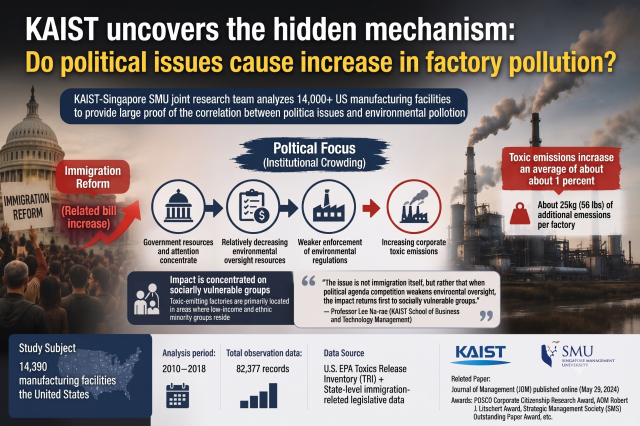
SEOUL, July 10 (AJP) - When immigration dominates political debate, factories quietly release more toxic chemicals. That is the finding of a new study by researchers in South Korea and Singapore, who traced the connection to a simple constraint: governments have only so much money and attention to go around.
The Korea Advanced Institute of Science and Technology (KAIST) said Friday that a research team led by Lee Na-rae, a professor in its School of Business and Technology Management, and Heli Wang of Singapore Management University analyzed immigration-related legislation and environmental data across the United States. They found that as immigration rose on the political agenda, government environmental oversight weakened and toxic emissions from manufacturers increased.
The researchers examined 82,377 records from 14,390 manufacturing facilities across the United States between 2010 and 2018, combining the Environmental Protection Agency's Toxics Release Inventory with state-level immigration legislation data. Each additional immigration-related bill was associated with an average 1 percent increase in toxic releases per facility, roughly 25 kilograms, or 56 pounds, of additional toxic chemicals per plant.
The team calls the mechanism "institutional crowding." When a politically charged issue such as immigration demands government attention and enforcement resources, less visible policy areas like environmental monitoring get pushed aside. Firms, sensing looser oversight, cut back on costly pollution abatement and toxic waste management. The researchers stressed that environmental regulations themselves did not change during the period studied. What changed was how closely anyone was watching.
The effect was strongest where money was tightest. In states carrying heavy debt or fiscal burdens, environmental oversight deteriorated further when political attention shifted to new issues, suggesting that cash-strapped governments funnel resources toward whatever is politically urgent first.
Although the study used immigration as its test case, the researchers said the mechanism is general. Any issue that consumes government resources, from a public health crisis to a security scare, could crowd out enforcement elsewhere.
The findings carry implications for environmental justice, since pollution burdens tend to fall hardest on poorer communities that are least equipped to push back. The Korea Advanced Institute of Science and Technology (KAIST) said the study offers new grounds for designing safeguards that keep environmental enforcement insulated from political swings.
The paper, titled "There's More Than Meets the Eye: Assessing the Impact of Immigrants on Firm Environmental Performance," was published online in the Journal of Management on May 29, with Lee as first author. It has received the POSCO Corporate Citizenship Research Award, the Academy of Management's Robert J. Litschert Award, and a best paper award from the Strategic Management Society.
"This study does not argue that immigration causes environmental pollution, but shows that shifts in the political agenda can weaken environmental oversight and increase corporate pollution," Lee said. "Even when the government's limited resources are concentrated on a particular issue, environmental oversight needs institutional protection so that it does not falter."
(Reference Information)
Journal/Source: Journal of Management
Title: There's More Than Meets the Eye: Assessing the Impact of Immigrants on Firm Environmental Performance
Link/DOI: https://doi.org/10.1177/01492063261442451

Copyright ⓒ Aju Press All rights reserved.
