

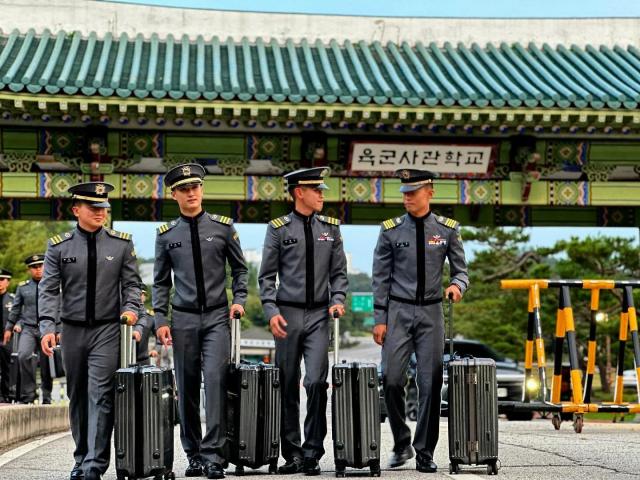
Defense Minister Ahn Gyu-back announced the decision after a government-ruling Democratic Party meeting at the National Assembly in Seoul.
“The new Korea Armed Forces Academy will be located at Jaundae in Daejeon,” Ahn said, adding that the government would build a high-tech smart campus near major universities and research institutes.
Ahn described the plan as a fundamental overhaul of officer education rather than “a mechanical consolidation” of the three existing institutions.
He said the current system must be redesigned as warfare expands beyond land, sea and air into space, cyberspace and the electromagnetic spectrum, with artificial intelligence and drones playing an increasingly important role.
The new academy will seek to train officers capable of leading multidomain operations and the South Korea-U.S. combined defense system following Seoul’s planned recovery of wartime operational control, Ahn said.
The government selected Daejeon because it is home to the Korea Advanced Institute of Science and Technology, the Agency for Defense Development and major national institutes specializing in aerospace, telecommunications, astronomy and nuclear technology.
Cadets will spend all four years at the new academy in Jaundae, receiving common education during their first two years and specialized training for the Army, Navy or Air Force during their third and fourth years.
The government also plans to raise the proportion of civilian professors from about 24 percent to more than 50 percent and provide them with working conditions comparable to those at national universities.
Ahn said the existing academies educate about 2,900 cadets while employing roughly 3,000 support personnel, arguing that separate facilities and organizations had resulted in duplicated investment and inefficient use of resources.
The ministry will establish a new bureau to oversee the reform and announce detailed plans, including admissions and curriculum, in October.
The announcement immediately drew opposition from the alumni associations of the three academies.
In a joint statement Thursday, the groups called the plan incoherent and warned that closing the existing academies would sever their identities, histories and traditions.
They argued that cooperation among the services could be strengthened without abolishing the schools and said moving the Naval Academy inland and the Air Force Academy to a site without an airfield would weaken service-specific education.

Copyright ⓒ Aju Press All rights reserved.
