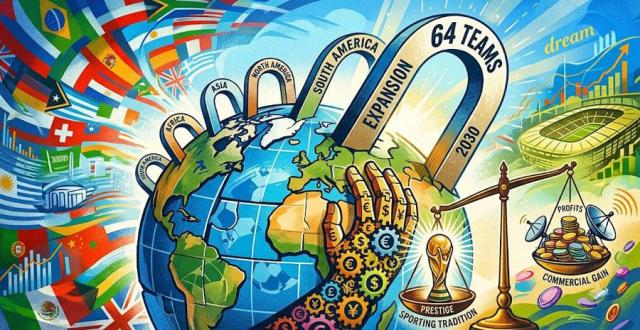
That is why FIFA's consideration of expanding the quadrennial tournament to 64 teams in 2030 has sparked a debate that goes far beyond simply adding more matches or making the event bigger.
FIFA President Gianni Infantino has argued that a larger World Cup would make the tournament more inclusive by allowing more countries to dream of reaching the biggest stage in the world's most popular sport. After this year's World Cup, which expanded from 32 to 48 teams and wrapped up last week, Infantino called the new format a success, pointing to the stronger performances of teams from regions such as Africa.
But critics see a different picture. They worry that another expansion, coming so soon after the latest increase, could erode the prestige of the World Cup, reduce the importance of qualifying matches and transform the competition into something closer to a global festival than a top-level sporting competition.
At the center of these debates is a simple question: Is FIFA trying to grow the sport or is it trying to grow its profits? Football is no longer dominated solely by Europe and South America. Countries from Africa, Asia and other regions have invested heavily in nurturing the sport, with more teams now capable of competing on the international stage. A larger World Cup would give these countries more chances to gain experience, attract investment, and inspire young players. For some, just reaching the tournament is enough to reshape the sport at home.
But every change often comes with a cost, and the World Cup's appeal has always come from being exclusive. The challenge of qualifying is part of what makes the tournament so exciting and valuable. Critics say that allowing more than a quarter of FIFA's members to reach the tournament stages could make qualifying feel less meaningful.
European football powerhouses have been among the fiercest critics of the move. They argue that expanding the tournament would lower the quality of matches and diminish the importance of the qualification process. Meanwhile, players, coaches and fans alike worry that additional fixtures will only lengthen the schedule without enhancing the spectacle.
FIFA's latest move appears to be driven in part by financial considerations that it cannot ignore. A larger World Cup means more matches, more broadcasting rights, more sponsorship opportunities and more revenue. FIFA has previously faced similar criticism over ideas such as holding the World Cup every two years, which many saw as commercial attempts to simply increase income.
It has also revived speculation about China, one of the world's largest economies and a major potential market for global sports. Despite its vast population and significant investment in football, China has not qualified for the World Cup since its lone appearance in 2002.
If the World Cup grows to 64 teams, Asia would likely get more berths, which could improve China's chances of qualifying for the tournament. This has led some observers to wonder whether FIFA's plan is partly aimed at tapping into China's huge commercial market.
There is no evidence, however, that FIFA is expanding the tournament specifically to benefit China. In fact, even a larger Asian quota would not guarantee China a place. The Chinese national team remains behind several Asian rivals including Australia, Japan, South Korea and emerging teams from the Middle East and Southeast Asia.
Still, the suspicion reflects a broader concern that football's governing body is increasingly prioritizing commercial interests over sporting principles.
FIFA now faces a fundamental question over whether the tournament's expansion from 24 teams in 1998 to 32, then 48 this year and potentially 64 four years later reflects the natural evolution of a truly global sport or whether it risks undermining the qualities that make the World Cup special.
A bigger World Cup may create more opportunities and inspire more dreams, but FIFA must also reckon with the risk of turning it into a tournament in which every match matters just a little less. The challenge is not simply making space for more teams but preserving the qualities that have made the World Cup more than just a football tournament for decades.
Copyright ⓒ Aju Press All rights reserved.