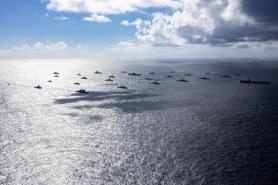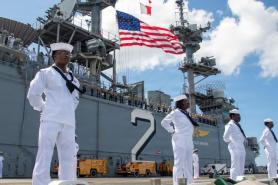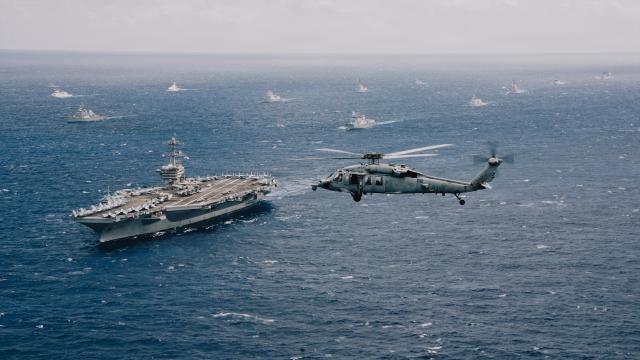
The Republic of Korea Navy served as commander of the Combined Forces Maritime Component during this year's Rim of the Pacific Exercise (RIMPAC), becoming the first Asian country and only the fourth non-U.S. navy to assume the role since the exercise began in 1971.
While overall command remained with the U.S.-led Combined Task Force, the appointment placed a South Korean admiral in charge of planning and coordinating multinational maritime operations involving surface combatants, submarines and maritime patrol aircraft from participating navies.
The distinction is more than ceremonial.
Rather than simply contributing ships to a multinational drill, South Korea helped direct how allied and partner naval forces operated together at sea — a responsibility reflecting the growing confidence of both Seoul and Washington in the Korean Navy's operational capabilities.
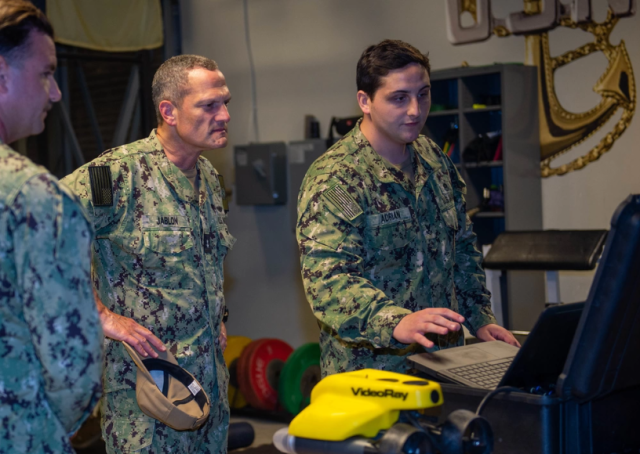
Jablon noted that South Korea, alongside Chile, Canada and Japan, held leadership positions across different components of the exercise.
"These leadership roles are not simply symbolic. They are operational," he said, emphasizing that participating countries contributed real capabilities while exercising command responsibilities.
Rear Adm. Kim In-ho, who led the Combined Forces Maritime Component, described the exercise as another step in expanding the Korean Navy's multinational operational experience.
"This was a valuable opportunity to improve the capabilities of the Republic of Korea Navy," Kim said, adding that the Navy had fulfilled the responsibilities and expectations entrusted to it.
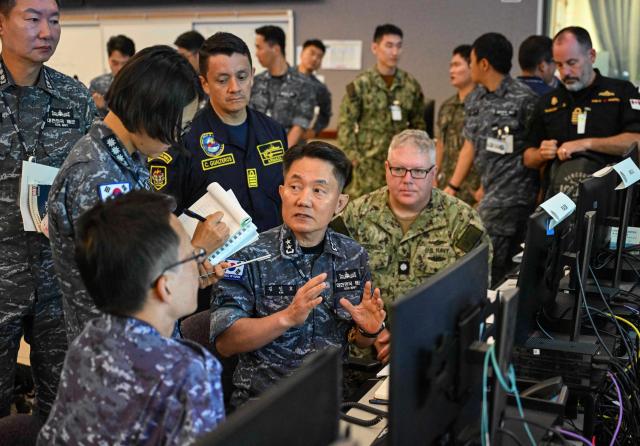
South Korea formally joined the exercise in 1990 as a participant. In 2022 it commanded an expeditionary strike group. Two years later it became deputy commander of the maritime component. This year it assumed the top maritime operational command beneath the overall U.S.-led task force.
The progression mirrors the broader transformation of the Korean Navy.
For decades, South Korea's naval strategy centered overwhelmingly on coastal defense and deterring North Korea around the peninsula. But as South Korea emerged as one of the world's leading trading nations—whose economy depends heavily on uninterrupted maritime commerce—the Navy increasingly shifted toward protecting sea lines of communication and participating in multinational maritime operations.
That evolution has been accompanied by significant modernization.
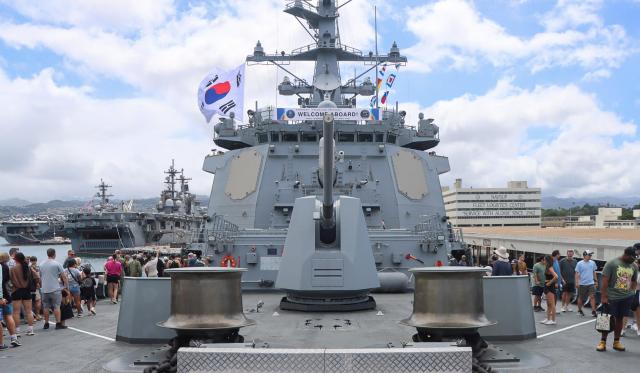
For this year's RIMPAC, South Korea deployed the 8,200-ton Aegis destroyer Jeongjo the Great, the 3,000-ton submarine Dosan Ahn Chang-ho and a P-8A Poseidon maritime patrol aircraft, illustrating the expanding range and sophistication of its fleet.
The exercise itself also reflected the widening geography of Indo-Pacific security cooperation.
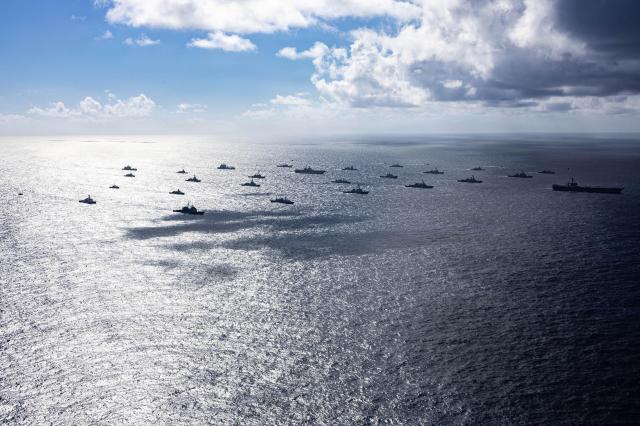
Defense analysts say South Korea's expanded role reflects more than institutional recognition within RIMPAC. It also comes as maritime security itself grows more complex.
Ban Kil-joo, an assistant professor at the Korea National Diplomatic Academy, said Seoul faces fundamentally different maritime challenges from North Korea and China.
North Korea remains an immediate military threat centered on missiles, nuclear weapons and conventional provocations.
China, by contrast, increasingly relies on so-called gray-zone activities that stop short of open conflict while gradually expanding its maritime presence.
In the Yellow Sea, Beijing has likewise expanded its operational presence through structures and maritime activities in areas where the two countries' interests overlap.
Although the Yellow Sea has not reached the level of militarization seen in the South China Sea, Ban said the pattern is familiar.
"China first establishes a physical or operational presence and then gradually seeks to normalize that presence," he said.
He argued that South Korea should study developments in the South China Sea as a cautionary example while strengthening maritime cooperation with Southeast Asian countries that have dealt with similar gray-zone tactics for years.
Ban said Seoul should deepen maritime security cooperation on three fronts: leveraging U.S. operational experience through the alliance, expanding cooperation with ASEAN partners and participating more actively in international efforts to protect critical underwater infrastructure such as subsea communications cables.
The exercise also highlighted the increasingly geopolitical nature of maritime operations.
Asked whether RIMPAC was intended to prepare for a potential contingency involving Taiwan, Jablon rejected that interpretation.
"RIMPAC is not about signaling to any one nation," he said, describing the exercise as a multinational effort to improve interoperability and readiness among participating navies.
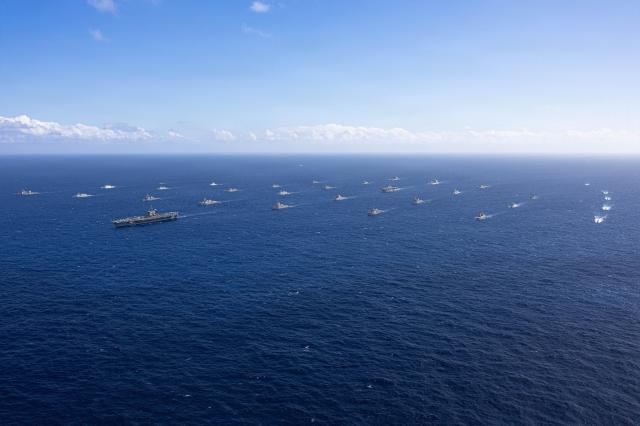
Beijing, however, has long portrayed RIMPAC as part of a broader U.S.-led containment strategy. Ahead of this year's exercise, China released footage of a DF-17 hypersonic missile launch for the first time, a move widely interpreted by regional analysts as a strategic show of force.
The expanding strategic importance of maritime security extends well beyond traditional naval competition.
Another maritime defense expert said recent tensions surrounding the Strait of Hormuz demonstrated how disruptions at sea can quickly reverberate across the global economy, affecting energy supplies, trade routes, food security, digital connectivity and supply chains.
The expert noted that maritime security today encompasses not only protecting commercial shipping but also safeguarding critical infrastructure and maintaining the rules-based international order that underpins global commerce.
That broader definition is reshaping military strategy across the Indo-Pacific.
The United States has increasingly focused on protecting strategic maritime chokepoints while expanding its attention to emerging theaters such as the Arctic. North Korea, meanwhile, is pursuing larger destroyers and strategic submarines in an apparent effort to develop limited blue-water capabilities of its own beyond the Korean Peninsula.
South Korea's command role at RIMPAC therefore represents more than a milestone in a multinational exercise.
For decades, the Korean Navy measured success largely by defending the peninsula. Commanding RIMPAC's maritime component suggests it is increasingly being judged by a different standard — whether it can help lead multinational naval operations across the wider Indo-Pacific.
That shift marks not only the coming of age of South Korea's navy but also the country's steadily expanding role in shaping regional maritime security.

Copyright ⓒ Aju Press All rights reserved.