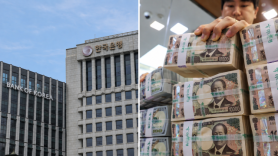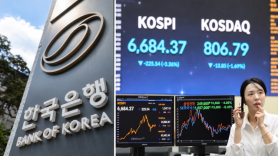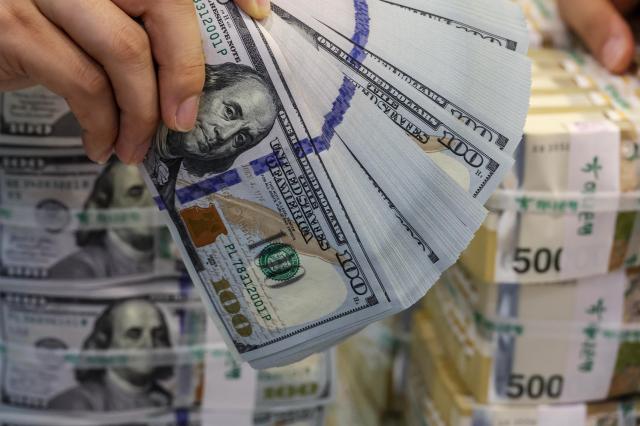
The country's reserves stood at $427.95 billion at the end of July, up $590 million from $427.36 billion a month earlier, according to the Bank of Korea.
The modest increase came as gains from a weaker U.S. dollar, investment returns on reserve assets and proceeds from the government's foreign exchange stabilization bond issuance were largely offset by foreign exchange swaps with the National Pension Service and other market operations.
The BOK did not disclose how much each factor contributed to the monthly change, consistent with its practice of withholding detailed breakdowns of reserve movements related to currency market intervention and swap transactions.
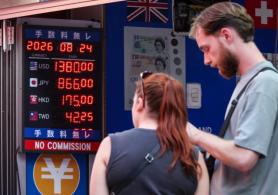
The U.S. dollar lost more than 8 percent against the Korean won in July from a prior month, steeper than 1.31 percent fall in the dollar index.
South Korea's finance ministry raised 1.7 billion euros ($1.94 billion) through dual-tranche foreign exchange stabilization bonds on July 8, marking the country's largest-ever euro-denominated issuance.
The sale consisted of 700 million euros of three-year notes and 1 billion euros of seven-year notes. The bonds were priced at 10 basis points and 28 basis points above the euro mid-swap rate, respectively, representing the lowest spreads ever achieved for Korean euro-denominated stabilization bonds.
The ministry confirmed strong investor demand, secured despite heightened geopolitical uncertainty in the Middle East, reflected confidence in South Korea's economic fundamentals and was expected to lower overseas funding costs for Korean borrowers by establishing a tighter benchmark spread.
The issuance completed the government's planned $5 billion equivalent foreign-currency bond program for this year.
South Korea's reserves nevertheless remained $100 million below the $428.05 billion recorded at the end of 2025, leaving the country's external liquidity buffer broadly unchanged over the first seven months of the year.
Securities, which account for the largest share of the reserves, fell $340 million from June to $380.01 billion, representing 88.8 percent of the total.
Deposits increased $860 million to $23.13 billion, accounting for 5.4 percent of the reserves.
Special Drawing Rights allocated by the International Monetary Fund rose $60 million to $15.70 billion, while South Korea's reserve position at the IMF increased $10 million to $4.32 billion.
Gold holdings were unchanged at $4.79 billion, accounting for 1.1 percent of total reserves.
South Korea was the world's 10th-largest holder of foreign exchange reserves at the end of June, the latest month available for international comparison.
China remained the largest holder with $3.416 trillion, followed by Japan ($1.288 trillion) and Switzerland ($1.088 trillion). Russia, India, Taiwan, Germany, Saudi Arabia and Hong Kong ranked fourth through ninth, while Singapore placed 11th with $426.2 billion, slightly below South Korea's end-June total.

Copyright ⓒ Aju Press All rights reserved.