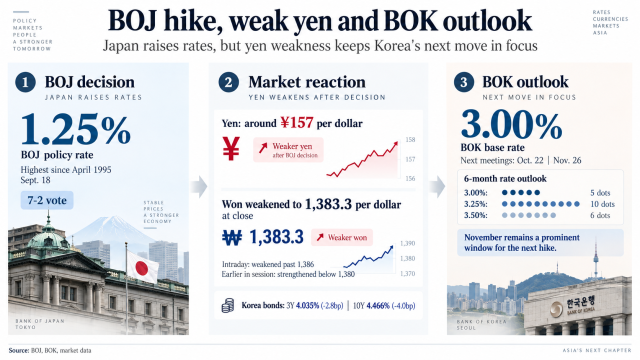
The Bank of Japan (BOJ) raised its policy rate by 25 basis points to 1.25 percent Friday, its highest in 31 years, in a 7-2 vote. The yen weakened to around 157 per dollar after the widely expected move as investors focused on the two dissenting votes and the pace of further tightening.
"The outcome has somewhat tempered expectations for further rate hikes and conveyed a dovish impression," said Hirofumi Suzuki, chief foreign exchange strategist at SMBC in Tokyo.
The won weakened to 1,383.3 per dollar at the Seoul close from 1,382.2 Thursday. It had briefly weakened past 1,386 in afternoon trading after strengthening below 1,380 earlier in the session.
Before the BOJ decision, KB Kookmin Bank's capital markets group said a hawkish policy signal could strengthen the yen and pull the won higher in tandem. The yen's post-decision decline left that potential source of support for the Korean currency weaker than expected.
Korean government bonds closed broadly stronger Friday. The three-year yield fell 2.8 basis points to 4.035 percent, while the benchmark 10-year yield dropped 4.0 basis points to 4.466 percent.
The broader external backdrop has also turned less favorable for the won after the U.S. Federal Reserve raised its benchmark rate by 25 basis points this week to a range of 3.75 to 4.00 percent. Sixteen of 18 Fed policymakers projected at least one more increase this year, keeping U.S. rates and the dollar among the main external variables facing Asian currencies.
For the Bank of Korea (BOK), the significance of Japan's move lies primarily in the exchange-rate and inflation channels.
The BOK raised its base rate for a second consecutive meeting on Aug. 27 to 3.00 percent and said inflation was likely to remain above its 2 percent target for a considerable period.
Its September Monetary Policy Report maintained a tightening bias, citing inflation, economic conditions and financial stability as the factors shaping further tightening.
"All upcoming meetings are live," BOK Governor Shin Hyun-song said after the August decision, while emphasizing the need to monitor how two consecutive hikes feed through the economy and financial markets.
The BOK's latest conditional rate projections also leave room for more tightening. Of 21 dots submitted by the seven Monetary Policy Board members, 10 were placed at 3.25 percent, six at 3.50 percent and five at the current 3.00 percent.
"The policy focus has shifted from whether to raise rates to the timing and pace of further increases," said Kim Myung-sil, a researcher at iM Securities, in an assessment of the August policy minutes.
Kim said the BOK could raise the key rate to 3.25 percent in November if strong growth, underlying inflation and risks from housing prices and household debt persist.
A third consecutive hike in October appears less favored.
The semiconductor boom has yet to produce the broader domestic spillover needed to meet higher growth expectations, reducing the case for another immediate increase, said Lim Jae-kyun, a researcher at KB Securities.
JPMorgan also expects tightening to resume in November rather than October. Economist Park Seok-gil projects quarter-point increases in November, February and May, placing the final destination at 3.75 percent.'
The BOK's remaining policy meetings this year are scheduled for Oct. 22 and Nov. 26.
November therefore remains a prominent window in existing forecasts, while October could come back into play if the won weakens more sharply, oil prices remain elevated or domestic inflation and financial-stability risks intensify.
A clearer BOJ signal of further tightening that strengthens the yen could work in the opposite direction, easing one source of pressure on regional currencies and giving the BOK more time to assess the effects of its previous increases.
The BOJ decision therefore does not mechanically raise the likelihood of a Korean rate hike.
Its significance for Seoul rests on whether Japanese tightening eventually strengthens the yen enough to support the won or leaves currency-driven inflation risks in place as the BOK decides when to move again.
AJP TAKEAWAYS
- Japan's rate increase to 1.25 percent failed to strengthen the yen, limiting a potential source of support for the South Korean won.
- The won weakened to 1,383.3 per dollar at the Seoul close from 1,382.2 Thursday after trading as weak as the 1,386 level in the afternoon.
- November remains a prominent window for the BOK's next increase, while a third consecutive hike in October is viewed as less likely unless currency, inflation or financial-stability risks intensify.

Copyright ⓒ Aju Press All rights reserved.