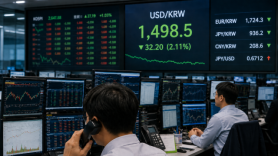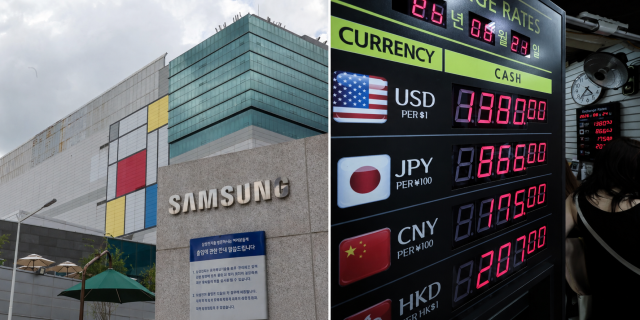
The dollar influx, however, won't likely match the recent boost from SK hynix's $26.5 billion American depositary receipt issuance, traders say.
The won has strengthened sharply in recent weeks as exporters increased dollar selling and SK hynix converted part of its ADR proceeds. Whether it gains further grounds can depend on shareholder payouts by the two chipmakers.
Samsung Electronics last week announced plans to return an estimated 90 trillion won to 110 trillion won ($65 billion to $79 billion) to shareholders this year, including around 30 trillion won in third-quarter dividends.
SK hynix separately unveiled a 40 trillion won ($29 billion) share repurchase and cancellation program and raised its shareholder-return target to more than 50 percent of cumulative free cash flow generated from 2025 through 2027.
Both companies earn a large share of their revenue in dollars and would need local money to pay domestic dividends and buy Seoul-listed shares.
Converting part of their foreign-currency holdings to finance the programs could therefore add to dollar supply in the Seoul market.
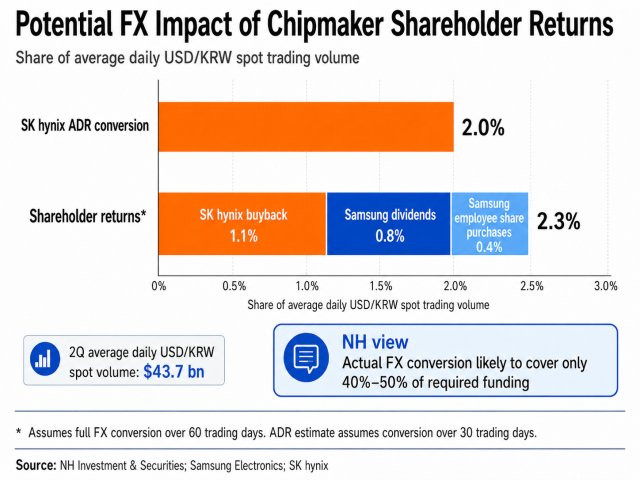
Kwon Ah-min, an FX analyst at NH Investment & Securities, estimated that SK hynix's ADR conversion would have represented around 2 percent of average daily dollar-won spot trading volume in the second quarter.
The estimate assumes the proceeds were exchanged over 30 trading days. Daily spot transactions averaged $43.7 billion during the quarter.
Under a full-conversion scenario, shareholder-return flows from Samsung and SK hynix could equal around 2.3 percent of average daily spot volume if spread over 60 trading days.
That would be broadly comparable with the estimated impact of SK hynix's ADR conversion.
SangSangIn Investment & Securities analyst Choi Ye-chan estimated that the transactions could generate net dollar supply of 15 trillion won to 45 trillion won.
The estimate assumes the two companies convert 50 percent to 60 percent of the won needed for shareholder returns over six to 12 months.
His scenarios imply a decline of roughly 18 won to 77 won in the dollar-won rate after accounting for foreign-investor remittances.
Still, analysts caution against equating the announced payout amounts with the amount of dollars likely to be sold.
Samsung and SK hynix already hold substantial won liquidity and generate domestic-currency cash flow, reducing the need to convert foreign earnings into won.
Kwon estimates that only around 40 percent to 50 percent of the required funding will need foreign-currency conversion.
That would make the actual flow substantially smaller than under a full-conversion scenario.
Foreign investors may provide another offset by converting won-denominated dividends or buyback proceeds back into dollars before remitting the funds overseas.
Those transactions would create dollar demand and partly reverse the companies' initial dollar supply.
The structure differs from SK hynix's ADR offering, which raised fresh dollars abroad that were expected to be used partly for investment in South Korea.
That created a relatively direct need for dollar-to-won conversion.
Shareholder returns can instead be financed through existing won balances, operating cash flow and foreign-currency holdings.
Part of the payout to foreign investors could later return to the FX market as dollar demand.
The balance of risks nevertheless remains tilted toward additional won strength as long as semiconductor exporters continue generating large dollar revenues.
Kwon sees the dollar-won rate testing the 1,340 to 1,350 range if corporate dollar selling continues, implying another 40 won to 50 won of downside from recent levels.
Recent trading shows that corporate flows alone are unlikely to determine the currency's direction.
The dollar-won rate fell as low as 1,378.9 on Tuesday before rebounding to close daytime trading at 1,386.1 as dollar demand and bargain buying offset continued exporter selling.
U.S. Treasury yields and global dollar moves will also remain important. Foreign equity flows and expectations for Bank of Korea policy could further shape the currency's direction.
The scale of Samsung and SK hynix's shareholder returns nevertheless gives the market another reason to watch corporate FX flows closely. The announced programs are large enough to create meaningful dollar supply even if only part of the funding is converted from foreign currency.
How much further the won can strengthen will ultimately depend on the actual conversion ratio, the pace of execution and how much of the money paid to foreign shareholders is eventually converted back into dollars.
- Samsung Electronics and SK hynix's massive shareholder-return programs could add fresh dollar supply to Seoul's foreign-exchange market and extend the Korean won's recent rally.
- A full-conversion scenario would generate flows equal to around 2.3 percent of average daily dollar-won spot trading volume, broadly comparable with the estimated impact of SK hynix's $26.5 billion ADR issuance.
- NH Investment & Securities expects only around 40 percent to 50 percent of required funding to need FX conversion, while dollar demand from foreign shareholders could offset part of the supply.
- Analysts see corporate dollar selling as a steady tailwind for the won rather than another concentrated ADR-sized shock, with global dollar moves, execution speed and foreign-investor remittances determining how far the rally can extend.

Copyright ⓒ Aju Press All rights reserved.