

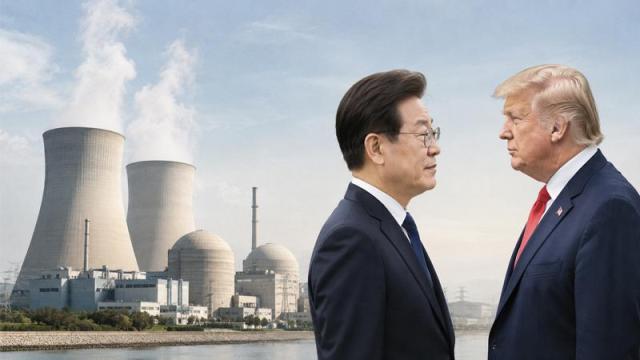
Seoul has denied a report that Washington proposed jointly acquiring an equity stake in Westinghouse Electric, even as the Trump administration presses to draw Korean capital and construction muscle into a sweeping revival of American nuclear power.
The Ministry of Trade, Industry and Energy said Tuesday that the claim that the two countries would co-invest to buy into the U.S. reactor maker "is not true."
It pushed back against reports that the Pennsylvania-based company could become part of the allies' strategic investment program.
State nuclear operator Korea Hydro & Nuclear Power (KHNP) also kept its distance.
"We have nothing to say about this matter," a company spokesperson said.
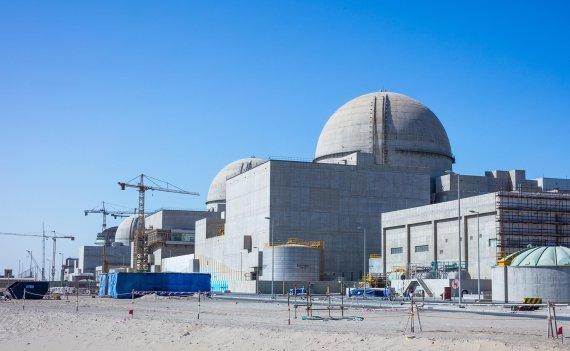
Even if Korea were to participate in such a venture, the spokesperson said, it would not necessarily mean abandoning the homegrown APR1400 reactor model used at the Barakah nuclear power plant in the United Arab Emirates, South Korea's first nuclear export project.
"It would be a structure where KEPCO leads and KHNP takes part," the spokesperson added, referring to Korea Electric Power Corp. (KEPCO), the state utility and KHNP's parent company.
KEPCO separately declined to comment.
Shares of Korea Electrical Power Industrial Development ended Wednesday 12.72 percent higher at 13,270 won ($9). KEPCO E&C rose 13.63 percent to 123,400 won and KEPCO gained 6.42 percent to 34,800 won, well above the main KOSPI's gain of 0.97 percent.
Business dailies in Seoul reported this week that the ministry and KEPCO had received a U.S. proposal and were weighing possible investment structures and financing, with part of South Korea's pledged U.S. investment cited as a potential source of funds.
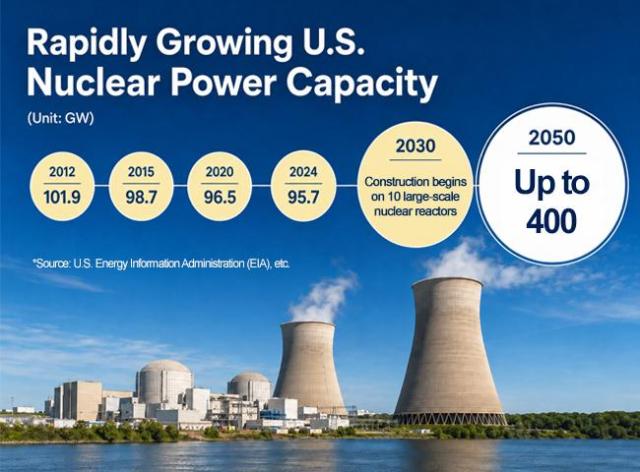
The reports come as Washington seeks to revive a domestic nuclear industry that has struggled to build large reactors at scale even as electricity demand surges from artificial intelligence data centers and advanced manufacturing.
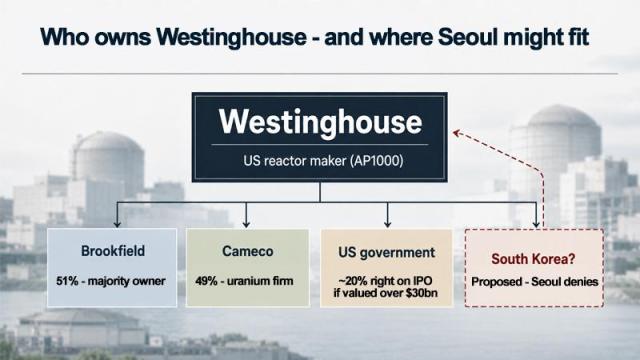
Westinghouse is controlled by Brookfield alongside Canadian uranium producer Cameco, which owns 49 percent.
The U.S. government struck a strategic partnership with Brookfield and Cameco last October aimed at supporting at least $80 billion in new Westinghouse reactor construction in the United States.
The arrangement gives Washington a path to a substantial financial interest in Westinghouse if the reactor program proceeds.
Once specified investment conditions are met, the U.S. government would receive a participation interest tied to Westinghouse cash distributions.
Washington could also require an initial public offering if the interest has vested and Westinghouse is expected to command a valuation of at least $30 billion by January 2029, with the participation interest convertible into a warrant under the agreement's formula.
The structure gives the Trump administration a direct financial incentive to accelerate Westinghouse reactor deployment.
Korea could supply something Washington has found harder to reproduce – the capacity to build large nuclear plants at scale.
One industry insider who asked not to be named said U.S. utilities remain reluctant to shoulder the financing and construction risks of a new wave of large reactors, giving Washington an incentive to bring Korean capital into the equation.
Under such a structure, Korean companies could help finance and build the reactors and, depending on the equity terms, secure a lasting share of the returns generated by the projects.
Whether that pays off for Seoul would depend heavily on the size of Korea's stake and how deeply Korean suppliers are allowed into the supply chain.
Some industry experts argue that an equity investment would give Korea little strategic value that it does not already possess.
Westinghouse absorbed Combustion Engineering, the U.S. company whose pressurized-water technology Korea licensed decades ago as it developed its own nuclear reactor program.
One expert argued that decades of technology transfer and domestic development mean an equity investment would offer Korea relatively little additional technical know-how.
"We already received all the technical data — we simply don't hold the property rights to it," the expert said. "There is nothing new to gain."
The concern is that Korea could provide capital and construction expertise without gaining corresponding control over intellectual property or project leadership.
If Washington also acquires a financial interest in Westinghouse, the expert said, U.S. influence over the company could further complicate Korea's ability to use and export its own technology freely, potentially leaving Seoul "to put up the money and end up subordinate to the United States."
A Westinghouse stake would not necessarily open the overseas nuclear markets Korea most wants to penetrate.
KEPCO, KHNP and Westinghouse reached a global settlement in January 2025 ending a bruising intellectual-property dispute over Korean reactor exports.
Korean media have reported that the agreement restricts KEPCO and KHNP from independently pursuing certain projects in North America and Europe. Neither side has publicly disclosed the detailed geographic or commercial restrictions.
Experts said buying into Westinghouse would not automatically remove obligations contained in the existing settlement.
That uncertainty sits at the heart of Seoul's calculation.
Westinghouse has formidable strength in reactor design, licensing and intellectual property, but the United States has struggled to reproduce the construction capacity needed to deliver large nuclear projects on time and at predictable cost.
Korea's record runs in the opposite direction.
KEPCO and KHNP delivered the four-reactor Barakah project in the United Arab Emirates, establishing South Korea as one of the few democratic countries with recent experience building a large nuclear complex from the ground up. Korea's flagship APR1400 also received U.S. Nuclear Regulatory Commission design certification in 2019.
Washington therefore has reason to court both Korean money and Korean execution.
The U.S. Commerce Department, which helped broker the broader Westinghouse framework, said it "continues to progress the President's agenda of promoting new Nuclear Power projects, including through the Japanese and Korean trade deals," adding that it was "in discussions with all relevant parties."
Even if discussions advance, the two sides could remain divided over who leads the projects and which reactor is built.
Washington's nuclear expansion is centered on Westinghouse's 1.1-gigawatt AP1000, including reactors aimed at meeting rising electricity demand from AI data centers and other power-intensive industries.
Seoul has its own interest in expanding the global footprint of the larger APR1400 and preserving a leading role for KHNP and the Korean nuclear supply chain.
The potential upside is access to what could become one of the world's largest nuclear construction markets and a long pipeline of orders for Korean engineering, equipment and construction companies.
The trade-off therefore goes well beyond the price of a Westinghouse stake.
Washington needs capital and construction capacity to turn its nuclear revival from policy into actual reactors. Seoul must decide how much of both it is willing to commit if Korean companies remain supporting players rather than equal partners.
AJP Takeaways
• South Korea denied reports that Washington proposed a joint investment in Westinghouse, but the controversy exposes deeper differences over financing, reactor technology and project leadership.
• The United States needs Korean capital and construction expertise to accelerate its nuclear revival, while Seoul wants sufficient control and commercial returns before taking on large financing and execution risks.
• A Westinghouse stake would not automatically expand KEPCO and KHNP's freedom in overseas markets because the detailed terms of their confidential 2025 settlement with Westinghouse remain in force.

Copyright ⓒ Aju Press All rights reserved.
