

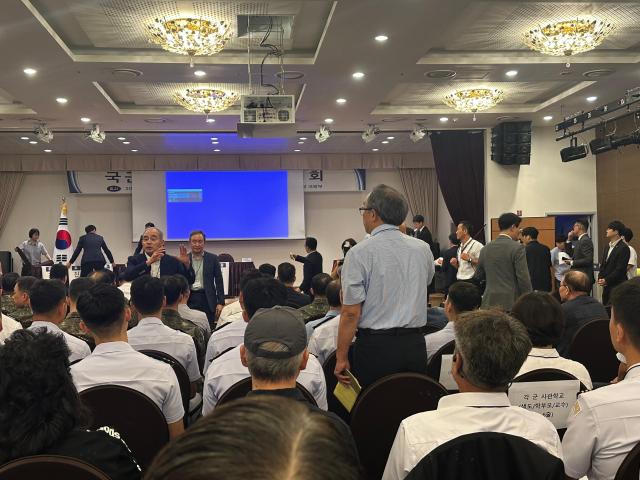
What was supposed to be a forum for public debate quickly descended into angry shouting, profanity and heckling at the Defense Convention Center in Yongsan, central Seoul.
Much of the anger was directed at Ahn, whose absence became an issue before the policy discussion even began.
"Bring Ahn here now," some attendees shouted.
Kim Hong-chul, head of the Ministry of National Defense's defense policy office, represented the ministry instead. Ahn's absence had already drawn criticism from academy alumni groups, which had demanded that the minister personally attend and hear their objections.
The tension was apparent from the outset.
Attendees shouted over organizers and demanded that the ministry scrap parts of its planned presentation. When officials asked the audience to remain seated and wait for the question-and-answer session, angry voices responded with profanity.
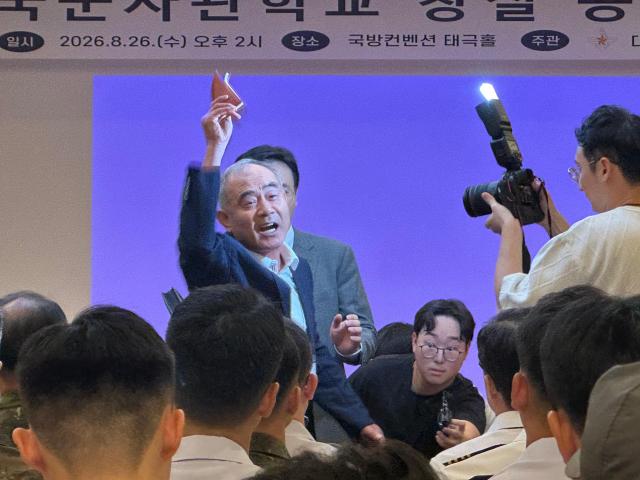
Organizers repeatedly appealed for what they called a "mature discussion culture," saying the hearing could not proceed if participants continued shouting without microphones.
Even technical problems became part of the protest.
When a promotional video prepared by the ministry failed to appear properly on screen, an opponent joked that "heaven helped us," drawing reactions from the audience. The video was eventually skipped and the ministry moved directly to its policy presentation.
The confrontation intensified when the heads of alumni associations representing the three service academies took the floor.
Park Pan-jun, president of the Korea Military Academy alumni association, accused the government of trying to push through the merger without sufficient consultation.
"They are handling the closure of the service academies the way gangsters handle business," Park said.
He argued that the plan would require the government to close the existing academies, build a new campus at the Jaun-dae military complex in Daejeon and relocate units already based there, resulting in massive public spending.
"I am certain this plan cannot be carried through to the end," Park said. "It will only waste the national budget and the country's resources."
Park also criticized Ahn for staying away from the hearing, saying alumni groups had specifically asked the minister to attend because he was ultimately responsible for the policy.
"We asked that the minister come, listen, answer questions and tell us what he intends to do," Park said. "But once again, the minister stayed away."
Lee Beom-rim, president of the Naval Academy alumni association, delivered an even sharper warning.
Lee criticized the ministry for announcing plans to preserve monuments and memorial facilities at the existing academy sites before Wednesday's hearing, arguing that such preparations suggested the merger had effectively already been decided.
"If you say you are holding a public hearing to listen to the people, then are all these procedures nothing more than a formality to establish procedural legitimacy?" he said.
"Are you saying the train will keep running even if the dogs bark?" Lee continued. "Dogs do not only bark. They can bite and tear."
He then addressed Ahn directly.
"I warn the defense minister once again not to go down in history as a sinner."
Hwang Sung-jin, president of the Air Force Academy alumni association, pointed to President Lee's own recent remarks that government proposals should remain open to criticism and revision during public consultation.
"Why is the Ministry of National Defense not applying the commander-in-chief's own instruction to the creation of the Armed Forces Academy?" Hwang asked.
Behind much of Wednesday's anger was another set of remarks by Lee earlier this month.
During a televised government briefing on Aug. 5, Lee criticized the historical role of Korea Military Academy graduates in South Korea's military coups and questioned why the institution had never been held accountable. He urged Ahn to move quickly on integrating the service academies. Lee's comments have since become a rallying point for opponents, who argue that the merger risks being interpreted as political punishment rather than military education reform.
Kim Se-jin, secretary-general of the civic group Future Thinking and one of three anti-merger panelists, rejected the president's characterization during Wednesday's debate.
Kim argued that criminal responsibility belonged to individuals who took part in past coups, not to an educational institution or generations of cadets who had nothing to do with them.
"The government has already decided the conclusion and is only pretending to listen," Kim said earlier in his presentation, accusing officials of repeatedly producing new justifications for the merger after previous arguments came under criticism.
He later directly challenged Lee's remarks about three coups and questioned why today's cadets should bear responsibility for the actions of past graduates.
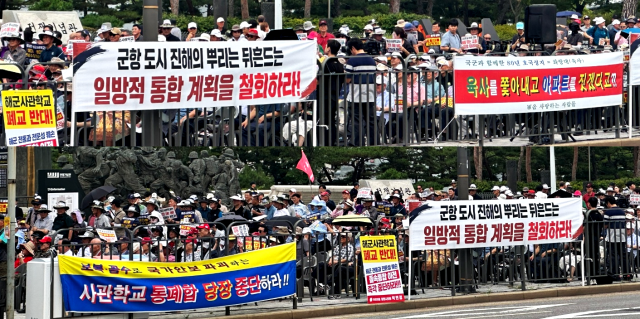
Even one panelist supporting the creation of a unified academy sought to distance the reform from the idea of collective punishment.
Doo Jin-ho, head of the Eurasia Center at the Korea Research Institute for National Strategy, said it was an undeniable historical fact that some Korea Military Academy graduates had participated in past coups and political intervention.
But, he said, "it is difficult to justify attributing the historical wrongdoing of certain individuals to the Korea Military Academy as an educational institution, including its past, present and future graduates."
"The essence of creating the Armed Forces Academy is not whether to impose punitive responsibility on a particular academy," Doo said. "It should be about how to scientifically redesign the officer training system for the future security environment."
The government has framed the merger largely as a response to changes in modern warfare.
Officials argue that military operations increasingly span land, sea, air, space, cyber and the electromagnetic spectrum, while artificial intelligence and unmanned systems are blurring traditional boundaries between the armed services.
Under the basic plan announced July 16, the Army, Navy and Air Force academies would be integrated into a single four-year institution at Jaun-dae in Daejeon. The government says the overhaul is intended to strengthen joint operations and prepare future officers for a rapidly changing security environment.
Cadets would receive more common education during the early part of their studies before moving into more service-specific training.
The ministry also argues that the reform would help the armed forces cope with South Korea's shrinking pool of military-age recruits while creating an officer corps better equipped for joint warfare.
Opponents do not necessarily dispute those challenges. They argue instead that the government has failed to demonstrate why they require dismantling the existing academy system.
They warn that integration could weaken the service-specific expertise, institutional identity and traditions developed separately by the Army, Navy and Air Force.
That divide was visible throughout Wednesday's hearing.
As Kim Hong-cheol attempted to explain the ministry's case, audience members repeatedly heckled him. At one point, after another burst of profanity, Kim responded from the podium: "Please do not swear. If you want to swear, do it after this is over."
Around 300 people attended the hearing, including ministry officials, cadets, retired officers, academy alumni and members of the public. Cadets seated inside largely watched the confrontation without making public remarks.
The ministry plans to incorporate views collected at the hearing as it draws up a more detailed blueprint around October. The government had previously said it would gather public opinion before finalizing the plan.
But Wednesday's confrontation showed that the dispute has moved well beyond questions of curriculum, campuses and military efficiency.
The merger has become entangled with competing interpretations of South Korea's history of military rule, distrust of the government's motives and fears among the services that decades-old institutional identities could disappear.
If the scene in Yongsan was any indication, drawing up the blueprint may prove considerably easier than building consensus around it.
AJP Takeaways
• South Korea's Defense Ministry faced fierce opposition at a public hearing on plans to merge the Army, Navy and Air Force academies, with shouting, profanity and heckling repeatedly disrupting proceedings.
• Defense Minister Ahn Gyu-back's absence further angered academy alumni, who accused the government of treating the hearing as a formality after effectively deciding to proceed with the merger.
• President Lee Jae Myung's criticism of Korea Military Academy graduates' role in past military coups has deepened resistance, with opponents arguing that today's academy and cadets should not bear collective responsibility for historical wrongdoing.
• The government says a unified Armed Forces Academy in Daejeon would strengthen joint warfare capabilities and prepare officers for AI, unmanned systems and a shrinking military-age population, while opponents warn it could erode service-specific expertise and traditions.

Copyright ⓒ Aju Press All rights reserved.
