SEOUL, August 31 (AJP) - SK hynix, fresh from breaking ground on a more than $4 billion HBM packaging plant in the United States, is weighing Japan as a possible next overseas production base as surging AI demand pushes the South Korean memory giant to widen its manufacturing footprint.
"We are in the process of studying. As soon as we finish, I'll let you know," SK Group Chairman Chey Tae-won told reporters in Japan on Monday when asked about potential investment in a Japanese semiconductor plant.
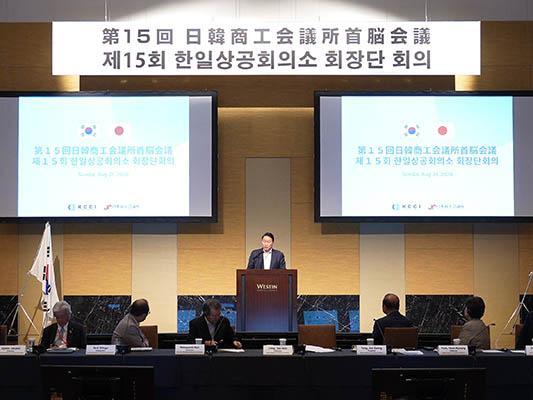
Chey, who doubles as the head of the Korea Chamber of Commerce and Industry, has been in Japan to attend the 15th Korea-Japan Chambers of Commerce and Industry Chairmen’s Meeting in Sendai, where business leaders discussed cooperation in supply chains, energy security and future industries.
His remarks followed growing speculation that SK hynix was considering memory-chip production in Japan, including reports pointing to Miyagi Prefecture in northeastern Japan as a possible candidate.
An SK hynix official told AJP that Chey's remarks were a general reference to the company's review of potential production locations and should not be taken as confirmation of a specific joint venture or investment project in Japan.
Japan nevertheless presents a compelling backdrop for the search.
The country accounted for around half of the global semiconductor market around 1990 before losing ground to South Korea, Taiwan and the United States. Its share has since fallen to around 10 percent, according to Japan's Ministry of Economy, Trade and Industry.
Tokyo is spending heavily to reverse that decline, seeking to rebuild domestic manufacturing capacity and strengthen semiconductor supply chains increasingly regarded as critical to economic security.
Kumamoto has become the most visible symbol of that push.
Taiwan Semiconductor Manufacturing Co. established Japan Advanced Semiconductor Manufacturing, or JASM, in the southwestern prefecture, restoring advanced logic-chip production capacity that Japan had largely lost.
The Japanese government has already budgeted up to 732 billion yen in support for TSMC's second Kumamoto fab.
Taiwanese authorities in March approved a revision of the project toward production of advanced 3-nanometer chips. Tokyo has said the specific investment amount, timetable and any additional government support remain under discussion.
Japan is also rebuilding its position in memory, an area that provides a more direct connection to SK hynix.
Kioxia, one of Japan's largest remaining semiconductor manufacturers, produces NAND flash memory from plants including Yokkaichi in Mie Prefecture. Tokyo has supported capacity expansion there as part of its drive to secure domestic semiconductor production.
The company also provides an existing financial link between Japan and SK hynix.
The Korean memory giant participated in the Bain Capital-led acquisition of the former Toshiba Memory business and retains an indirect connection to Kioxia through Bain-linked investment vehicles and convertible rights.
That relationship has gained renewed attention as SK hynix expands beyond conventional memory to capture the AI infrastructure boom.
The company has become the dominant supplier of high-bandwidth memory, or HBM, stacked memory used alongside AI accelerators, while also seeking additional capacity to meet demand that executives expect to remain tight for years.
Japan offers another attraction.
Even after losing much of its global chipmaking share, the country retains formidable positions in semiconductor materials, components and manufacturing equipment. METI itself has identified equipment, parts and materials as areas where Japanese companies continue to hold a competitive edge.
That combination of suppliers, government incentives and an aggressive push to restore advanced semiconductor manufacturing puts Japan among the plausible candidates as SK hynix studies the next stage of its overseas expansion.
Tokyo has increasingly relied on both domestic and foreign chipmakers to rebuild the ecosystem.
Alongside TSMC and Kioxia, the government has backed projects spanning advanced logic, memory and image sensors. In April, METI approved subsidies of up to 60 billion yen for a new Sony Semiconductor Manufacturing image-sensor plant under construction in Kumamoto.
Any Japanese investment by SK hynix would follow a major expansion in the United States.
The company last week broke ground on an advanced HBM packaging facility in West Lafayette, Indiana, with investment expected to exceed $4 billion. The plant is scheduled to begin mass production of next-generation HBM in the second half of 2029, using wafers produced in South Korea for packaging and testing in the United States.
Japan would represent a different proposition: a potential memory-chip production base in a country that was once the center of global semiconductor manufacturing and is now spending heavily to reclaim part of that position.
For now, SK hynix is keeping its options open.
The company stressed that no specific Japanese joint venture or investment has been decided and that Chey's comments referred to its broader study of potential production locations.
AJP Takeaways
• SK hynix is studying additional overseas production locations after breaking ground on its $4 billion-plus HBM packaging plant in Indiana, with Japan emerging as a potential candidate.
• Japan's global semiconductor share has fallen from around 50 percent around 1990 to roughly 10 percent, prompting Tokyo to pour resources into rebuilding domestic chip production.
• TSMC's Kumamoto fabs, Kioxia's memory operations and Japan's strength in semiconductor materials and equipment provide an established ecosystem as SK hynix considers its next manufacturing move.

Copyright ⓒ Aju Press All rights reserved.