

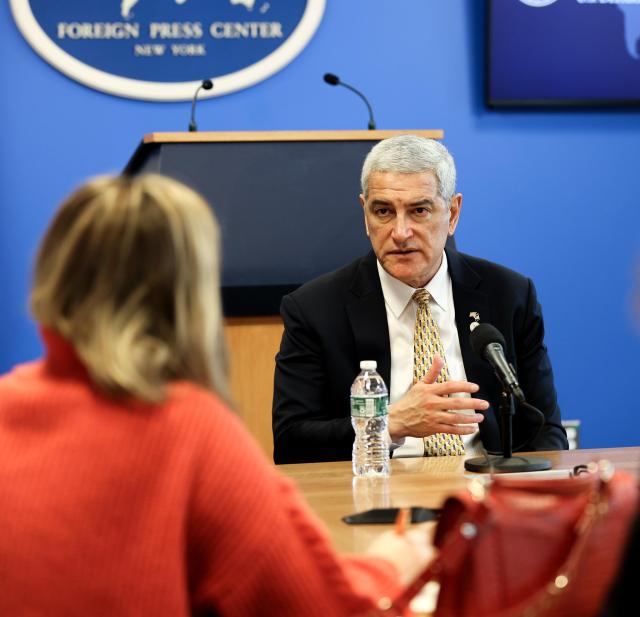
Kelly McKeague, director of the Defense POW/MIA Accounting Agency (DPAA), said Monday that his agency had been asked to outline what could realistically be done in the event of an agreement between Trump and Kim.
McKeague made the remarks during a virtual discussion hosted by the National Committee on North Korea, a Washington-based nonprofit organization.
He compared the request with preparations made before Trump’s first summit with Kim in Singapore in June 2018, saying the situation was “no different than the lead-up to the Singapore summit in 2018.”
The DPAA, an agency under the U.S. Department of Defense, is responsible for locating, recovering and identifying American military personnel missing from past conflicts.
McKeague said the agency has told both the White House and the Pentagon that it is ready to resume cooperation with North Korea on recovering the remains of U.S. troops killed or missing during the 1950-53 Korean War.
According to McKeague, the agency proposed that North Korea return remains already in its possession and that the two countries resume joint field recovery missions for the first time since 2005.
The DPAA has also proposed reviving a recovery model familiar to both sides, deploying two teams to areas around Unsan and Chosin, known in Korea as Jangjin, four times a year for 42-day periods.
“We proposed this to the White House. We are ready,” McKeague said.
The disclosure is notable as Trump has stepped up efforts in recent weeks to reopen a channel with Kim.
Trump said on Aug. 19 that he expects to meet the North Korean leader later this year, while repeatedly emphasizing that maintaining a good personal relationship with Kim is beneficial. Reports have suggested that a meeting could potentially take place during an Asia trip later this year, although no summit has been formally announced.
Trump has also moved to reduce the scale of major South Korea-U.S. military exercises that Pyongyang has long denounced as rehearsals for invasion.
At Trump’s direction, South Korea and the United States shortened this year’s Ulchi Freedom Shield exercise and scaled back some field training, with Trump saying the drills could send a hostile signal to North Korea.
Taken together, the White House inquiry to the DPAA and Trump’s recent overtures suggest the administration is at least exploring practical measures that could accompany a renewed diplomatic opening with North Korea.
Recovering American war remains has historically been one of the few areas in which Washington and Pyongyang have managed to cooperate even during periods of strained relations.
U.S. teams conducted 37 joint recovery operations in North Korea between 1996 and 2005 alongside personnel from the Korean People’s Army. Those operations ultimately led to the identification of 153 U.S. service members, according to the Pentagon. Field activities were suspended in 2005 amid U.S. security concerns.
The issue again became part of high-level diplomacy during the 2018 Singapore summit.
In their joint statement, Trump and Kim agreed to work toward recovering the remains of prisoners of war and service members missing in action, including the immediate repatriation of those already identified.
North Korea subsequently handed over 55 boxes containing remains to the United States in July 2018, but plans for renewed joint excavation work failed to materialize as broader nuclear negotiations stalled.
Trump and Kim met three times during the president’s first term, in Singapore in June 2018, in Hanoi in February 2019 and at the inter-Korean border village of Panmunjom in June 2019.
Their diplomacy ultimately failed to produce an agreement on North Korea’s nuclear program, and formal negotiations have remained stalled since then.
The DPAA estimates that about 5,300 U.S. service members missing from the Korean War remain unaccounted for in North Korea, making renewed access to excavation sites a longstanding priority for the agency.
McKeague said remains recovery should be viewed first as a humanitarian mission but can also provide a diplomatic channel between countries with otherwise deeply strained relations.
Still, North Korea has continued to accuse Washington of pursuing a hostile policy and vowed to strengthen its nuclear arsenal, highlighting the challenges facing any renewed dialogue despite Trump’s overtures.
AJP Takeaways
· White House asks DPAA to prepare options for possible North Korea talks.
· DPAA is ready to resume U.S.-North Korea war remains recovery work.
· Trump’s outreach to Kim continues despite Pyongyang’s nuclear stance.

Copyright ⓒ Aju Press All rights reserved.
