

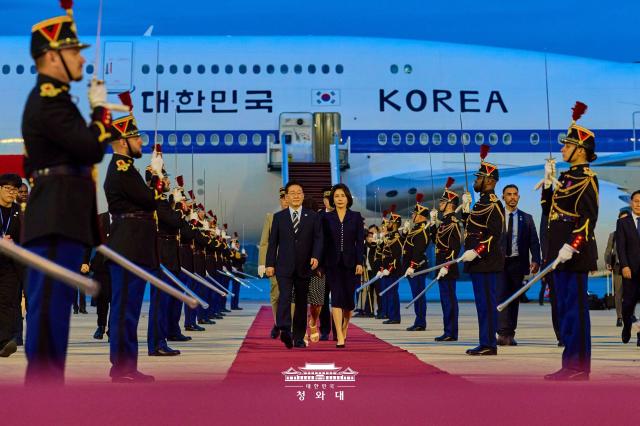
SEOUL, September 08 (AJP) - South Korean President Lee Jae Myung may be in France this week, but back home the political heat is rising over a question the opposition wants him to answer himself. Will he rule out another presidential run if constitutional reform moves forward?
Main opposition People Power Party (PPP) wants a clear answer before going into any discussion for constitutional revision.
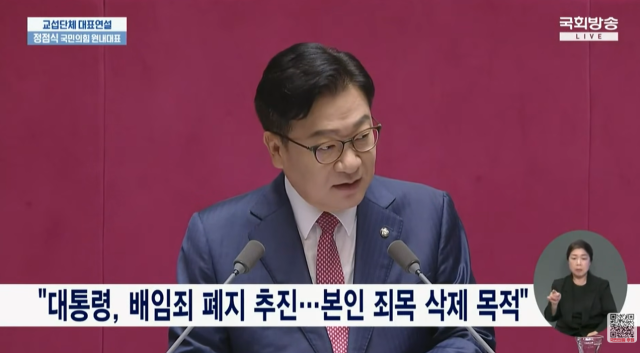
PPP floor leader Jeong Jeom-sig during his parliamentary address at the National Assembly Tuesday accused Lee of leaving open the possibility of extending his time in office through constitutional revision.
“The president has also mentioned a constitutional amendment introducing a two-term presidency. But he never says, ‘I will not seek reelection’ or ‘I will stand trial,’” Jeong said.
“Is the intention to extend his term through constitutional revision and use that to delay his trials?”
Jeong went on to declare that his party would reject constitutional negotiations with the administration.
“There will be no constitutional amendment under this government,” he said. “We will never discuss constitutional revision with forces that commit clear unconstitutional acts and seek private interests through constitutional revision.”
The remarks marked one of the opposition’s strongest attempts yet to link the long-running debate over South Korea’s presidential system to Lee’s own political future.
Earlier in the day, Hong Ihk-pyo, senior presidential secretary for political affairs, rejected suggestions that Lee was considering another presidential term.
“The president has never even thought about such a thing,” Hong said during an appearance on the YouTube program “Kim Ou-joon’s News Factory,” expressing regret that the controversy continued despite explanations from the presidential office.
Hong said Lee was expected to make his position clearer himself when an appropriate opportunity arose.
Hong also said Lee had discussed the issue during an April meeting with then-Democratic Party (DP) leader Jung Chung-rae and PPP leader Jang Dong-hyeok. According to Hong, Lee said at the time that he had “no thoughts” of seeking another term and questioned the point of publicly declaring he would not do something he had no intention of doing.
The dispute comes as constitutional revision has again moved toward the center of South Korean politics. DP leader Kim Min-seok said in his parliamentary group speech Monday that the ruling party would pursue “realistically achievable constitutional reform” reflecting changes in society and public demand, including possible changes to the country’s power structure.
Lee has long supported replacing South Korea’s current single five-year presidential term with a system allowing presidents to serve more than one term.
As a DP presidential candidate on Jan. 18, 2022, Lee said in an MBN interview that a four-year, two-term presidency with dispersed presidential powers was necessary to strengthen political accountability.
“Five years is not enough time to plan policies, implement them and see the results,” Lee said, adding that he would be prepared to shorten his own term by one year if political agreement could be reached on constitutional revision.
“If an agreement is possible now, even if I become president, I think it would be desirable to amend the Constitution in that way even if it means shortening my term by one year,” he said.
Lee returned to the issue during the 2025 presidential campaign.
On May 18 that year, he proposed a four-year presidency allowing consecutive reelection as part of a broader constitutional reform package intended to strengthen presidential accountability while dispersing presidential powers. He argued that allowing voters to judge an incumbent after four years would effectively create a midterm evaluation of the administration.
Lee also said at the time that the change would not apply to the president elected in the 2025 election.
“The current Constitution explicitly states that a constitutional amendment does not apply to the president serving at the time,” Lee told reporters in Gwangju after attending a May 18 pro-democracy commemoration.
The issue resurfaced after Lee took office.
On Aug. 14, Lee wrote on X that his position remained unchanged, saying the presidential term should be changed to either a four-year, two-term system or a four-year system allowing consecutive reelection so that voters could conduct an interim assessment of a president’s performance.
He also called for transferring some presidential powers, including authority involving the Board of Audit and Inspection, the nomination of the prime minister and some appointments, to the National Assembly, while strengthening local autonomy and fundamental rights.
“Changing the presidential term to a four-year two-term or four-year renewable system to enable responsible politics through an interim evaluation, while strengthening local autonomy and the fundamental rights of citizens, is my campaign pledge and has been my consistent position,” Lee said.
He reiterated that he would accept shortening his term if necessary to achieve constitutional reform, saying that had been his official position during the 2022 presidential campaign and remained unchanged.
Lee’s use of both “two-term” and “consecutive reelection” systems has helped fuel the latest political dispute. In Korean constitutional debate, a two-term system can allow a former president to return after leaving office, while a consecutive-term system refers specifically to an incumbent immediately running for another term.
The legal barrier to Lee benefiting from such a change is substantial under the current Constitution.
Article 128, Paragraph 2 of the Constitution states that an amendment extending a president’s term or allowing presidential reelection “shall not be effective for the President in office at the time of the proposal” for the amendment. That means a constitutional amendment proposed while Lee is serving as president could not, under the current provision, simply give him the right to extend his existing term or seek reelection under the newly created system.
The Constitution also requires an amendment to win support from at least two-thirds of all National Assembly members before being put to a national referendum, making cooperation across party lines effectively indispensable.
AJP Takeaways
- PPP sets condition for constitutional reform talks: The People Power Party says it will not engage in constitutional revision discussions unless President Lee Jae Myung personally rules out seeking another presidential term.
- Lee has consistently backed a two-term presidency: Lee has supported replacing South Korea’s single five-year term with a four-year system allowing reelection, while repeatedly saying any change should not benefit the sitting president.
- Constitution itself limits Lee’s options: Article 128 bars constitutional amendments extending presidential terms or permitting reelection from benefiting the president in office when the amendment is proposed, while any revision would also require bipartisan support in the National Assembly.
Copyright ⓒ Aju Press All rights reserved.
