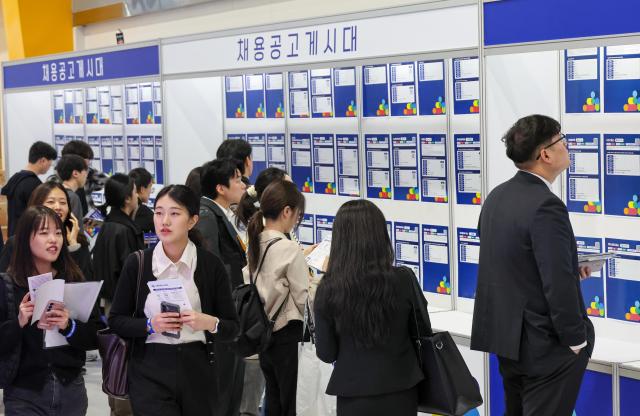
The survey of 1,052 job seekers and employed people aged 20 to 34 found that 81.0 percent expected an extension to reduce new recruitment.
Of the respondents, 51.4 percent expected hiring to fall to some extent and 29.6 percent anticipated a sharp decline. Another 12.4 percent expected no impact, while 6.7 percent said they were unsure.
Among those expecting recruitment to fall, 31.6 percent said large companies would see the biggest impact, followed by public institutions at 29.9 percent, midsized companies at 22.7 percent and small and midsized enterprises at 15.8 percent.
Broader perceptions of the labor market were also weak. Some 62.9 percent described the current job market as difficult, including 31.9 percent who said conditions were somewhat difficult and 31.0 percent who said they were very difficult.
Asked why finding work had become difficult, 49.5 percent cited the growing preference for experienced workers, while 49.2 percent pointed to reduced recruitment from a year earlier and 49.1 percent cited lower labor demand linked to the use of artificial intelligence. Multiple responses were allowed.
Expectations for next year were similarly subdued, with 57.0 percent expecting new hiring in 2027 to decline from this year. Another 37.7 percent expected hiring to remain at a similar level, while 5.2 percent anticipated an increase.
Pay was the most frequently cited consideration when choosing an employer, selected by 66.6 percent of respondents in a multiple-response question. Job security followed at 46.0 percent and job suitability or relevance to a respondent's academic major at 34.7 percent.
Civil service and public institutions were the most preferred workplaces at 30.2 percent, closely followed by large and midsized companies at 29.3 percent.
Preferences differed by region. Among young people living in the Seoul metropolitan area, 32.5 percent preferred large or midsized companies, compared with 28.4 percent for civil service or public institutions. Outside the capital region, public-sector employment led at 33.3 percent, compared with 24.1 percent for large and midsized companies.
A separate KEF survey released on March 10 showed that 66.6 percent of 500 companies with at least 100 employees planned to recruit new workers this year, up 5.8 percentage points from 2025. The same survey found that 67.6 percent of companies regarded job-related work experience as the most important factor when evaluating new recruits.
Official labor data have meanwhile continued to show weakness among younger workers. The Ministry of Data and Statistics said in its Aug. employment report released Sept. 9 that the unemployment rate for people aged 15 to 29 rose 0.5 percentage point from a year earlier to 5.4 percent, even as total employment increased by 184,000.
AJP Takeaways
- South Korean young adults are increasingly concerned about recruitment, with 81.0 percent expecting a statutory retirement-age extension to reduce new hiring.
- South Korean respondents cited experienced-worker hiring, reduced recruitment and AI-related labor demand as the leading reasons for difficult job-market conditions.
- The Korea Enterprises Federation's March survey found that 66.6 percent of companies planned new hiring in 2026, while job-related work experience was their most frequently cited evaluation factor.

Copyright ⓒ Aju Press All rights reserved.