
SEOUL, October 01 (AJP) - South Korea and the United States have finally put multibillion-dollar price tags on the energy ventures underpinning Seoul’s investment pledge in return for tariff relief - $120 billion for eight nuclear reactors and $22.3 billion for a South Texas power project.
But the project that stole the limelight when President Donald Trump announced the package was the one Seoul has yet to commit to — a long-proposed gas pipeline in Alaska.
Flanked by U.S. officials and Alaska Sen. Dan Sullivan at the Oval Office on Wednesday, Trump touted a “gigantic win” for Alaska, presenting the LNG project as a centerpiece of South Korea’s $200 billion investment pledge outside shipbuilding.
On Truth Social, he credited his meeting with South Korean President Lee Jae Myung on the sidelines of the United Nations General Assembly last month with securing the package and again celebrated the Alaska project.
“The United States and Korea have agreed to commence working together on the 50 Billion Dollar ALASKA LNG PROJECT — unlocking the tremendous resources of our Great State of Alaska, and creating new American Gas Infrastructure, and building it with our wonderful American Workers. This Project will deliver transformational change for the People of Alaska,” he wrote.
The problem is that Alaska is far from a done deal.
The official language was considerably more restrained.
South Korea’s Ministry of Trade, Industry and Resources said the two governments had agreed to begin reviewing Alaska LNG, dubbed Project North.
A decision on whether to proceed would depend on its “commercial reasonableness” and compliance with domestic legal requirements. The U.S. Commerce Department’s fact sheet likewise made cooperation conditional.
For those familiar with the project’s long struggle to get built, the gap between the presidential celebration and the negotiated language reflected the audience each was intended to reach.

“It was a political announcement from President Trump,” Larry Persily, a former federal coordinator for Alaska natural-gas transportation projects and former deputy commissioner of the Alaska Department of Revenue, said in a phone interview with AJP.
“No one from South Korea was at the event. It was made for TV.”
Sullivan is fighting a competitive reelection race against Democrat Mary Peltola. Trump praised his work on the pipeline and presented the project as a victory for Alaska just weeks before the Nov. 3 midterm elections.
The senator’s connection to Alaska LNG nevertheless runs deeper than election-year staging. He has spent years promoting the project in Washington and Asia, courting governments, utilities and potential investors. His office said last year that he had made four trips to Japan and South Korea to promote it and had personally pressed Trump and senior administration officials to make it a priority.
Yet the venture Trump celebrated still needs enough buyers, financing and investors willing to bear its risks.
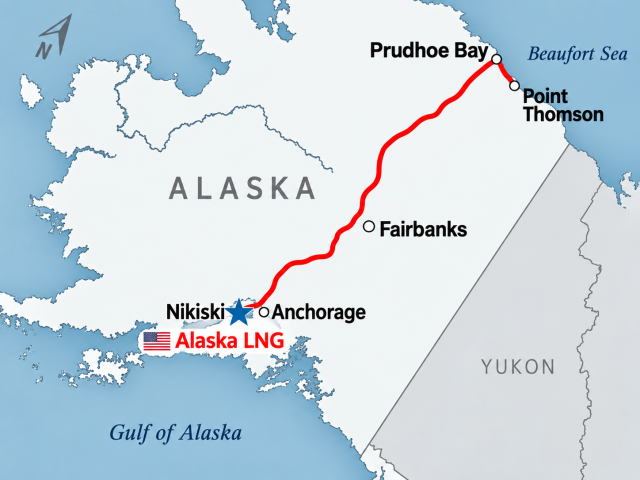
Alaska LNG is 75 percent owned by Glenfarne Group, with the state holding the remaining 25 percent through the Alaska Gasline Development Corporation. It would carry gas from the North Slope through more than 800 miles of pipeline to a liquefaction plant capable of producing 20 million metric tons a year for export.
Developers have preliminary arrangements covering about 13 million tons annually, but need additional commitments and ultimately binding contracts to support financing. Construction estimates range from roughly $44.5 billion to $54.5 billion.
For Persily, the most striking implication of Trump’s announcement was that an investment roughly equivalent to the cost of the entire project could be assigned to South Korea.
Large LNG ventures normally distribute risk among producers, infrastructure companies, governments, lenders and long-term buyers, he said.
“Look at Australia, Papua New Guinea or Mozambique,” Persily said. “No one entity ever takes the entire risk.”
He pointed to LNG Canada, which began operations in 2025 with five major partners despite being smaller than Alaska LNG.
“For one entity, it is too much risk,” he said.
The construction estimate itself offers little reassurance, in his view.
“Most people in the industry seriously question the supposed $54 billion estimated cost of construction,” he said. “The estimated price tag has low credibility.”
Such doubts help explain Seoul’s caution.
One member of South Korea’s National Assembly committee overseeing industry and energy said Trump’s announcement should not be confused with what Seoul had agreed to.
“This is Trump’s unilateral announcement,” the lawmaker told AJP. “The agreement and Trump’s announcement will be very different.”
The lawmaker said the negotiated language was understood to be closer to “explore the possibility” of investing in Alaska LNG, leaving Seoul room to walk away if the economics fail.
Another committee member said South Korea remained unconvinced of the project’s commercial viability and viewed the announcement partly through the lens of the U.S. midterms.
“The Alaska LNG project has not been agreed,” the lawmaker said. “Consultations have begun. Korea is still not convinced of its commercial viability.”
Seoul’s assessment, however, has become less dismissive as the risks surrounding other energy supplies have grown.
A committee member said Industry Minister Kim Jung-kwan had questioned the project’s commercial rationale last year. Since then, the war with Iran and disruption to Middle Eastern energy flows have strengthened the case for diversifying South Korea’s LNG supplies.
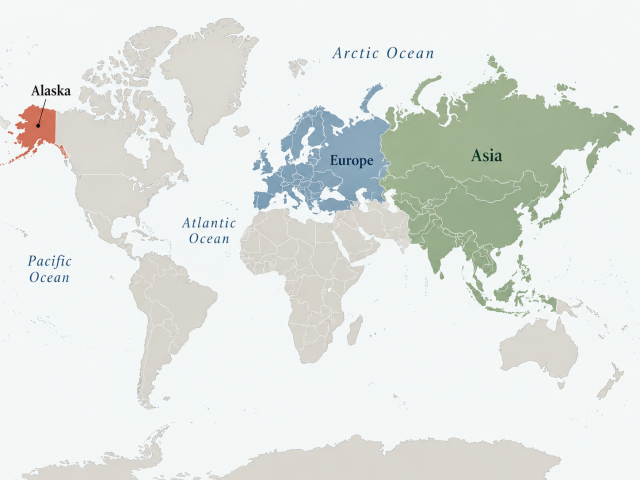
Alaska offers a relatively short shipping route to Northeast Asia that avoids the Strait of Hormuz. It would also give South Korea another source of supply outside the Middle East and Australia.
Its strongest selling point may therefore be the security of having another option. Whether buyers will pay enough for that advantage is another question.
“Geographically, Alaska LNG is not going to Germany, Poland, Lithuania or the U.K.,” Persily said. “It has to go to the Asian market, and the Asian market is price sensitive.”
The economics depend on prices over decades, well beyond the current disruption.
Brett Watson, a professor of applied and natural-resource economics at the University of Alaska Anchorage, said the Japan-Korea Marker, the benchmark for spot LNG delivered to Northeast Asia, was around $25 per thousand cubic feet in the price framework he uses.
That compares with a range of $8 to $14 from January 2024 through February 2026, he said, against $25 to $35 after Russia invaded Ukraine and as little as $2 to $5 during the pandemic.
“When we think about the competitiveness of LNG, everything hinges on one’s expectations of future prices,” Watson told AJP.
For Alaska, the same volatility presents a different calculation.
Southcentral Alaska’s traditional Cook Inlet gas supply is becoming more expensive as production declines. Without access to North Slope gas, the region could increasingly depend on imported LNG, paying the Asian benchmark price plus shipping and regasification costs, Watson said.
“If gas prices are low, then it makes more sense for Alaska to be a gas buyer,” he said. “If gas prices are high, then we want to be a gas seller.”
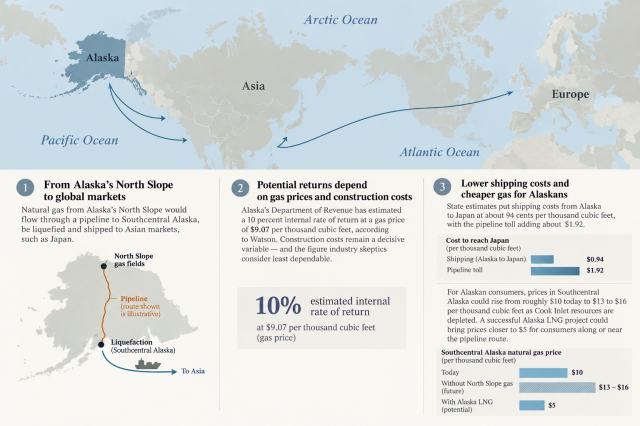
Alaska’s Department of Revenue has estimated that the project could generate a 10 percent internal rate of return at a gas price of $9.07 per thousand cubic feet, according to Watson. But construction costs remain a decisive variable — and precisely the figure industry skeptics consider least dependable.
The geographic advantage is easier to quantify. Watson said state estimates put shipping costs from Alaska to Japan at about 94 cents per thousand cubic feet, with the pipeline toll adding about $1.92.
For Alaskan consumers, the potential benefits are substantial. Watson estimates that without North Slope gas, prices in Southcentral Alaska could rise from roughly $10 today to $13 to $16 per thousand cubic feet as Cook Inlet resources are depleted. A successful Alaska LNG project could bring prices closer to $5 for consumers along or near the pipeline route.
Those local benefits help explain the enthusiasm in the Oval Office. They do not, by themselves, establish the investment case for South Korea.
Seoul said that if the project proceeds, Washington would provide favorable conditions for Korean equipment suppliers, tariff relief on materials such as steel, economically viable long-term LNG purchase arrangements and priority Korean access to the gas.
Those terms remain part of the case Seoul must assess. Trump has already claimed the political dividend; South Korea has yet to decide whether the investment will pay.
AJP Takeaways
- Trump cast Alaska LNG as a centerpiece of South Korea’s $200 billion U.S. investment pledge, but Seoul has agreed only to review the project and says any participation depends on commercial viability and domestic law.
- The project still faces major financing and cost questions, with developers needing more binding buyers and experts warning that the roughly $44.5 billion to $54.5 billion construction estimate carries substantial uncertainty.
- Alaska LNG could strengthen South Korea’s energy security by diversifying supplies and avoiding Middle Eastern chokepoints, but whether those strategic benefits justify the cost remains unresolved.

Copyright ⓒ Aju Press All rights reserved.