

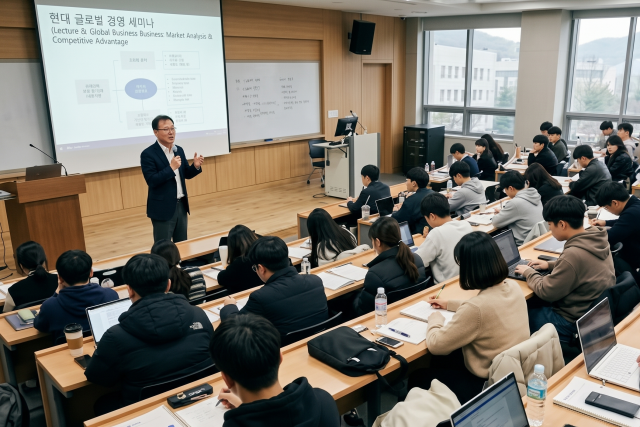
SEOUL, October 01 (AJP) - Humanities and social science students at Kookmin University are getting career training built around specific jobs such as sales, marketing and planning. The Seoul university is trying to help them overcome a hiring gap that has followed liberal arts graduates for years.
In South Korea's latest national survey, humanities graduates had the lowest employment rate of any field. Among people who finished school in August 2023 or February 2024, 61.1 percent of humanities graduates had found work, against an average of 69.5 percent. The figures come from the Ministry of Education's graduate employment survey, released Dec. 29, 2025, with the Ministry of Data and Statistics and the Korean Educational Development Institute.
Social science graduates did better at 69.0 percent. That still trailed the 70.4 percent rate for engineering and the 79.4 percent rate for medicine.
South Korean students have long joked about the gap with the word "Munsonghamnida." It is a clipped form of a phrase meaning "sorry for being a liberal arts major," and it has become shorthand for the job struggles of humanities graduates.
Kookmin said the core problem is that a humanities degree does not map neatly onto a job title. Its answer is to help students show employers how what they learned connects to the skills a company actually needs.
The university said in a statement on Thursday it has moved away from one-size-fits-all career lectures. Instead, counselors at its University Job Plus Center, part of a government-backed network of campus career offices, find out what students want through one-on-one sessions. The center passes those needs to individual colleges, which turn them into extracurricular programs tailored to students' majors and target jobs.
On Sept. 15, the College of Social Sciences ran a workshop called "Branding Myself Through a Portfolio." The university said it designed the session because portfolios are increasingly used in hiring for jobs that draw many humanities and social science graduates, such as marketing, advertising planning, service planning and television production.
A working marketing designer led the session. Students learned how to turn their experience and skills into a single story, and how to plan a portfolio and use visuals to make it easier to read.
Kookmin is also pitching sales and sales management as a path for liberal arts students. An introductory course set by the career center for the second half of the 2026 academic year moves step by step from what the job involves to real-world cases, customer management and job-search strategy.
The course splits its advice by field. Engineering students are pointed toward technical sales, and arts and sports students toward sales jobs in industries tied to their majors. Humanities students get job-by-job strategies and road maps for applying to sales roles across a range of industries, regardless of what they studied.
Over the 2026 summer break, the university ran an online marketing program taught by an industry practitioner. It covered how different social media platforms work and how to plan advertising and branding, with the stated aim of giving aspiring marketers hands-on judgment rather than theory alone.
Kookmin pointed to Shin Hyo-jin, a graduate of its School of Korean Language and Literature, as an example of the approach working. She now works at Asung Daiso, which runs the Daiso discount store chain.
Shin settled on sales as her goal early in her studies, the university said. Through a bank's student ambassador program and CoREP, Kookmin's hands-on career program, she worked on projects that involved selling real products and producing measurable results.
According to the university, those projects became central material in her job applications. What set her apart was showing in concrete terms what she had done to prepare for the job, rather than the name of her major.
Kookmin, founded in 1946, marks its 80th anniversary this year. It plans to expand its job-focused career support and tie it to entrepreneurship, which the university describes as its practical educational philosophy. It also plans to break down the boundaries between coursework, extracurricular programs and industry partnerships so that students can apply what they learn to real problems.
"As the lines between industries and jobs disappear, what students need is not to limit their potential to a single major, but the ability to connect their strengths to a range of jobs," President Jeong Seung-ryul said.
Copyright ⓒ Aju Press All rights reserved.
