
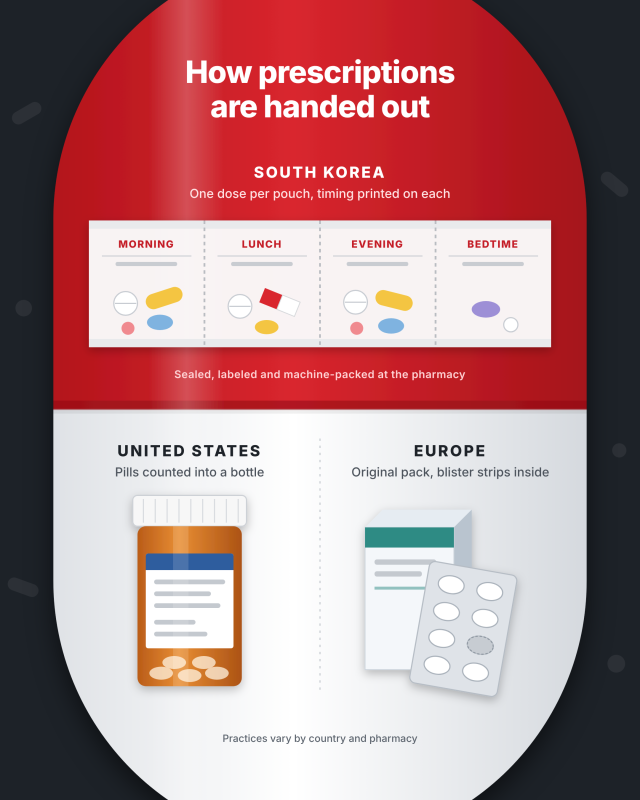
Automated dispensing machines sort and package the pills. JVM, a Hanmi Science subsidiary, describes itself as the global leader in pouch-type dispensing automation. Pharmacies are also a frequent stop for overseas visitors: they accounted for 12.9 percent of foreign visitors’ medical spending in Korea in May 2026 and 69.8 percent of their medical transactions, according to the Korea Tourism Data Lab.

Kim Dong-young
Kim Dong-young is a bilingual journalist at AJU Press (AJP), covering Korean tech, energy, and bio/pharma.
He reports from the field at events like CES and APEC, runs AJP's YouTube channels,
and is pursuing a master's at Sogang's MOT program.
Copyright ⓒ Aju Press All rights reserved.
Related News
-
 Nobel Prize in Physiology or Medicine Awarded for Optogenetics Advancements
This year's Nobel Prize in Physiology or Medicine has been awarded for the development of optogenetics, a technique that allows researchers to turn specific neurons on and off using light. Originally a laboratory tool, this technology is now expanding possibilities for treating blindness and brain disorders.Optogenetics involves inserting light-sensitive proteins from microorganisms into specific neurons and then using light to control the activity of those cells. The technique began with the discovery of the protein 'channelrhodopsin' in green algae. Unlike traditional electrical stimulation, which affects surrounding cells, optogenetics selectively regulates only the targeted cells.Professor Kim Ki-hyun of Seoul St. Mary's Hospital explained, "We can now directly verify the causal relationship between neural circuits and functions by observing which behaviors emerge when specific neurons are activated and how behaviors change when their activity is suppressed. This has significantly changed the way we study complex brain functions such as memory, emotion, reward, and movement."The applications of this technology extend to disease research as well. Professor Kim Jun-ki of Asan Medical Center noted, "Optogenetics is being used to study the mechanisms behind neurological disorders such as Parkinson's disease, epilepsy, and sleep disorders, as well as to validate new therapeutic targets and drug candidates. It also helps test hypotheses about the effects of developing drugs on the brain." Identifying which cells cause symptoms allows for the design of targeted drugs or therapies.Initially, the proteins only responded to blue light, which is difficult to penetrate deep into tissues. However, recent advancements have led to the development of proteins that respond to red light and have increased sensitivity, propelling therapeutic research forward. The field that has made the most progress in patient treatment is ophthalmology. Since light can easily reach the eye, introducing light-sensitive proteins into remaining retinal neurons can recreate visual signals even after photoreceptor cells have died.Professor Kim stated, "Research is underway to provide light-sensing capabilities to the remaining retinal neurons in patients with retinitis pigmentosa, and reports have emerged that some visual functions have been restored." The optogenetic gene therapy 'Mogenly' from the U.S. company Nanoscope Therapeutics has been submitted for FDA approval, with a review target set for the first half of next year. However, applications for brain disorders are still in preclinical stages, with challenges remaining in delivering light deep into the brain and ensuring long-term safety.The scope of regulation is also expanding beyond neurons. Professor Hyung Soo-jin's research team at Samsung Medical Center summarized studies in a 2023 review published in the journal 'Frontiers in Cellular Neuroscience' that stimulated glial cells, which were previously considered supportive cells for neurons, with light. According to the summarized studies, light-stimulated astrocytes released signaling molecules that altered communication between neurons, while Schwann cells in peripheral nerves produced myelin, the protective sheath around nerves, solely through light stimulation. This suggests that treatment targets could expand to diseases like multiple sclerosis or nerve damage.Professor Hyung remarked, "The ability to turn neurons on and off with light has become a standard method for elucidating brain function. It is encouraging that we are beginning to provide clues for functional recovery in patients with conditions like terminal blindness, for which there were previously no effective treatments." He added, "While expanding this to other organs remains a challenge, I expect this award will accelerate progress in that direction."Professor Kim Ki-hyun anticipates that future research will lead to a more precise understanding of the neural circuits related to diseases, paving the way for the development of clinically applicable therapies.Meanwhile, Karl Deisseroth, a co-recipient of this year's Nobel Prize and a professor at Stanford University, emphasized that optogenetics could offer hope for patients with autism and depression. In an interview with foreign media shortly after the announcement on October 5, he stated, "As a physician-scientist and psychiatrist, I think of my patients suffering from autism and depression. The hope that this research brings is significant."* This article has been translated by AI.
-
Celltrion Launches Omliclo in the U.S. as a Key Growth Product
Celltrion has launched its chronic spontaneous urticaria and allergic asthma treatment, Omliclo (generic name: omalizumab), in the United States. This marks the first entry of an omalizumab biosimilar into the U.S. market, and it has been included in the prescription drug lists of major pharmacy benefit managers (PBMs), establishing a foundation for initial market expansion. On October 6, Celltrion announced that Omliclo is being offered at a wholesale acquisition cost (WAC) approximately 15% lower than that of the original drug. It is available in three dosage forms: 75 mg, 150 mg, and 300 mg. Omliclo received approval from the U.S. Food and Drug Administration (FDA) in March of last year for all indications held by the original drug, including asthma, chronic rhinosinusitis with nasal polyps, chronic spontaneous urticaria, and IgE-mediated food allergies. It has also secured interchangeability status, allowing it to replace the original drug at the pharmacy level if it meets relevant state laws and insurance policy requirements. Notably, upon its launch, Omliclo was listed as a preferred drug in the private insurance formulary of Optum, a major U.S. PBM. Inclusion in PBM formularies is a critical factor that influences insurance reimbursement and patient access in the U.S. market. Celltrion is currently negotiating listings with other major PBMs, with some contracts nearing completion. Celltrion plans to replicate the initial market penetration success of Omliclo in Europe in the U.S. The drug is currently sold in 26 European countries, and as of July this year, it has surpassed a 90% market share in Spain. In Denmark, it is expected to achieve a market share of around 98% by the end of the year, based on national tender wins. In the U.S., Celltrion will leverage its established direct sales network and distribution channels to expand prescriptions. The company’s blood cancer treatment, Truxima, recorded a 39% market share in the U.S. in August, while its autoimmune disease treatment, Inflectra, held a 31% share. Stekima and Uplima also recorded shares of 15% and 12%, respectively. Kim Bon-jung, CEO of Celltrion's U.S. subsidiary, stated, "Omliclo not only benefits from being the first omalizumab biosimilar in the U.S. but also possesses competitive advantages with its full range of indications, interchangeability, and three dosage forms. We aim to finalize additional PBM listings quickly to develop Omliclo into a key growth product in the U.S." Meanwhile, Celltrion has been actively enhancing shareholder value this year, announcing a share buyback worth 400 billion won and a share cancellation worth 200 billion won. This aggressive execution aligns with the management's commitment to return one-third (approximately 33%) of annual consolidated net income to shareholders. This strategy is supported by record-high performance and strong free cash flow. Last year, Celltrion achieved its highest-ever revenue of 4.1625 trillion won and an operating profit of 1.1685 trillion won. In the first half of this year, the company continued its high growth, recording revenue of 2.5387 trillion won and an operating profit of 773.7 billion won.* This article has been translated by AI.
-
Korea's Food and Drug Administration Discovers 949 Illegal Posts on GLP-1 Obesity Drugs
Wegovy and Mounjaro, both GLP-1 obesity treatment drugs, are being illegally distributed online. Over the past nine months, 949 illegal posts have been identified, promoting overseas direct purchase sites or encouraging personal transactions through social media.The Korea Food and Drug Administration (KFDA) reported on October 6 that it had detected 949 violations of the Pharmaceutical Affairs Act related to the online illegal sale, solicitation, and advertising of GLP-1 obesity treatments from January 1 to September 30 this year. The agency has requested the Korea Communications Standards Commission to block access to these posts.Among the detected cases, 716 posts (75.4%) were related to the introduction of sales sites. This was followed by 129 posts (13.6%) on cafes and blogs, 72 posts (7.6%) encouraging transactions through social media chats, and 32 posts (3.4%) involving personal second-hand sales.A significant concern is the safety of products traded online. Obesity treatments are classified as prescription medications that should only be used after a doctor's consultation and prescription, followed by dispensing and guidance from a pharmacist at a pharmacy, adhering to specified dosages and methods.Additionally, users can verify detailed approval information, including efficacy, dosage, and precautions, for domestically approved medications by searching product names and ingredients on the KFDA's Drug Safety Information website. However, purchasing products online bypasses these essential procedures, increasing the risk of misuse.Products purchased through overseas direct sales may not be approved in South Korea, raising concerns about their safety and efficacy. If the manufacturing and distribution processes are not verified, there is a risk that these products could be counterfeit or substandard. Consumers may find it difficult to receive legal protection, such as recalls or compensation, if they suffer harm from using these products.Particularly for GLP-1 obesity treatments, proper storage and distribution are critical issues. Some products require cold chain management to maintain appropriate temperatures. Even if products are distributed correctly overseas, issues may arise during transport to South Korea if refrigeration or freezing is not maintained.The KFDA has urged against the arbitrary use of obesity treatments for cosmetic purposes. It also advised against purchasing or selling these medications through online overseas direct sales or personal transactions.A KFDA official stated, "Products purchased through overseas direct sales carry risks of being counterfeit or substandard due to unverified manufacturing and distribution processes. Even if harm occurs, it is difficult to receive legal protection such as product recalls or compensation."Previously, the KFDA, in collaboration with the Korea Institute of Drug Safety and Risk Management, distributed a safety usage guide for GLP-1 obesity treatments to local medical associations and regional drug safety centers across the country. The revised guide includes enhanced safety information for adolescents and pregnant women, covering topics such as the diseases treated by obesity medications, proper dosing methods, storage and disposal, and precautions during administration.* This article has been translated by AI.