
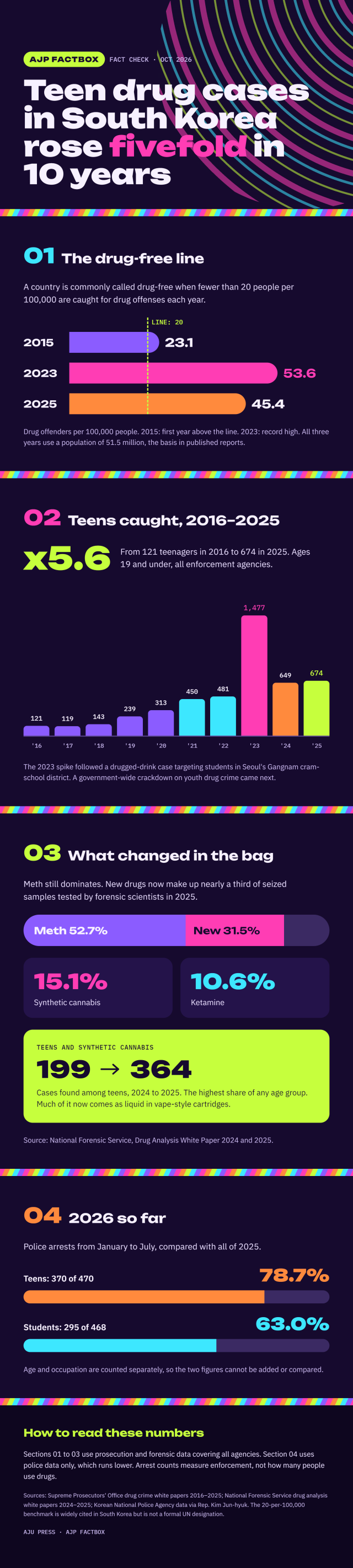
Drug cases involving teenagers in South Korea have risen more than fivefold over the past decade, from 121 in 2016 to 674 in 2025, with synthetic cannabis sold in vape-style cartridges recording its highest share of cases among teens last year, according to the Supreme Prosecutors' Office and the National Forensic Service.
The count is climbing again this year, with police arresting 370 teenagers from January to July, 78.7 percent of the 2025 total, according to data released Wednesday by Democratic Party lawmaker Kim Jun-hyuk.

Park Sae-jin
Experienced journalist and editor at AJU PRESS specializing in multilingual news. I cover international diplomacy, geolpolitics, and policy, consistently delivering highly accurate, compelling reporting for a worldwide audience.
Copyright ⓒ Aju Press All rights reserved.
Related News
-
 Interview with Kim Jeong-hoon: Developing New Drugs to Degrade Disease-Related Proteins
As the research and development system of government-funded research institutes shifts to strategic research projects centered on national missions, the Korea Research Institute of Bioscience and Biotechnology (KRIBB) has embarked on developing next-generation drug technologies for treating intractable diseases.Utilizing artificial intelligence (AI) technology, the institute aims to secure a therapeutic platform that combines antibody and protein degradation technology applicable to various intractable diseases such as cancer, inflammation, and autoimmune disorders, ultimately linking this to new drug development by private pharmaceutical and biotech companies.In an interview with Aju Economy, Kim Jeong-hoon, head of the Rare and Intractable Disease Research Center at KRIBB, outlined the research direction and commercialization plans.KRIBB is pursuing an 'AI-based Hybrid Therapeutics Strategic Research Project' with a total investment of 39.6 billion won (KRW) over five years from this year until 2030. The core of the project is to develop technology that degrades disease-related proteins in a different manner than existing therapeutics and to establish a therapeutic platform that can be expanded to various intractable diseases.Kim cited the differences in disease characteristics among patients as a reason for the need for new therapeutic technologies. In the past, drugs were developed primarily for types of cancer such as lung and colorectal cancer, but recently, patients have been subdivided based on genetic mutations and disease characteristics, increasing the importance of personalized treatment technologies."Previously, lung cancer or colorectal cancer patients were treated as one disease. However, it has been confirmed that the same drug has different effects on different patients," he said. "We began to subdivide patients based on the characteristics of the cancer and genetic mutations, which necessitated new technologies to develop treatments tailored to each characteristic."The technology KRIBB focuses on involves combining antibodies with substances that selectively degrade specific proteins instead of cytotoxic drugs. While existing antibody-drug conjugates (ADCs) attack cancer cells with cytotoxic drugs, KRIBB is also researching technologies that degrade disease-related proteins present outside cells or on cell membranes, aiming to allow for the application of the platform to other diseases by changing targets once established.Kim explained, "Existing antibody therapeutics neutralized the function of target proteins by binding to them, but we are currently developing technology that degrades the target proteins themselves." He added, "While it is not possible to treat all diseases with one technology, if we can change the target according to the disease, it could serve as a valuable platform for developing various therapeutics."AI will be utilized to expand the therapeutic platform. Researchers are designing artificial proteins that bind to disease-related proteins using AI and are developing technologies to adjust binding locations and affinities, as well as improve the performance of existing antibodies.To commercialize the developed technologies, KRIBB is also collaborating with pharmaceutical and biotech companies. The institute plans to validate efficacy and safety through proof of concept (PoC) and secure the data required by companies to facilitate technology transfer.Kim stated, "The developed platform can be applied to various diseases by changing the target, allowing companies to either acquire the entire platform or selectively utilize only the necessary technologies," adding that the method of technology transfer will vary depending on corporate demand.As the first year of the research project begins, there is a plan to narrow the research scope and focus on 'selection and concentration.' Reflecting on the past year, Kim noted that the initial goals were somewhat broad and emphasized the need to concentrate capabilities on core technology development based on corporate demand and feasibility.He remarked, "Initially, we set research ideas somewhat broadly, but now is the time for selection and concentration to lead to actual technology development and commercialization."He also stressed the necessity of a culture of challenging research. Kim stated, "Not all research projects can succeed 100%. Government-funded research institutes need to conduct more challenging research, and even if there are failures, there will definitely be lessons learned from the process."He added, "While we cannot guarantee the success of the research, it is important to make 100% effort to achieve our goals."* This article has been translated by AI.
-
No Such Thing as 'Study Drugs' for Exams; 571 Illegal Online Sales Detected
As the College Entrance Exam approaches, numerous online posts illegally selling or promoting drugs labeled as 'study aids' or 'exam drugs' have been uncovered. Most of these involved medications for attention deficit hyperactivity disorder (ADHD) containing narcotic ingredients.On November 16, the Food and Drug Administration (FDA) reported that between October 26 and 30, it identified 571 instances of illegal drug sales and promotions on social media and general websites. The FDA has requested the blocking of these sites from the Korea Communications Standards Commission and other relevant authorities.Among the detected posts, 553 promoted methylphenidate, an ADHD treatment, as 'study drugs' or 'focus enhancers.' Methylphenidate is a prescription medication with narcotic properties that can cause side effects such as anxiety, headaches, nausea, hallucinations, growth delays, and increased heart rate when used outside its approved indications.The FDA conducted focused inspections in May, August, and October, coinciding with major exam periods, and identified 2,536 illegal posts related to methylphenidate by October this year.Eighteen posts were also found promoting the illegal sale and advertisement of propranolol, a medication referred to as 'exam drugs' or 'interview drugs.' This was the first special inspection targeting this substance. Propranolol is a beta-blocker used to treat cardiovascular conditions such as arrhythmia, angina, and hypertension. Although marketed as a means to reduce anxiety, it can lead to side effects including drowsiness, fatigue, dizziness, orthostatic hypotension, and bradycardia.The FDA cautioned that medications sold online often have unclear origins, lack verified safety and efficacy, and may be counterfeit. Purchasing methylphenidate online or obtaining it through a family member or friend’s prescription is a violation of narcotics control laws. Illegally possessing, using, or trading psychoactive drugs can result in up to five years in prison or fines of up to 50 million won. Simply sharing information about such drugs can lead to up to three years in prison or fines of up to 30 million won.The FDA stated, 'There is no such thing as a 'study drug' or 'exam drug,' and we will strengthen inspections of illegal online sales and promotions of medications that attract public interest.'* This article has been translated by AI.
-
South Korea Warns of Vision Loss Risk from GLP-1 Obesity Drugs
Patients using GLP-1 obesity medications who experience sudden vision loss should stop taking the drug and seek medical attention immediately. This follows a directive from the U.S. Food and Drug Administration (FDA) to include warnings about optic nerve disease associated with GLP-1 medications. The Korea Food and Drug Administration (KFDA) announced on November 11 that it has distributed a 'drug safety letter' to domestic medical professionals and patients, based on overseas safety information indicating that GLP-1 medications may increase the risk of non-arteritic anterior ischemic optic neuropathy (NAION). Healthcare providers are advised to discontinue treatment for patients showing related symptoms and recommend prompt medical evaluation. NAION is a condition where reduced blood flow to the optic nerve leads to nerve damage. Delayed treatment can result in permanent vision loss. The KFDA has instructed patients to immediately inform healthcare providers if they experience sudden vision loss in one eye without pain, partial loss of vision, or difficulty distinguishing colors. The safety letter pertains to GLP-1 medications including terzepatide (Mounjaro), semaglutide (Wegovy, Ozempic), liraglutide (Saxenda), and efpeglenatide (Epe). In South Korea, four pharmaceutical companies have 38 products approved, including Novo Nordisk's Wegovy and Saxenda, Eli Lilly's Mounjaro and Trulicity, Hanmi Pharmaceutical's Epe, and Sanofi's Soliqua. The KFDA has requested these companies to submit safety information and plans for label changes. Based on the submitted materials, the agency will review whether to amend usage precautions. This action follows the FDA's requirement on November 9 (local time) for all GLP-1 receptor agonists to reflect the potential increased risk of NAION in their product labeling. Ozempic, Wegovy, Mounjaro, and Zepbound are among those included in the warning. However, the FDA noted that NAION is a rare condition and that a causal relationship with GLP-1 medications has not been established. The KFDA clarified that it is not banning the medications but is taking preventive measures to assist in early diagnosis and treatment decisions when vision abnormalities occur.* This article has been translated by AI.