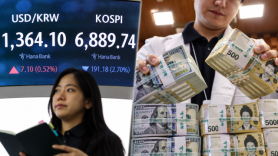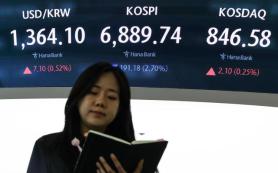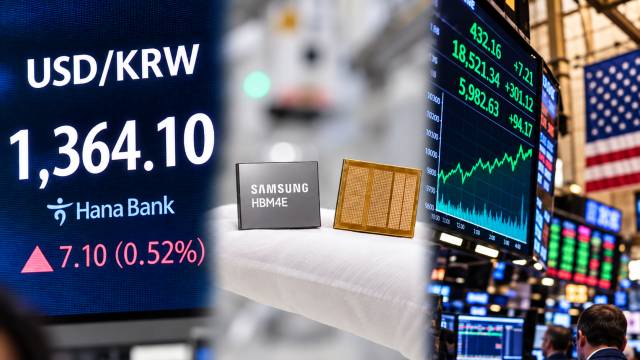
SEOUL, October 7 (AJP) — The South Korean won has held steady for more than a month after a volatile year despite heavy foreign stock selling, renewed Korean investment overseas and advance government payments tied to U.S. investment — offering relief to Koreans planning overseas trips or financing education abroad.
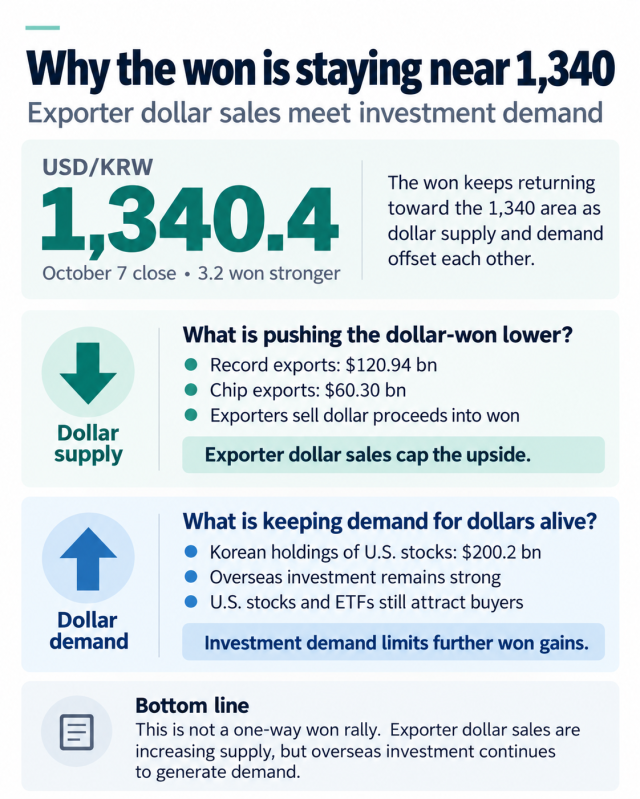
The won closed Wednesday at 1,340.4 per dollar, up 0.9 percent from September and nearly 7 percent from the end of 2025.
The pair has hovered around 1,340 since early September, weathering elevated U.S. Treasury yields, renewed dollar strength, oil prices above $100 a barrel and persistent foreign selling of Korean equities.
Dealers broadly attribute that resilience to dollar sales by cash-rich exporters converting earnings accumulated during months of currency volatility as year-end settlements approach.
“A sizable amount of exporter dollar selling is coming into the market, and that is capping the dollar-won's upside,” an FX official at a regional bank said. “We would need to check exactly which industries the flows are coming from.”
Exporters sell dollars to obtain won for domestic expenses such as wages, taxes and supplier payments, adding foreign-currency supply to the local spot market.
The potential pool of those dollars has expanded sharply alongside Korea’s record exports.
Exports reached $120.94 billion in September and the trade surplus widened to a record $49.85 billion. Semiconductor shipments alone surged 262.8 percent from a year earlier to $60.30 billion, according to the Ministry of Trade, Industry and Resources.
An FX official at a commercial bank said the dominance of chips in the export boom suggested that semiconductor companies accounted for a substantial share of the dollar sales.
“Semiconductors are leading exports, so a substantial share of exporter dollar sales is bound to come from the chip sector,” the official said. “Those flows are clearly easing upward pressure on the dollar-won rate.”
The official stopped short of linking individual transactions to specific semiconductor companies, reflecting dealers’ limited ability to trace the ultimate source of funds moving through the interbank market.
Nor does a record trade surplus translate directly into an equivalent amount of dollars being sold in Seoul.
Exporters can retain earnings in foreign-currency accounts, use them for overseas expenses and investments, hedge future payments or wait for a more favorable exchange rate before converting them into won.
That distinction matters because Korea’s external surplus is only one side of the currency equation.
The Bank of Korea said in an April study that a widening current-account surplus had coexisted with won depreciation for a prolonged period since the second quarter of 2023, as private overseas portfolio investment became increasingly important in the country’s external balance sheet.
Overseas investment creates immediate demand for foreign currency, the central bank has also noted, even if the resulting assets generate income and strengthen Korea’s external position over time.
The tension between cheaper dollars and continued overseas demand is also apparent among Koreans who regularly spend or invest abroad.
Jeon Hyun-a, 52, sends living expenses to her eldest daughter, who is in her final year at a U.S. university. Her two younger children are also preparing for possible study in the United States.
The earlier surge in the dollar-won rate into the 1,500s made those payments particularly painful, she said. The additional currency burden ate into gains she had made on U.S. and Korean AI-related stocks.
“Since around mid-September, the burden of exchanging and sending money has eased a little,” Jeon said.
But the stronger won has not diminished her interest in dollar assets.
She has already bought some dollars and is considering increasing her holdings of dollar-denominated assets, including U.S.-listed exchange-traded funds such as QQQ, with potentially years of overseas education expenses ahead.
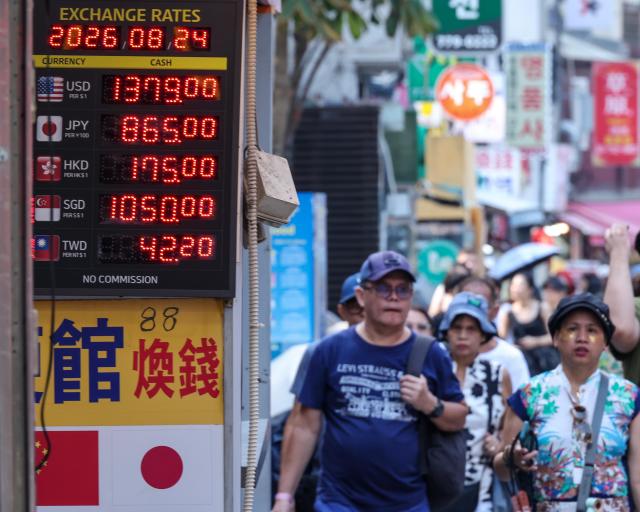
The recent stabilization has made exchanging money less burdensome, although he remains wary of another abrupt rise in the dollar.
“I don't think I would buy dollars outright right now,” Kim said. “But I would consider U.S. stocks, ETFs or other investments that give me dollar exposure.”
Available data do not yet establish whether education remittances, travel-related currency purchases or other household dollar buying have increased since the won strengthened.
Still, cheaper dollars give households with future overseas expenses an incentive to buy foreign currency or acquire dollar-denominated assets.
For now, exporter dollar sales are helping meet demand arising from foreign equity outflows, overseas investment and other transactions. Record export earnings have enlarged the potential supply.
Whether the exchange rate will stay stable for longer cannot be assured, but for families budgeting for tuition or travel, the respite is welcome — and an opportunity to prepare for the next bill.
AJP Takeaways
- The won closed at 1,340.4 per dollar Wednesday and has remained near the 1,340 level since early September despite persistent external headwinds.
- Exporter dollar sales are helping cap the dollar-won's upside, with record semiconductor exports expanding the potential pool of foreign-currency supply.
- Overseas investment remains a major source of dollar demand, suggesting the won's recent resilience does not necessarily point to a one-way appreciation through year-end.

Copyright ⓒ Aju Press All rights reserved.