
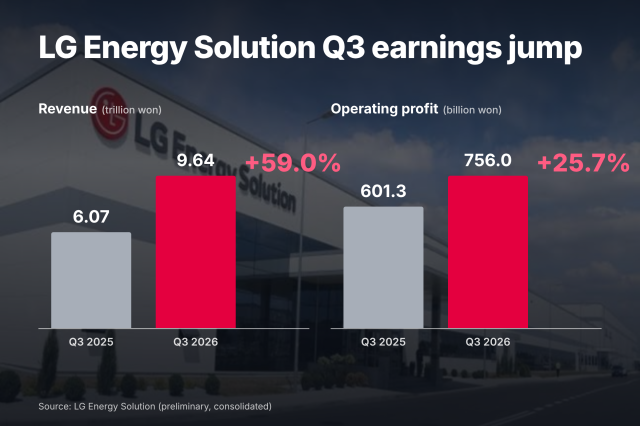
Investors cheered the stronger-than-expected and record third-quarter earnings of LG Energy Solution, with shares on Oct. 8 rising 5.12 percent to 411,000 won as of 9:31 a.m. The stock is up about 41 percent from its low of 290,500 won in late July.
Third-quarter operating profit of 756 billion won was more than double the 326.4 billion won average forecast compiled by FnGuide. U.S. advanced manufacturing tax credits made up 416.9 billion won of that profit. Without them, operating profit was 339.1 billion won, compared with a loss of 127.7 billion won in the second quarter.

Kim Dong-young is a bilingual journalist at AJU Press (AJP), covering Korean tech, energy, and bio/pharma.
He reports from the field at events like CES and APEC, runs AJP's YouTube channels,
and is pursuing a master's at Sogang's MOT program.
Copyright ⓒ Aju Press All rights reserved.
Related News
-
 KOSPI Falls Despite Samsung Electronics' Strong Earnings Report
Samsung Electronics reported earnings that exceeded market expectations, but its stock fell after an initial rise. Following a decline in all three major U.S. stock indices overnight, most of the KOSPI's top market capitalization stocks also showed weakness.As of 9:23 a.m. on October 8, the KOSPI was down 22.90 points (0.44%) at 6,774.26 compared to the previous trading day.In the securities market, foreign and institutional investors sold a net 545 billion won and 234.8 billion won, respectively, while individual investors bought a net 756.9 billion won.Before the market opened, Samsung Electronics announced its preliminary earnings for the third quarter of 2026, reporting sales of 195 trillion won, a 126.6% increase from the same period last year. Operating profit reached 107.4 trillion won, up 782.5% year-on-year.These figures surpassed the previous quarter's record earnings of 171.5 trillion won in sales and 89.5 trillion won in operating profit. Compared to the previous quarter, sales and operating profit increased by 13.7% and 20%, respectively. The operating profit slightly exceeded the consensus estimate of 106 trillion won compiled by financial information provider FnGuide. However, Samsung's stock, which initially rose by over 1% before the opening, was down 0.37%.Most of the top market capitalization stocks were also weak, with SK Square down 1.4%, Samsung Electro-Mechanics down 0.4%, and Hyundai Motor down 2.98%. In contrast, LG Energy Solution rose 5.12%, and SK Hynix increased by 1.2%.At the same time, the KOSDAQ index recorded a drop of 9.56 points (1.06%) to 888.58 compared to the previous trading day.In the KOSDAQ market, individual investors bought a net 170.9 billion won, while foreign and institutional investors sold a net 149.9 billion won and 23.4 billion won, respectively.Among the top market capitalization stocks, EcoPro rose 0.98%, EcoPro BM increased by 2.65%, and JUSUNG Engineering was up 1.01%, while Alteogen fell 6.03% and Rainbow Robotics dropped 2.01%.Overnight, U.S. stock markets closed lower. The Dow Jones Industrial Average finished down 341.41 points (0.66%) at 51,179.87.The S&P 500 index fell 17.16 points (0.22%) to close at 7,801.77, while the Nasdaq Composite dropped 61.20 points (0.22%) to finish at 27,538.69.Long-term U.S. Treasury yields surged to their highest levels in over 20 years, putting pressure on the stock market. The yield on the 10-year Treasury note exceeded 5.36%, marking the highest level since 2002. The 30-year Treasury yield also rose to around 5.73%, the highest in 24 years.Han Ji-young, a researcher at Kiwoom Securities, stated, "Today, despite the easing of the surge in U.S. 10-year Treasury yields and a reduction in the decline of U.S. stocks, the market is expected to show volatility as it digests the preliminary earnings announcement from Samsung Electronics, along with supply and demand issues related to the holiday and options expiration dates."He added, "The focus should be on the changes in stock prices and foreign investor demand immediately after Samsung's preliminary earnings announcement, as well as the changes in profit estimates for 2027, rather than whether the results exceeded consensus expectations."Han emphasized that since this announcement is preliminary, the lack of detailed figures may lead to temporary discrepancies in market interpretations regarding exchange rate impacts and performance by business segment. He also noted that short-term supply and demand issues could arise due to the market closure on Friday and ETF rebalancing on October 8 and 12, as well as options expiration on October 8.* This article has been translated by AI.
-
LG Energy Solution Signs Long-Term Lithium Supply Agreement with Elevra Lithium
LG Energy Solution announced on October 8 that it has signed a long-term supply agreement for lithium ore from Canadian producer Elevra Lithium. Starting at the end of this year, the company will receive a total of 240,000 tons of lithium ore over four years.This amount is equivalent to approximately 30,000 tons of lithium hydroxide, enough to produce batteries for about 700,000 high-performance electric vehicles. The lithium will be sourced from Elevra Lithium's North American Lithium (NAL) mine in Quebec, Canada.Lithium ore is a raw material processed and concentrated from lithium minerals, which is refined into lithium carbonate and lithium hydroxide. Lithium carbonate is primarily used in lithium iron phosphate (LFP) batteries and nickel-cobalt-aluminum (NCA) batteries, while lithium hydroxide is mainly used in high-performance nickel-rich NCA batteries.With this agreement, LG Energy Solution secures the upstream part of the value chain in North America, covering raw materials (lithium ore), materials (lithium carbonate, lithium hydroxide, and cathode materials), and batteries. By securing raw materials at the processing stage, the company expects to respond more flexibly to the fluctuating demand for lithium carbonate and lithium hydroxide based on the electric vehicle and energy storage system (ESS) market conditions.The secured materials will be used at LG Energy Solution's North American battery production facilities. As demand for ESS grows rapidly in North America, driven by the expansion of AI data centers and renewable energy, the company anticipates that this will aid in the production of LFP batteries for ESS.LG Energy Solution has established five ESS production sites in North America, including three standalone plants: the Lansing and Holland plants in Michigan, and the NextStar Energy plant in Ontario, Canada, as well as joint ventures with Honda and GM in Ohio and Tennessee, respectively. The company plans to expand its production capacity for LFP batteries for ESS to over 50 GWh by the end of this year.Lee Kang-yeol, Executive Vice President and Head of the Purchasing Center at LG Energy Solution, stated, "This contract is a significant achievement in strengthening the North American raw material supply chain and responding to the rapidly growing North American battery market. Based on a stable supply of lithium ore, we will enhance the stability and flexibility of our supply chain and respond more quickly to customer demand."Meanwhile, LG Energy Solution reported a 10.5% increase in revenue for the first half of this year, totaling 14.1152 trillion won compared to the same period last year. The shift in production capacity from electric vehicle batteries to ESS batteries has resulted in a 4.6-fold increase in ESS-related sales compared to the same period last year, expanding its share of total revenue to the upper 20% range.* This article has been translated by AI.
-
Samsung Electronics Reports Record Q3 Operating Profit of 107.4 Trillion Won
Samsung Electronics, which holds a significant share of the domestic market, is expected to influence the KOSPI's direction following the announcement of its earnings that slightly exceeded market expectations.According to a disclosure made on October 8 by the Financial Supervisory Service's electronic disclosure system (DART), Samsung Electronics reported a preliminary operating profit of 107.4 trillion won for the third quarter of 2026, a staggering 782.5% increase compared to the same period last year. Revenue reached 195 trillion won, marking a 126.6% year-on-year rise.These figures surpass the previous record set in the second quarter of 2026, which reported revenue of 171.5 trillion won and an operating profit of 89.5 trillion won. Compared to the previous quarter, revenue and operating profit increased by 13.7% and 20%, respectively. The operating profit also slightly exceeded the consensus estimate of 106 trillion won compiled by financial information provider FnGuide.Market reactions are being closely monitored, as analysts suggest that Samsung's performance could lead to a stable upward trend in stock prices and the KOSPI index.The domestic stock market is also expected to rise, buoyed by strong performances in U.S. AI-related stocks and easing macroeconomic pressures from interest rates and oil prices. As of 8:43 a.m. on the NXT pre-market, shares of Samsung Electronics (up 1.68%), SK Hynix (up 0.81%), SK Square (up 1.14%), Samsung Electro-Mechanics (up 1.87%), LG Energy Solution (up 2.94%), and Hyundai Motor (up 0.30%) are all showing gains.In the KOSPI, a wait-and-see approach was observed leading up to Samsung's earnings announcement. The KOSPI closed at 6,803.90, down 137.49 points (1.98%) from the previous trading day. The index opened at 6,864.25, down 77.14 points (1.11%), and although it briefly reduced its losses, it ultimately fell further.While individual investors made a net purchase of 25.57 billion won, foreign and institutional investors sold a net 26.08 billion won and 6.68 billion won, respectively, contributing to the index's decline.U.S. markets closed lower overnight, with the Dow Jones Industrial Average falling 341.41 points (0.66%) to finish at 51,179.87. The S&P 500 dropped 17.16 points (0.22%) to close at 4,801.77, and the Nasdaq Composite fell 61.20 points (0.22%) to end at 27,538.69.The rise in U.S. Treasury yields, reaching their highest levels in over 20 years, has added pressure to the stock market. The yield on the 10-year Treasury note surpassed 5.36%, marking the highest level since 2002. The 30-year yield also rose to around 5.73%, the highest in 24 years.Recent increases in U.S. Treasury yields are linked to inflation concerns stemming from rising international oil prices and apprehensions regarding increased government spending.However, strong demand was confirmed in a $39 billion auction of 10-year Treasury notes conducted by the U.S. Treasury, leading to a retreat in yields from their intraday highs. Following the auction, the 10-year yield fell to around 5.28%. The auction yield was recorded at 5.3%, the highest since 2000.Han Ji-young, a researcher at Kiwoom Securities, stated, "Today, we expect volatility in the market as it digests the strong demand for U.S. 10-year Treasury notes and the reduced losses in U.S. stocks, alongside the preliminary results from Samsung Electronics, holiday effects, and option expiration issues."She added, "The focus should be on the changes in stock prices and foreign investor demand immediately following Samsung's preliminary results, as well as adjustments to profit estimates for 2027, rather than just whether the results exceeded consensus expectations."Han emphasized that since this is a preliminary report, the lack of detailed figures may lead to temporary discrepancies in market interpretations regarding exchange rate impacts and performance across different business segments. She also noted that short-term supply issues could arise due to the market closure on Friday and ETF rebalancing on October 8 and 12, as well as the option expiration date on October 8.* This article has been translated by AI.