
SEOUL, October 13 (AJP) - A team from Sookmyung Women's University, Seoul National University and battery maker Samsung SDI developed a way to keep lithium growing evenly inside anode-free batteries.
These batteries are a next-generation design that packs more energy into the same space, but they tend to wear out early.
An anode-free battery has no separate anode material. During charging, lithium from the cathode travels across the cell and plates directly onto a thin copper foil, called the current collector, as a layer of metal.
Removing the conventional anode saves space and weight. That is why the design has drawn attention as a route to higher energy density.
The weak point is how that lithium grows. When it builds up unevenly, it forms branching structures called dendrites.
Dendrites react with the liquid electrolyte and use up the lithium the battery needs to hold charge, which shortens the battery's life.
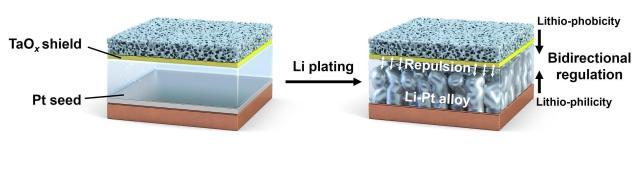
The researchers attacked the problem from two directions at once. On the copper foil, they added a platinum layer about 50 nanometers thick.
Platinum attracts lithium, so lithium spreads evenly across the foil from the start.
Facing the foil is the separator, a thin membrane that keeps the battery's two electrodes apart. On its surface, the team applied a layer of amorphous tantalum oxide about 70 nanometers thick.
Amorphous means the material has no regular crystal structure. Lithium does not readily spread across this layer, so the layer keeps lithium from rising in local spikes and steers it to grow sideways into a dense sheet.
Each coating is roughly a thousandth the thickness of a human hair.
The second layer made the difference. When the researchers coated only the copper foil with platinum, its effect faded as the lithium grew thicker.
With both coatings in place, the lithium stayed dense and uniform through its full depth, even under high-capacity conditions in which large amounts of lithium build up.
The team confirmed the difference with electron microscopy and three-dimensional X-ray imaging. Computer simulations supported their explanation of how tantalum oxide limits contact with lithium.
Oh Ji-hoon, an assistant professor in Sookmyung's Department of Chemical and Biological Engineering, said the work "presents a design strategy that controls the growth of the entire lithium layer, going beyond the current collector surface where lithium first accumulates."
He said the team expects the approach, once extended to other combinations of materials that differ in how strongly they attract lithium, to help improve the lifespan and stability of high-capacity anode-free batteries.
Sookmyung's announcement did not give cycle-life figures, such as how many charge cycles the cells lasted or how much capacity they kept. It also did not describe tests in commercial-format cells.
Samsung SDI, the Samsung group's battery affiliate, took part through its own researchers.
The paper was published in Advanced Functional Materials, with Oh and Seoul National University (SNU) professors Jung Yoo-sung and Choi Jang-wook as co-corresponding authors.
[Reference Information]
Journal/Source: Advanced Functional Materials (IF 19.9, JCR top 4.2%)
Title: Dual-Sided Regulation of Lithium Deposition for High-Energy-Density Anode-Less Lithium Metal Batteries
Link/DOI: https://doi.org/10.1002/adfm.78958

Copyright ⓒ Aju Press All rights reserved.