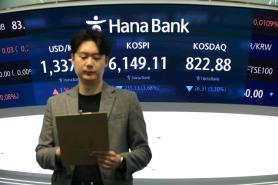
The benchmark KOSPI tumbled 5.46 percent to close at 6,035.35, marking its steepest decline since Aug. 19, when it fell 5.80 percent. The index opened 3.10 percent lower at 6,186.08 and plunged as much as 7.41 percent to an intraday low of 5,911.11 before paring losses late in the session.
Foreign investors offloaded a net 4.53 trillion won (US$3.4 billion) worth of KOSPI-listed shares, marking their heaviest selling since the market rout on July 28. Retail investors bought a net 2.25 trillion won, while institutional investors purchased 1.69 trillion won, but their combined buying failed to offset the foreign selloff. Decliners outnumbered advancers 630 to 247.
The losses were led by the country's two largest chipmakers, as concerns over the sustainability of AI-driven earnings and intensifying competition from Chinese memory chipmakers weighed on investor sentiment.
Samsung Electronics closed the session 6.79 percent lower at 233,500 won, while SK hynix plunged 9.47 percent to 1,453,000 won after briefly falling more than 10 percent intraday. Both extended their losses in after-hours trading, with Samsung slipping to 233,000 won, down 6.99 percent from the previous close, and SK hynix falling to 1,452,000 won, down 9.53 percent, as of around 4:30 p.m.
Foreign investors sold a net 2.36 trillion won of SK hynix shares and 1.36 trillion won of Samsung Electronics, making them the two most heavily sold stocks on the main bourse.
The concerns intensified after China's ChangXin Memory Technologies (CXMT) announced plans to introduce server DRAM using a new memory-cell structure by the end of the year. The technology could increase chip density and lower production costs, raising fears of greater pricing pressure on South Korean chipmakers.
The selloff was further compounded by weakening corporate buying demand. Samsung Electronics has completed its share repurchases for employee compensation, while SK hynix's buyback and cancellation program is nearing completion, reducing a source of demand that had helped support their share prices.
Foreign selling was particularly heavy in the KOSPI's electrical and electronics sector. They sold a net 4.26 trillion won of shares in the sector, while retail investors purchased 2.58 trillion won and institutions bought 1.09 trillion won. Other corporations recorded net purchases of just 574.5 billion won.
Other technology shares also suffered steep losses in after-hours trading. SK Square, the investment holding company and largest shareholder of SK hynix, tumbled 11.99 percent to 866,000 won as of 4:37 p.m., while Samsung Electro-Mechanics, a supplier of electronic components, dropped 7.94 percent to 1,369,000 won. Samsung Electronics' preferred shares lost 6.42 percent to 174,800 won.
The weakness extended to automakers, financial companies and insurers as well. Hyundai Motor fell 2.81 percent to 311,000 won, while KB Financial Group edged down 0.49 percent to 162,000 won. Samsung Life Insurance dropped 5.05 percent to 254,000 won.
Battery and biotechnology shares were relatively less affected. LG Energy Solution gained 2.64 percent to 408,500 won following its stronger-than-expected preliminary third-quarter earnings, supported by demand for energy storage systems (ESS). Samsung Biologics edged up 0.33 percent to 1,205,000 won.
Amid the sharp decline, a sell-side trading curb was activated at 9:47 a.m., temporarily suspending program sell orders on the KOSPI. It was the first such activation since Aug. 19 and the 26th this year.
The KOSDAQ also finished lower, though its losses were more limited than those of the main bourse. The junior index fell 1.43 percent to 837.03. Retail investors sold a net 191.1 billion won, while foreign investors bought 137.5 billion won and institutions purchased 43.7 billion won.
Among semiconductor equipment makers, Jusung Engineering, which produces equipment used to deposit thin films during chip manufacturing, rose 3.56 percent to 262,000 won as of 4:37 p.m. Wonik IPS, another chipmaking equipment supplier, edged up 0.08 percent to 131,000 won.
Battery-related stocks remained mixed. EcoPro BM, a producer of cathode materials for rechargeable batteries, declined 3.29 percent to 111,800 won, while its parent company EcoPro slipped 0.36 percent to 83,800 won.
Biotechnology and robotics shares also weakened. Alteogen, a developer of drug-delivery technologies for biologic medicines, fell 3.67 percent to 223,000 won, while Rainbow Robotics, a developer of industrial and collaborative robots, dropped 2.43 percent to 381,500 won.
In currency trading, the South Korean won weakened to 1,342.5 per dollar, compared with 1,335.1 at the previous close.
Investors will now turn to U.S. consumer price data due Wednesday and upcoming corporate earnings for signs of whether sentiment can recover. Attention will also turn to Samsung Electronics' third-quarter results, scheduled for Oct. 29, for clues to the sustainability of AI-driven chip profits.
Asian markets elsewhere closed mixed. Japan's Nikkei 225 fell 1.82 percent to 67,777.52, while China's Shanghai Composite edged up 0.10 percent to 3,800.86. Hong Kong's Hang Seng Index gained 0.30 percent to 24,345.22.

Copyright ⓒ Aju Press All rights reserved.