SEOUL, October 15 (AJP) - The head of South Korea's parliamentary defense committee warned Thursday that relocating a major military air base to make way for a massive semiconductor manufacturing complex must not compromise national security or military readiness, as President Lee Jae Myung's administration accelerates plans to establish a new chipmaking hub in the country's southwest.
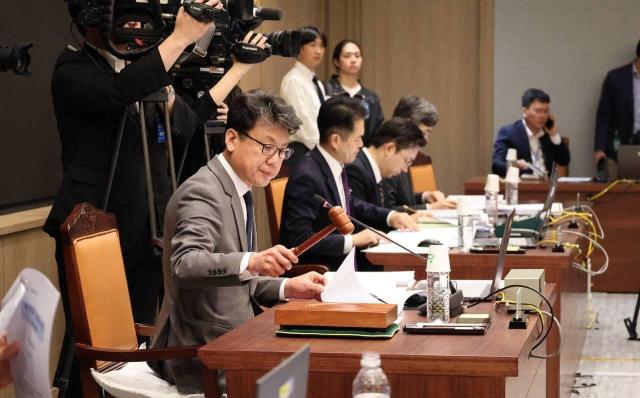
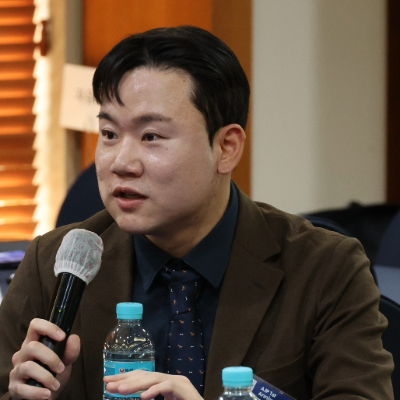
Rep. Jin Seong-joon, a lawmaker from the ruling Democratic Party and chair of the National Assembly's National Defense Committee, made the remarks during an on-site inspection of the Air Force's 1st Fighter Wing in Gwangju, where the government plans to develop the Honam semiconductor cluster.
"There must not be even the slightest gap in national security or military readiness during the relocation of Gwangju's military air base and the temporary redeployment of its forces," Jin said.
He described the semiconductor project as an important initiative for strengthening South Korea's advanced industrial competitiveness and promoting regional development, while emphasizing the challenges involved in relocating an operational military installation.
"This is not simply a matter of moving a military unit. It requires comprehensive consideration of military readiness, operational activities, pilot training and coexistence with local communities," Jin said.
The committee inspected the base's runways, major equipment and other military facilities as part of its annual parliamentary audit. Most of the inspection was conducted behind closed doors.
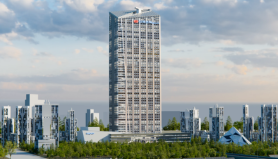
The visit comes as the Lee administration presses ahead with plans to transform the Gwangju air base into a semiconductor manufacturing hub, a central component of its broader strategy to expand industrial investment beyond the Seoul metropolitan area.
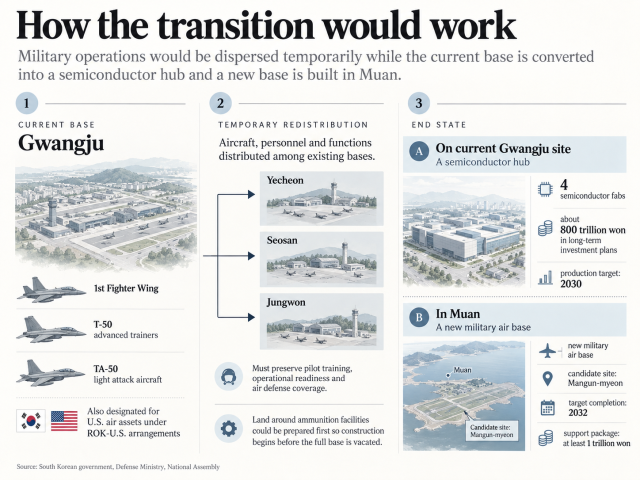
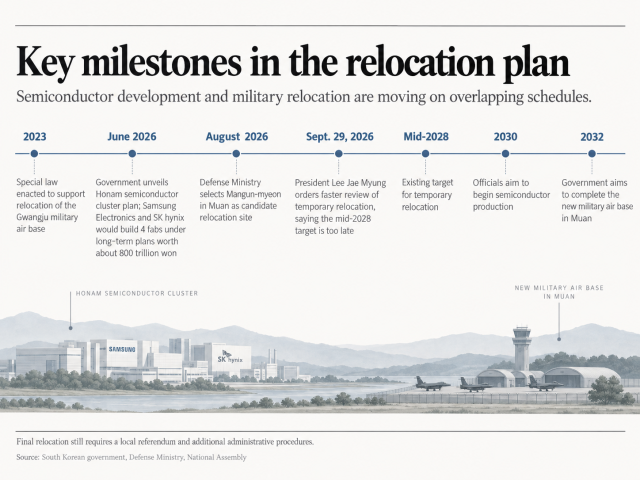
In June, the government unveiled plans for Samsung Electronics and SK hynix, two of the world's leading memory-chip manufacturers, to build four semiconductor fabrication plants, or fabs, in the Honam region under long-term investment plans valued at roughly 800 trillion won ($593 billion).
The government subsequently designated approximately 8.3 million square meters of land occupied by the Gwangju military air base as a candidate site for a national industrial complex.
Officials aim to begin semiconductor production at the new complex in 2030, although the schedule depends heavily on relocating military facilities and securing the electricity and industrial water required to operate the factories.
The government intends to begin preparing land currently occupied by military ammunition facilities before the entire air base is vacated, allowing semiconductor construction and military relocation work to proceed simultaneously.
The relocation has become an increasingly urgent issue for the administration.
At a government meeting on Sept. 29, Lee ordered the Defense Ministry to review ways to accelerate the temporary relocation of military operations, saying the existing target of mid-2028 was too late.
The military has been preparing to temporarily distribute the 1st Fighter Wing's personnel, aircraft and functions among existing air bases in Yecheon, Seosan and Jungwon, near Chungju, before completing a permanent relocation.
The wing operates T-50 advanced jet trainers used to prepare fighter pilots, as well as TA-50 light attack aircraft assigned to operational and training missions.
The planned redistribution has raised questions about whether the military can maintain pilot training schedules, operational readiness and air defense coverage while accommodating additional aircraft at other bases.
Gwangju is also one of the facilities designated for the deployment of American air assets under ROK-U.S. military arrangements, making coordination with Washington another consideration in the relocation process.
The longer-term destination is Muan, southwest of Gwangju, where the Defense Ministry selected the Mangun-myeon area as a candidate relocation site in August. The government aims to complete the new military air base by 2032.
The selection does not constitute final approval. The relocation process still requires a local referendum and additional administrative procedures.
Moving the air base has been a longstanding regional controversy, with residents of potential host communities expressing concerns about aircraft noise, environmental disruption and compensation.
South Korea enacted special legislation in 2023 to facilitate the relocation of the Gwangju military air base, including provisions for government financial support. The government has since outlined a support package worth at least 1 trillion won for Muan as part of efforts to secure local consent.
The semiconductor project has added economic urgency to a relocation effort that had struggled for years to overcome disagreements among local authorities and residents.
On Oct. 9, SK Group Chairman Chey Tae-won visited the proposed semiconductor site alongside local officials and SK hynix executives, expressing his intention to accelerate construction in response to rapidly growing demand for memory chips.
Chey said the company was reviewing how quickly it could begin construction, even if supporting infrastructure such as electricity and water facilities was not yet fully completed.
Defense Minister Kang Shin Chul also visited the Gwangju base on Wednesday, instructing military commanders to maintain air defense readiness while carrying out the relocation and supporting the government's industrial development initiative.
Jin said Thursday that the Defense Committee would continue monitoring preparations to ensure that national security and regional economic development could advance without undermining each other.
Copyright ⓒ Aju Press All rights reserved.