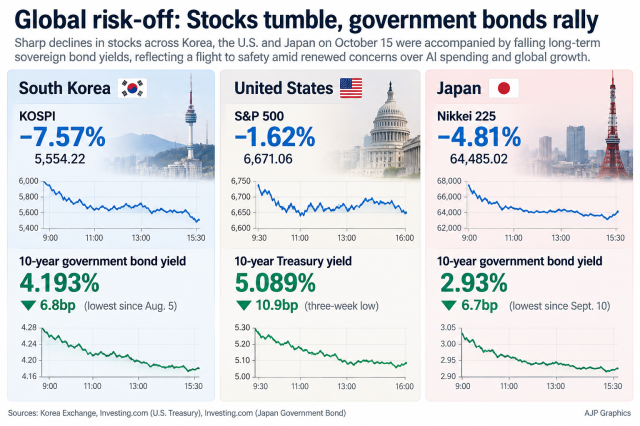
The three-year Korean government bond yield closed Thursday 1.6 basis points lower at 3.867 percent, while the 10-year yield fell 6.8 basis points to 4.193 percent, its lowest since Aug. 5.
The 20-year and 30-year yields dropped 5.9 and 4.9 basis points to 4.237 percent and 4.289 percent, respectively. Longer-dated bonds outperformed, narrowing the gap between short- and long-term yields. Bond prices rise as yields fall.
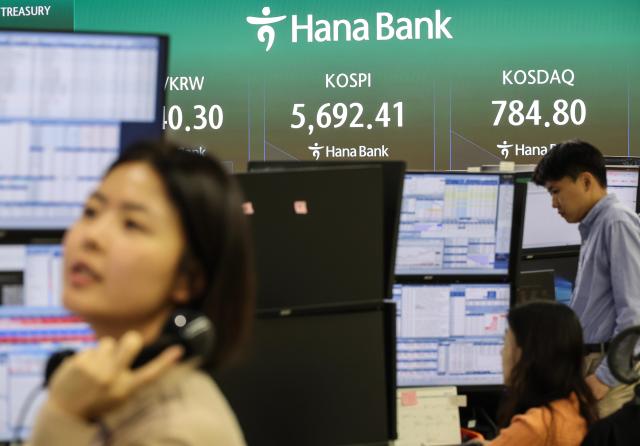
The rally came as Korean stocks suffered another steep selloff. The KOSPI finished down 7.57 percent at 5,554.22 and the KOSDAQ lost 7.65 percent to 760.82 after trading curbs were triggered in both markets.
Foreign investors sold a net 3.62 trillion won ($2.7 billion) of KOSPI shares, while institutions and retail investors bought a net 1.69 trillion won and 1.29 trillion won, respectively.
Similar moves unfolded overseas. The benchmark U.S. 10-year Treasury yield fell to about 5.09 percent in Asian trading and the 30-year yield to around 5.45 percent, both reaching three-week lows.
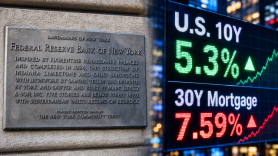
The reversal was notable because stronger-than-expected U.S. inflation had initially pushed Treasury yields sharply higher.
Consumer prices rose 3.7 percent from a year earlier in September, reviving expectations of another Federal Reserve rate increase and briefly sending the 10-year yield above 5.3 percent.
Yields subsequently retreated as the selloff in AI and technology shares deepened, strengthening demand for government debt as investors reduced exposure to riskier assets.
Japanese markets showed the same pattern. The Nikkei 225 closed down 4.81 percent at 64,485.02. Around the Tokyo close, the benchmark 10-year Japanese government bond yield was near 2.93 percent, its lowest since Sept. 10, while the 20-year yield stood around 3.80 percent, also its lowest since Sept. 10, and the 30-year yield near 3.99 percent.
The simultaneous gains in Korean, Japanese and U.S. sovereign debt pointed to a broader retreat from risk across global markets.
Jo Yong-gu, an analyst at Shin Young Securities, said earlier this week that investors were increasingly questioning whether long-term yields in the U.S. and other developed markets had passed their peaks.
“Strong tax revenue was also creating room for reduced Korean government bond issuance, while a more stable won was reinforcing favorable bond-market conditions,” he said.
“U.S. yields, which had been surging, are showing signs of pausing,” said Eugene Investment & Securities analyst Kim Ji-na.
Kim said most of the bearish factors that had pushed yields higher appeared to be reflected in prices, adding that “at current levels, yields are historically attractive.”
She cautioned against interpreting the rally as the start of a sustained decline in yields, however, citing lingering uncertainty and the need to manage short-term volatility.
Retail investors had been rebuilding bond exposure well before the gloomy week.
Individuals bought a net 27.8 trillion won of over-the-counter bonds from the start of the year through Oct. 12, equivalent to about 88 percent of their purchases for all of last year, according to Korea Financial Investment Association data.
Net purchases reached 4.02 trillion won in September, up about 816 billion won from August and the highest monthly total this year. The figures indicate that higher yields were already drawing individuals toward fixed-income assets before this week’s turmoil.
Risks to the rally remain. Persistent inflation, elevated energy prices and further monetary tightening could push global yields higher again. Investors are also awaiting the Bank of Korea’s Oct. 22 policy meeting after consecutive rate increases in July and August.
For now, government debt is regaining some of its traditional appeal as a hedge against falling stocks, after months in which rising long-term yields were themselves a source of market stress.

Copyright ⓒ Aju Press All rights reserved.