

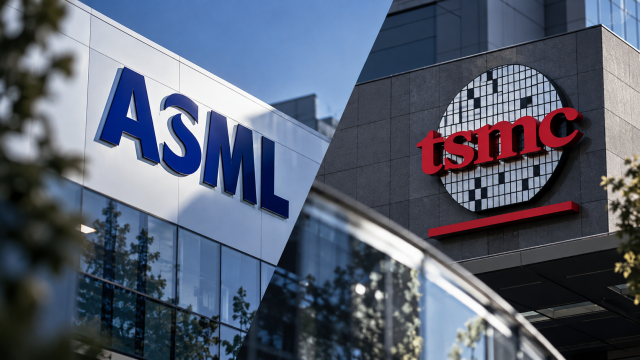
SEOUL, October 15 (AJP) - Contrary to the panicky selloff in chip stocks over fears of an overhyped AI boom, stellar earnings and bullish guidance from Taiwan’s TSMC and Dutch equipment maker ASML suggest the chip binge is far from over.
Samsung Electronics dropped 9.91 percent to 209,000 won Thursday, while SK hynix plunged 11.56 percent to 1,255,000 won. Yet results from the world’s largest contract chipmaker and the sole supplier of extreme ultraviolet lithography systems pointed to demand stretching years into the future.
The back-to-back results carry mixed implications for South Korean chipmakers. Expanding AI processor production could sustain demand for high-bandwidth memory, or HBM, supplied by Samsung and SK hynix. But TSMC’s growing strength in advanced manufacturing and packaging raises the stakes for Samsung’s foundry ambitions.
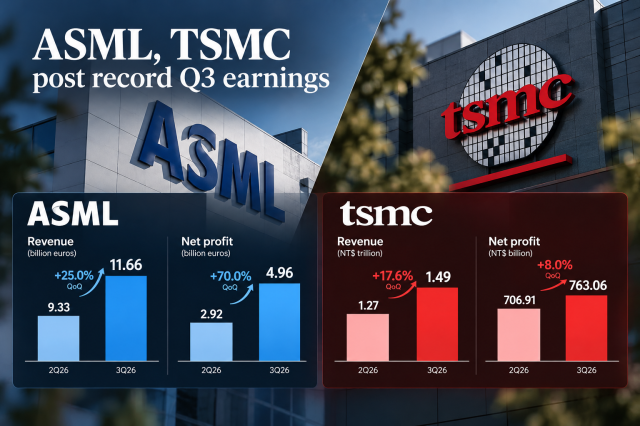
ASML reported third-quarter revenue of 11.66 billion euros ($13.1 billion), up 55.2 percent from a year earlier and 25 percent from the previous quarter.
Net profit more than doubled year-on-year to 4.96 billion euros, jumping 70 percent from the second quarter. The company raised its full-year revenue guidance to between 44 billion and 45 billion euros.
Chief Executive Christophe Fouquet said customers were already discussing equipment orders for 2029 and 2030, indicating that chipmakers are planning capacity well beyond the current wave of AI spending.
TSMC delivered a similarly strong outlook Thursday.
Its third-quarter revenue reached NT$1.49 trillion ($46.7 billion), up 50.9 percent year-on-year and 17.6 percent from the previous quarter.
Net profit rose 68.7 percent from a year earlier and 8 percent quarter-on-quarter to a record NT$763.06 billion ($23.6 billion), beating an LSEG SmartEstimate of NT$746.3 billion.
High-performance computing, which includes AI-related chips, accounted for 68 percent of revenue. TSMC forecast fourth-quarter sales of $52.3 billion to $54.3 billion and raised its full-year revenue growth outlook to around 44 percent.
“The demand is extremely robust, and we did not see any sign of slowdown,” Chairman and CEO C.C. Wei said during the earnings call. The gap between demand and available manufacturing capacity remained substantial, he added.
TSMC maintained its 2026 capital expenditure budget at $60 billion to $64 billion. Chief Financial Officer Wendell Huang said investment from 2026 through 2028 would be significantly higher than in the preceding three years.
For Samsung and SK hynix, the outlook supports expectations of sustained HBM demand as Nvidia, AMD and other chip designers expand AI accelerator production. ASML’s equipment outlook also points to continued investment in EUV technology for advanced DRAM manufacturing.
The implications are more challenging for Samsung’s foundry business, which competes directly with TSMC for advanced chipmaking contracts.
TSMC said processes of 7 nanometers and below accounted for 79 percent of third-quarter wafer revenue, including 33 percent from 3-nanometer chips and 8 percent from its newer 2-nanometer technology. It expects 2-nanometer capacity to more than double in 2027.
Its advanced packaging capabilities add another competitive hurdle. TSMC’s CoWoS technology integrates AI processors with HBM, making packaging an increasingly important part of its offering to chip designers.
Samsung is seeking to compete through its combined memory, foundry and packaging operations. Wei, however, emphasized TSMC’s lead in producing increasingly large chip packages.
“We are in the real-world production of five-times reticle size. I don’t believe that anybody can do that today except TSMC,” he said.
Expansion carries costs. TSMC’s gross margin slipped 1.3 percentage points from the previous quarter to 66.4 percent, partly reflecting the initial ramp-up of 2-nanometer production.

Copyright ⓒ Aju Press All rights reserved.
