
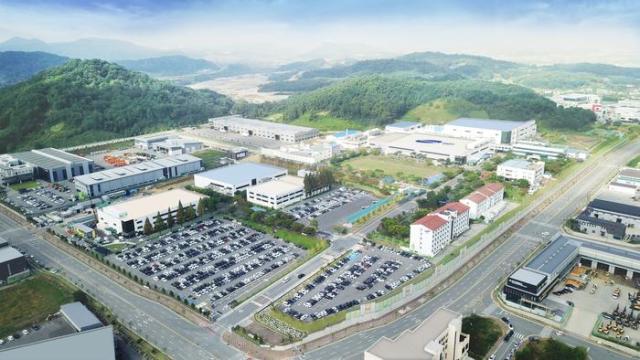
SEOUL, October 16 (AJP) - SK Trichem, a semiconductor materials maker under SK Group, is seeking to expand its operations in Sejong, where Samsung Electro-Mechanics is also pursuing a multibillion-dollar factory expansion, according to the city government Friday.
SK Trichem, which produces precursors used in semiconductor manufacturing, submitted its expansion plans to Sejong officials last month. The company is seeking additional land and infrastructure near its existing facility in the Myeonghak Industrial Complex.
With no vacant land remaining inside the complex, the company is considering acquiring adjacent property to the north, which could subsequently be designated as industrial land. The investment amount and expansion scale have yet to be disclosed.
Meanwhile, Samsung Electro-Mechanics is moving ahead with its own expansion in the same industrial complex after announcing plans to invest more than 8 trillion won ($5.6 billion) in its Sejong operations.
The company disclosed an initial investment of 4.27 trillion won last month and is exploring additional land purchases for a second phase of expansion.
Sejong has also approved an increase in industrial water supply to Samsung Electro-Mechanics' plant, from about 13,272 tons to 25,272 tons per day, to support the planned expansion.
The parallel investment plans could strengthen Sejong's position as a semiconductor manufacturing and materials hub, although SK Trichem's project remains in the early planning stage.

Candice Kim
Candice Kim is a dedicated business and technology reporter specializing in the intersection of high-tech innovation and fast-paced consumer trends. Her core beats span the semiconductor, IT, cosmetics, and retail sectors, where she provides in-depth coverage of industry titans including Samsung Electronics, SK hynix, and LG Electronics, alongside leading consumer brands like Olive Young and Musinsa. Whether analyzing complex silicon supply chains or tracking the latest shifts in beauty and fashion retail, Candice is committed to delivering sharp, accurate reporting that keeps readers informed on the forces shaping today's most dynamic markets.
Copyright ⓒ Aju Press All rights reserved.
Related News
-
 Panic in Stock Market Fuels Fear of Forced Liquidation, Surging to 89.3 Billion Won
The stock market has plummeted to the mid-5,000s, deepening the concerns of individual investors. Those who borrowed to invest in stocks are now facing fears of forced liquidation. The margin loan balance has exceeded 33 trillion won, with daily forced liquidation amounts nearing 90 billion won. There are growing worries about a vicious cycle where falling stock prices lead to forced liquidations, which in turn drive prices down further.According to the Korea Financial Investment Association, as of October 14, the total margin loan balance in the KOSPI and KOSDAQ markets was recorded at 33.7 trillion won. After peaking at over 38 trillion won in June, the balance dropped to the 27 trillion won range in early August but has since increased, recovering to over 34 trillion won by October 12. Although the balance slightly decreased on the 14th, it remains at a high level.As the stock market continues to decline, fears of forced liquidation among investors are escalating. The KOSPI, which started the month above 6,900, has been on a downward trend since October 6. On the 14th, it fell by over 7% during trading, dropping to the 5,500 range. When stock prices fall, the collateral value of stocks used for margin loans also decreases. If the collateral ratio falls below the standards set by brokerage firms, investors must provide additional collateral. Failure to do so may result in forced liquidation of their holdings.The scale of forced liquidations is rapidly increasing. The amount of forced liquidation, which was around 6.4 billion won on October 8, rose to 27.1 billion won on the 12th and 59.4 billion won on the 13th, reaching 89.3 billion won on the 14th. This marks an increase of approximately 78.4 billion won compared to a month ago on September 14 (10.9 billion won), representing a 719% increase. The proportion of forced liquidation amounts within the total margin loans also rose from 1.1% to 7.2% during the same period, an increase of 6.1 percentage points.Additionally, the margin debt from entrusted trading is also on the rise. As of October 14, the margin debt stood at 1.3575 trillion won, up 9.3% from 1.2415 trillion won on the previous trading day, October 13. The margin debt, which had been below 1 trillion won on October 7 and 8 (931.6 billion won and 991.5 billion won, respectively), has surpassed 1 trillion won this week and continues to increase. Margin debt refers to the amount that investors owe for stocks purchased but not yet paid for by the settlement date. If the amount is not repaid within the deadline, brokerage firms can forcibly liquidate the stocks in question.A representative from the financial investment industry stated, "As the domestic stock market experiences a sharp decline, investor anxiety is also growing. It is essential to manage investment sizes within manageable levels to reduce risk exposure."Amid the stock market's sharp decline, inverse products betting on falling stock prices saw double-digit gains across the board. The 'SOL SK Hynix Futures Single Stock Inverse 2X' surged by 21.36%, leading the day's gains. Other notable performers included 'PLUS Samsung Electronics Futures Single Stock Inverse 2X' (20.34%), 'TIGER 200 Futures Inverse 2X' (16.67%), 'PLUS 200 Futures Inverse 2X' (16.49%), and 'RISE 200 Futures Inverse 2X' (16.00%), all showing significant increases.* This article has been translated by AI.
-
KOSPI and KOSDAQ Plunge 7% Amid Market Panic
◆아주경제 주요뉴스▷코스피·코스닥 7% 동반 급락…'패닉'에 빠진 증시- On October 15, the KOSPI closed at 5,554.27, down 454.59 points (7.57%) from the previous trading day. The KOSDAQ also fell by 63.06 points (7.65%) to finish at 760.82. Both markets triggered circuit breakers simultaneously.- The KOSPI has dropped more than 20% in the past ten days since October 6. Its market capitalization shrank from approximately 577.5 trillion won on October 2 to 458.1 trillion won, erasing about 119.4 trillion won.- The sharp decline in the stock market is attributed to concerns over the profitability of artificial intelligence (AI) companies and the potential for further interest rate hikes due to rising inflation in the U.S. The U.S. Consumer Price Index (CPI) for September rose 3.7% year-over-year, exceeding market expectations of 3.6%.- Major semiconductor stocks also experienced significant losses, with Samsung Electronics down 9.91%, SK Hynix down 11.06%, SK Square down 10.45%, and Samsung Electro-Mechanics down 15.50%.- On this day, foreign investors sold a net 4.8098 trillion won in the securities market, while individuals and institutions bought a net 2.1802 trillion won and 1.9585 trillion won, respectively. Experts predict continued high volatility in the market ahead of earnings reports from major U.S. tech companies and the Federal Open Market Committee (FOMC) meeting.◆주요 리포트▷미국 9월 CPI, 인플레이션 경계 지속 - The U.S. CPI for September rose 3.7% year-over-year, surpassing both the previous month’s increase of 3.4% and market expectations of 3.6%. Month-over-month, it increased by 0.6%, up from 0.4% the previous month. Core CPI also rose 2.6% year-over-year, exceeding the forecast of 2.5%, indicating persistent inflationary pressures.- The surge in energy prices, driven by rising international oil prices, led to the increase in overall prices. Energy prices rose 5.2% month-over-month, with gasoline prices up 9.1%. Notably, the rise in gasoline prices accounted for more than half of the total CPI increase, while food prices remained stable compared to the previous month.- Core inflation also showed upward pressure from housing costs and some service and goods prices. Housing costs rose 0.4% month-over-month, with increases in hotel and lodging costs (2.0%), airfares (1.2%), and education costs (0.6%). However, considering the impact of volatile items and the slowdown in wage growth, it is too early to conclude that there is a fundamental re-acceleration of inflation.- The slowdown in the Zillow rental index, a leading indicator of housing costs, has stabilized, and core service prices excluding housing have rebounded, suggesting that the pace of future price declines may be limited. Particularly, if international oil prices (WTI) remain around $90 per barrel, the ripple effects of energy prices and base effects will continue to exert upward pressure on prices, and the U.S. Federal Reserve's concerns about inflation are expected to persist for the time being.◆장 마감 후(15일) 주요공시 ▷한화엔진, 삼성중공업과 1323억원 규모의 선박용 엔진 공급계약 체결▷한전KPS, 한국전력공사와 963억원 규모의 2026년 가공송전 순시점검 위탁공사 계약 체결▷우리산업, 자동차 부품사 일렉스 지분 100% 578억4791만원에 양수 결정◆펀드 동향(14일 기준, ETF 제외) ▷국내 주식형: 766억원▷해외 주식형: 22억원 ◆오늘(16일) 주요일정▷한국: 수출입물가지수(9월)▷유로존: 소비자물가지수(9월 확정)▷미국: 수출입물가지수(9월), 산업생산(9월), TIC 국제자본동향(8월)* This article has been translated by AI.
-
U.S. Stock Market Rallies as Treasury Yields Fall; Samsung, SK Hynix Gain in Pre-Market
The three major U.S. stock indices closed higher, buoyed by falling Treasury yields and strength in non-tech stocks. Following a more than 7% drop in the domestic market the previous day, a rebound is expected as buying interest returns. Notably, Samsung Electronics and SK Hynix saw gains of over 3% in pre-market trading, raising hopes for a recovery in semiconductor stocks.On October 15, the Dow Jones Industrial Average rose by 556.21 points (1.08%) to close at 52,177.69. The S&P 500 increased by 25.12 points (0.33%) to finish at 7,744.06, while the Nasdaq Composite gained 20.16 points (0.08%) to end at 26,713.03.The decline in U.S. Treasury yields supported the stock market's rise, with the yield on the 10-year Treasury note falling to 5.086%, marking its largest single-day drop since August 1. As buying interest shifted to sectors that had been relatively neglected, companies like Nike (up 5.21%), Home Depot (up 4.31%), and Walmart (up 1.46%) performed well.However, concerns about overheating in AI-related investments and credit risks persisted. Despite strong revenue growth from Anthropic and record earnings from Taiwan's TSMC, worries about the profitability of AI investments continued. The Philadelphia Semiconductor Index dropped as much as 4.39% during the day before closing down 0.88%.Inflationary pressures also weighed on the market. The U.S. Producer Price Index (PPI) for September rose by 1.3% from the previous month, significantly exceeding market expectations of 0.6%. Earlier, the Consumer Price Index (CPI) also surpassed forecasts, raising concerns about the Federal Reserve's potential for further tightening.The domestic market is expected to see a rebound as buying interest returns following the previous day's sharp decline. The MSCI Korea ETF fell by as much as 6.33% during the day but reduced its losses to close down 2.26%. KOSPI night futures rose nearly 4%, boosting expectations for a rebound.In the NXT pre-market on October 16, major large-cap stocks showed strength. As of 8:04 a.m., Samsung Electronics and SK Hynix were both up 3.33%. Other companies, including SK Square (up 4.05%), Samsung Electro-Mechanics (up 5.07%), Hyundai Motor (up 1.05%), and LG (up 1.85%), also saw gains.Seo Sang-young, a researcher at Mirae Asset Securities, stated, "The Korean market dropped sharply due to concerns over AI investment returns and credit risks, particularly in semiconductors. However, considering the U.S. market's recovery and the nearly 4% rise in KOSPI night futures, a strong rebound is expected at the open."He added, "While U.S. credit risks are still concentrated in some AI infrastructure companies, TSMC's record earnings and robust AI demand outlook indicate that the semiconductor sector itself has not been damaged. However, TSMC's cautious outlook for consumer semiconductor demand in 2027 and the continued decline of the Philadelphia Semiconductor Index pose challenges for the sustainability of any rebound."The exchange rate showed a relatively stable trend. In the previous day's Seoul foreign exchange market, the dollar-won exchange rate was recorded at 1,344.60 won, while the one-month dollar-won NDF was reported at 1,340.50 won.On October 16, at 12:30 p.m. Korean time, a discussion between Federal Reserve Chair Kevin Warsh and International Monetary Fund (IMF) Managing Director Kristalina Georgieva in Bangkok is also seen as a key variable.Seo noted, "Ahead of the Federal Open Market Committee (FOMC) meeting, direct guidance on monetary policy is expected to be restrained. However, recent high inflation, credit risks in the AI sector, and changes in the financial environment could lead to fluctuations in interest rates and the dollar."He concluded, "While a strong rebound is anticipated for the domestic market, the extent of the rise will depend on U.S. futures, Treasury yields, the dollar-won exchange rate, and changes in foreign investor sentiment."* This article has been translated by AI.