

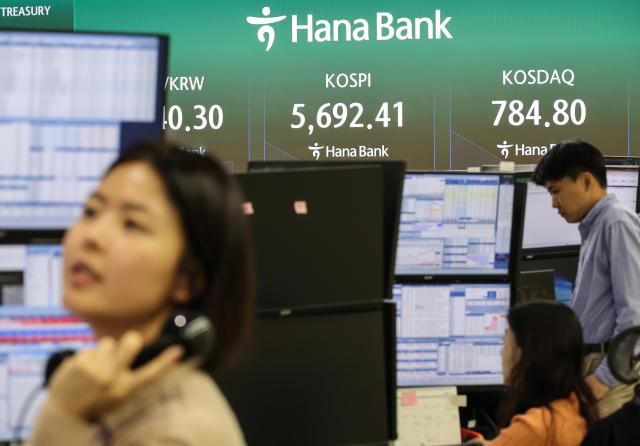
The KOSPI closed at 5,552.74, down 3.73 percent from the previous session's 5,768.01 after it opened at 5,733.57 before sliding as much as 4.76 percent to an intraday low of 5,493.24. It later recovered some of its losses but failed to reclaim the 5,600 level.
The junior KOSDAQ also fell sharply, closing at 781.97, down 3.33 percent from the previous close.
Foreign investors sold a net 530.0 billion won (US$399 million) of KOSPI shares and institutions unloaded 1.00 trillion won ($756 million). Retail investors bought a net 898.1 billion won ($676 million), absorbing part of the selling pressure.
Decliners overwhelmed advancers on the main board, with 773 stocks falling and 118 rising. On the KOSDAQ, 1,348 shares declined, compared with 310 gainers.
The latest selloff erased a two-session rebound that had lifted the KOSPI from 5,554.22 on Thursday to 5,768.01 on Monday, following seven consecutive sessions of losses. The recovery proved short-lived as concerns over the profitability of massive AI infrastructure investment continued to weigh on semiconductor valuations.
Global uncertainty added to the pressure. Violent protests in France heightened concerns over European political and fiscal stability, driving French government bond yields sharply higher and sending European stocks lower the previous day. The U.S. 10-year Treasury yield also rose to around 5.15 percent. Wall Street, however, moved in the opposite direction, with the Nasdaq Composite gaining 1.11 percent as AI-related stocks rebounded.
Yet South Korean stocks failed to follow that recovery, weighed down by persistent concerns over AI investment returns and heavy foreign selling.
Major chipmakers led the retreat. Samsung Electronics fell 2.98 percent to close at 211,500 won, while SK hynix dropped 4.23 percent to 1,223,000 won, extending pressure on the two stocks at the center of the market's recent volatility.
Samsung Electronics' preferred shares also lost 2.93 percent to 165,900 won and SK Square, the investment holding company and major shareholder of SK hynix, declined 5.00 percent to 741,000 won.
Losses extended beyond semiconductors. Battery maker LG Energy Solution fell 4.17 percent to 414,000 won, while Samsung SDI slipped 1.28 percent to 1,155,000 won.
Samsung Biologics, a major contract drug manufacturer, declined 2.52 percent to 1,391,000 won. Automaker Hyundai Motor dropped 4.91 percent to 310,000 won.
Financial shares also weakened. KB Financial Group fell 1.11 percent to 160,900 won and Samsung Life Insurance lost 3.07 percent to 237,000 won.
The weakness also spread across the secondary market, where selling was concentrated in biotechnology, battery materials, semiconductor equipment and robotics shares.
Biotechnology firm Alteogen declined 3.35 percent to 231,000 won, while battery materials group EcoPro lost 7.74 percent to 83,400 won. Its subsidiary EcoPro BM, a producer of cathode materials for electric vehicle batteries, plunged 9.15 percent to 105,200 won, making it one of the steepest decliners among major KOSDAQ stocks.
Semiconductor equipment maker Jusung Engineering fell 5.44 percent to 198,100 won, while Rainbow Robotics, a developer of humanoid and industrial robots, slipped 1.72 percent to 371,500 won.
Biotechnology and pharmaceutical company HLB was the only gainer among the major leading KOSDAQ stocks shown in the market data. It edged up 0.12 percent to 43,000 won.
The South Korean won, meanwhile, strengthened to 1,327.50 per U.S. dollar, compared with 1,331.40 in the previous session.
Tuesday's sharp selloff came just a day after President Lee Jae Myung sought to reassure investors about the outlook for South Korea's stock market amid its recent market volatility.
Speaking to reporters at Cheong Wa Dae on Monday, Lee admitted that market fluctuations would be inevitable after steep gains but maintained that South Korean equities remained significantly undervalued.
He pledged to pursue policies aimed at restoring market confidence, even as Tuesday's selloff underscored the continuing pressure on investor sentiment.
Across the region, major Asian markets mostly declined amid similar concerns over AI investment returns and rising bond yields. Japan's Nikkei 225 fell 1.30 percent to 64,075.42, while Hong Kong's Hang Seng Index dropped 1.12 percent to 23,916.36. Mainland China's Shanghai Composite bucked the trend, edging up 0.12 percent to 3,735.37.

Copyright ⓒ Aju Press All rights reserved.
