

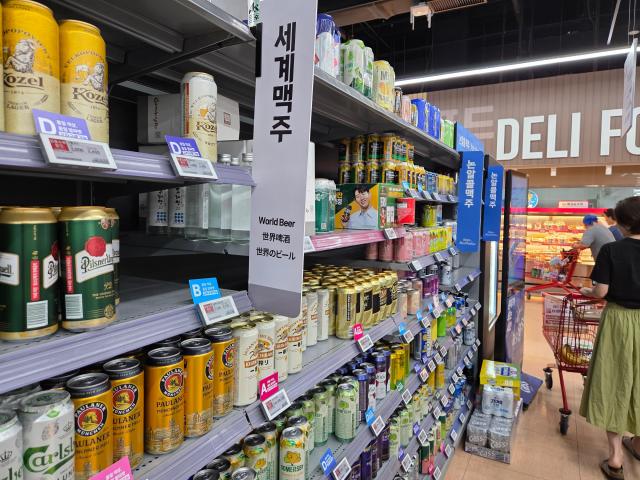
According to statistical data released by the Korea Customs Service (KCS) on Wednesday, South Korea imported $75.22 million worth of Japanese beer between January and September, up 25 percent from a year earlier.
The figure was already equivalent to about 95 percent of the $79.15 million imported in all of last year, putting annual imports on course to set another record.
Japan's beer imports reached a record 37,466 tons in the third quarter, up 24.3 percent from a year earlier, accounting for 48.4 percent of South Korea's total beer imports of 77,371 tons.
This contrasts with a broader slowdown in South Korea's alcohol market. According to the National Tax Service, domestic alcohol shipments fell from about 3.26 million kiloliters in 2022 to 3.23 million in 2023 and 3.15 million in 2024. They dropped further to about 2.99 million kiloliters in 2025, falling below 3 million for the first time in 27 years.
Against this backdrop, Japanese beer companies are stepping up efforts to win over picky South Korean consumers. HiteJinro, the South Korean importer and distributor of Japan's oldest brewer, Kirin Beer, began producing a canned pale lager this month at its plant in Jeonju, North Jeolla Province, with plans to meet about 75 percent of its sales in South Korea next year through domestic production, marking a shift toward local manufacturing.
Other Japanese brands are also stepping up marketing. Lotte Asahi Liquor expanded its portfolio in June with the launch of a zero-sugar beer, while M's Beverage, the importer and distributor of Sapporo, opened a pop-up store at The Hyundai Seoul department store last month, offering draft beer tastings and food pairings to woo consumers.
"Amid increasing demand for Japanese beer, brewers are diversifying their strategies beyond simply importing and selling, from broader lineups and marketing to local production," an industry watcher said.
Copyright ⓒ Aju Press All rights reserved.
