
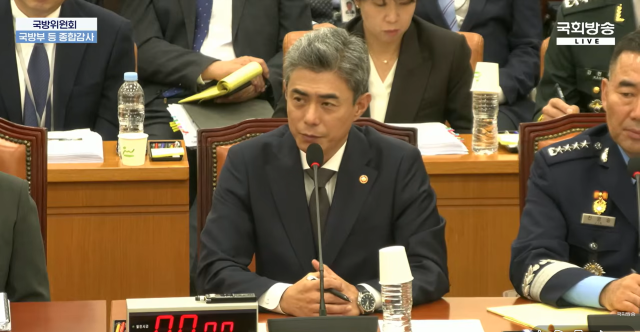
Speaking at a parliamentary audit of the Ministry of National Defense, Kang said the two allies are working toward completing the Full Operational Capability (FOC) verification and determining a specific year for the transfer.
His remarks came after Rep. Kim Byung-joo of the ruling Democratic Party urged the government to secure a clear timeline at the upcoming Security Consultative Meeting (SCM), expected to take place in the United States in December.
The FOC verification is the second stage of a three-phase assessment process designed to evaluate whether the future South Korea-U.S. Combined Forces Command, led by a South Korean four-star general, can effectively carry out wartime missions.
Seoul aims to complete the assessment and agree on a target transfer year at the SCM, although differences remain between the allies over whether the necessary conditions have been met.
Asked what Seoul would do if Washington refused to agree on a specific timeline, Kang said the government could consider various options but emphasized that close coordination with the United States remains its priority.
Kim suggested that South Korea should consider declaring independent exercise of wartime operational control if negotiations fail.
Kang, however, maintained that the transfer should proceed on the basis of mutual trust.
The minister also said Seoul had conveyed concerns over recent remarks by Gen. Xavier Brunson, commander of U.S. Forces Korea, suggesting that the criteria for meeting OPCON transfer conditions could change.
According to Kang, U.S. government officials expressed some understanding of Seoul's concerns.

Kim Hee-su
Kim Hee-su is a bilingual reporter at AJU Press, covering defense and foreign affairs. Before joining AJP in 2025, she worked at The Korea Times, where she wrote interview stories, including a profile of North Korean defector Kim Gum-hyok, and produced digital content. She also previously worked as a researcher for KBS News 9’s International News Department, supporting correspondents in 10 countries around the world. She graduated from the University of Toronto in Canada with a double major in Book and Media Studies and East Asian Studies.
Copyright ⓒ Aju Press All rights reserved.
Related News
-
 Trump may use OPCON transfer to withdraw U.S. troops from Korea, experts
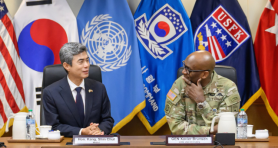
ROK Defense Minister Kang Shin-chul and U.S. Forces Korea Commander Gen. Xavier Brunson at Camp Humphreys on Oct. 2, 2026. Courtesy of the ROK Ministry of National Defense SEOUL, November 14 (AJP) - U.S. President Donald Trump may view South Korea's push to regain wartime operational control (OPCON) as an opportunity to withdraw American troops from the Korean Peninsula, U.S. security experts warned Friday. The assessment comes as President Lee Jae Myung's administration seeks to complete the long-delayed transfer within his term, raising concerns over the future of the South Korea-U.S. military alliance. "It has been said, and I think said very credibly, that President Trump sees OPCON transition as a way to pull the forces from the peninsula," Victor Cha, Korea Chair at the Center for Strategic and International Studies (CSIS), said during a discussion hosted by the Washington-based think tank on Nov. 13. Cha warned that congressional restrictions on reducing the roughly 28,500 U.S. troops stationed in South Korea might not prevent Trump from pursuing a withdrawal, citing his authority as commander in chief. Randall Schriver, a former U.S. assistant secretary of defense for Indo-Pacific security affairs, said he fully agreed that Trump could view OPCON transfer as an opportunity to withdraw or reduce American forces, describing it as consistent with the president's instincts. Former U.S. Ambassador to South Korea Mark Lippert, who moderated the discussion, said the transition could also provide an opportunity for broader talks on the alliance's future, even as Trump might seek troop withdrawals. Former U.S. Forces Korea Commander Gen. Vincent Brooks, meanwhile, criticized Seoul's urgency to complete the transfer within Lee's term, comparing it to similar efforts under former President Moon Jae-in. Brooks also expressed disappointment over Defense Minister Kang Shin-chul's recent assertion that all three conditions for OPCON transfer had been met and that the transition could take place immediately. He compared the claim to a college student declaring readiness to graduate without completing required courses or passing final examinations. Brooks warned against selectively interpreting the conditions for the transfer and criticized proposals to replace the existing South Korea-U.S. Combined Forces Command with a parallel command structure, arguing that such an arrangement could create confusion and risks during wartime. The experts also discussed the implications of the Democratic Party's sweeping victories in the Nov. 3 U.S. midterm elections, which gave the party control of both chambers of Congress. Schriver predicted possible changes in Trump's Cabinet amid mounting political pressure, including scrutiny of Defense Secretary Pete Hegseth and Commerce Secretary Howard Lutnick. Cha said the incoming 120th Congress could seek to reclaim some authority over tariffs from the executive branch. He also warned that South Korea could face greater difficulties advancing cooperation with Washington on shipbuilding, nuclear-powered submarines, uranium enrichment and spent nuclear fuel reprocessing. Cha said a Democratic-controlled Congress would include influential lawmakers strongly committed to nuclear nonproliferation, making progress on nuclear-related issues more challenging than under Trump and his Republican allies.
-
 Seoul, USFK look at different timetables for wartime OPCON transfer
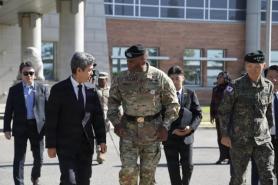
The Hon. Kang Shin-chul, Republic of Korea minister of national defense (second from left), walks with Gen. Xavier T. Brunson, commander of United Nations Command and U.S. Forces Korea, during a visit to Camp Humphreys, Republic of Korea, Oct. 2, 2026. Courtesy of U.S. Forces Korea SEOUL, October 15 (AJP) - South Korea and U.S. Forces Korea are sounding like a broken record as they repeat differing views over the conditions and timing for transferring wartime operational control to Seoul. Gen. Xavier Brunson, commander of U.S. Forces Korea (USFK), argued Wednesday in Washington that changes in the security environment and military planning require updated standards for the handover. “Because the conditions have changed, because we’ve changed our plan, we have new standards which we have to uphold,” Brunson said at an Indo-Pacific security forum hosted by the Gold Institute for International Strategy. Brunson described himself as a supporter of the transfer but stressed that it should depend on military capabilities rather than a political timetable. His remarks came as Seoul seeks to complete the transfer before President Lee Jae Myung’s term ends in 2030. Seoul remains firm to the original timetable. The defense ministry reaffirmed Thursday that the process should follow the conditions and evaluation criteria previously agreed upon by the allies. “If the goalposts keep moving, I think the transfer can never happen,” ministry spokesperson Jeong Bit-na said at a regular briefing, emphasizing that this was her personal opinion rather than the ministry’s official position. She said the South Korean military had spent the past 20 years working to meet the agreed conditions. The ministry’s official position remains that the transfer will proceed once those conditions are met, she said. The allies are continuing close consultations under the existing transition plan. Brunson cited North Korea’s recent missile launches as evidence of the changing security environment. Pyongyang has conducted missile tests on three occasions this month. It test-fired an intermediate-range hypersonic ballistic missile on Oct. 3, followed by multiple ballistic missile launches on Oct. 12, with at least one traveling more than 900 kilometers. On Oct. 14, it tested two types of submarine-launched strategic cruise missiles in the East Sea. The launches followed a Sept. 21 land mine explosion inside the Demilitarized Zone that injured three South Korean soldiers. South Korea’s military concluded on Oct. 5 that North Korean troops had deliberately planted antipersonnel mines south of the Military Demarcation Line. Pyongyang has denied responsibility. The dispute centers on how such developments should affect the handover process. Neither side has formally announced changes to the jointly agreed criteria, and Brunson did not specify which standards had changed or whether they would require a revision of the agreement. “The recent differences appear to reflect a more fundamental gap in how the two sides approach the OPCON transfer, rather than simply whether the conditions have been met,” said Jung Kyeong-woon, a research fellow at the Korea Association of Military Studies. The researcher suggested that Seoul’s push to complete the transfer within the current administration could be creating friction over whether additional requirements should enter the evaluation process. Under the Conditions-based OPCON Transition Plan agreed upon in 2015, the handover depends on three broad requirements: South Korea’s ability to lead combined defense operations, the alliance’s capability to counter North Korea’s nuclear and missile threats, and a security environment conducive to a stable transition. Graphics by AJP Song Ji-yoon The allies assess readiness through three stages: Initial Operational Capability, Full Operational Capability and Full Mission Capability. The process is in the second stage. Seoul aims to complete Full Operational Capability verification this year and propose a target year for the transfer, although differing assessments of military readiness could complicate that timetable. The ministry spokesperson said Seoul would seek to resolve outstanding differences through bilateral consultations based on the existing conditions and evaluation criteria ahead of the annual Security Consultative Meeting. The meeting, normally held in late October or early November, is reportedly being considered for December. A date has not been finalized. The latest exchanges contrast with Defense Minister Kang Shin-chul’s remarks to lawmakers on Oct. 7 that the allies had no significant differences over the transfer. Both sides continue to endorse a conditions-based handover. The unresolved question is whether the conditions Seoul has been working toward will remain the benchmark as the security environment changes.
-
 UFS puts S. Korea's OPCON transfer push to the test
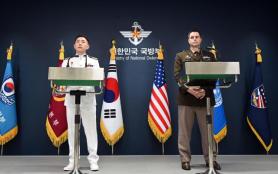
South Korea's Joint Chiefs of Staff spokesperson Jang Do-young (left) and U.S. Forces Korea spokesperson Ryan Donald attend a joint briefing on the 2026 Ulchi Freedom Shield exercise at the Ministry of National Defense in Seoul on Aug. 10, 2026. Joint Press Corps. (사진공동취재단) SEOUL, August 10 (AJP) - South Korea and the United States will stage their annual Ulchi Freedom Shield exercise from Aug. 17 to 27 in what will double as a test of Seoul’s push to advance the transfer of wartime operational control (OPCON) even as questions remain over whether a Korean-led command is ready for the full demands of war. The Joint Chiefs of Staff and the South Korea-U.S. Combined Forces Command announced the schedule during a joint briefing Monday, describing UFS as a defensive exercise aimed at strengthening the allies’ combined defense posture. About 18,000 South Korean troops will take part, roughly in line with previous years. The allies said this year’s scenario incorporates lessons from recent wars and will test combined and joint all-domain operations, including responses to cyberattacks and drones. The exercise will also advance preparations for the conditions-based OPCON transition. “It is a reality that North Korean military capabilities are changing after its forces were deployed to the war in Ukraine,” Ryan Donald, a public affairs officer for U.S. Forces Korea, said. “The exercise includes responses to threats the North Korean military could pose, as well as cyber and drone attacks.” The drills come as President Lee Jae Myung’s government seeks to complete verification of the future Combined Forces Command’s full operational capability (FOC) at the allies’ Security Consultative Meeting (SCM) this fall. Graphics by AJP Song Ji-yoon FOC is the second of three capability-validation stages under the first condition for OPCON transfer, following initial operational capability and preceding full mission capability, or FMC. If the two defense chiefs approve the FOC assessment, Seoul and Washington could move closer to recommending a target year for the transfer to their presidents. “If the standards are met, we believe it will be possible to make recommendations at the SCM on the FOC verification of the future Combined Forces Command and the timing of the transition,” JCS spokesperson Jang Do-young said. But the renewed push is reviving a more fundamental question: whether the future Korean-led command has actually been tested under conditions resembling those it would face after OPCON transfer. A person familiar with the transition process said the central issue is no longer whether South Korea should eventually regain wartime command, but whether a Korean four-star general leading the future Combined Forces Command would have the same assured access to U.S. intelligence, reinforcements and strategic assets during a crisis. WATCHCON, or Watch Condition, refers to the allies’ intelligence and surveillance alert posture for monitoring North Korean military activity and signs of an imminent threat. “After OPCON transfer, if the South Korean future combined commander orders a higher WATCHCON level during combined crisis management, is there a basis to receive the same level of U.S. assets as before?” the person said. “What is the plan to guarantee U.S. strategic assets and reinforcement forces in a full-scale war after OPCON transfer?” Under the current framework, the transfer depends on three broad conditions: South Korea’s ability to lead the allies’ combined defense, their capability to respond to North Korea’s nuclear and missile threats, and a stable security environment on the Korean Peninsula and in the region. The hardest question increasingly lies with North Korea’s nuclear arsenal. Critics argue that transferring OPCON without firmer guarantees of U.S. nuclear and strategic support could leave South Korea with greater command responsibility while remaining heavily dependent on Washington for the capabilities most critical in a major war. That concern is unlikely to be resolved by this year’s UFS alone. U.S. Forces Korea spokesperson Ryan Donald speaks during a joint South Korea-U.S. briefing on the 2026 Ulchi Freedom Shield exercise at the Ministry of National Defense in Seoul on Aug. 10, 2026. Joint Press Corps. (사진공동취재단) The exercise will not include a drill led by a South Korean four-star general acting as the future combined commander, leaving unanswered whether the command structure being assessed has been tested under the same circumstances it would face after transfer. Jeong Kyung-woon, a research fellow at the Korean Association of Military Studies, said a realistic debate should focus less on setting a political timetable and more on how South Korea would counter North Korea’s nuclear threat and secure stronger U.S. extended deterrence. “Given South Korea’s conventional military capability and economic strength, the first condition is not an impossible task,” Jeong said. “If South Korea makes the decision, it can be achieved within a reasonable period, and the risks to be accepted would not be excessive.” The second and third conditions are far harder, he said, because both ultimately come back to North Korea’s nuclear capabilities. “In the end, the second and third conditions are about the ability to respond to North Korea’s nuclear threat,” Jeong said. “The best option would be for South Korea to possess its own nuclear capability, but realistically that is difficult.” A U.S. Army AN/TWQ-1 Avenger air defense system assigned to the 35th Air Defense Artillery Brigade fires a Stinger missile during Exercise Tenacious Archer 2026 in Palau on Aug. 9. Courtesy of U.S. Eighth Army Nor, he said, would it be convincing to postpone OPCON transfer indefinitely on the assumption that North Korea is unlikely to denuclearize. “Under the current circumstances, the key to meeting the OPCON transfer conditions will be how South Korea can receive a more advanced form of extended deterrence than what exists now,” Jeong said. Those questions have gained urgency as shifting U.S. military priorities elsewhere in the world have demonstrated that American assets stationed on or assigned to the peninsula cannot necessarily be viewed in isolation. During the prolonged Iran war, THAAD launchers deployed in Seongju were temporarily moved to Osan Air Base before returning. USFK Commander Gen. Xavier Brunson told U.S. lawmakers that no THAAD system had left the Korean Peninsula, but said the command had sent “munitions” forward and repositioned assets to prepare those munitions for possible movement. For critics of a rushed OPCON transfer, the episode illustrated the possibility that U.S. missile-defense munitions and other assets on the peninsula could be repositioned when broader American operational priorities change. They argue that Seoul therefore needs clearer guarantees on what U.S. surveillance, missile-defense, reinforcement and strategic assets would be available during a full-scale conflict with North Korea — and under whose authority they would be deployed. Questions over South Korea’s own early-warning capabilities have added another layer to the debate. The South Korean military did not disclose details of North Korea’s June 25 weapons launches on the day they occurred, prompting questions over whether it had detected and properly classified the weapons in real time. The Defense Ministry later said South Korea and the United States had detected and tracked multiple projectiles in real time. Still, the episode highlighted the importance of early warning, weapons classification and intelligence-sharing procedures in any future command structure in which a South Korean general assumes wartime operational control. The United Nations Command will also participate in UFS, with 12 member states, including the United States, expected to send about 70 additional personnel. The Neutral Nations Supervisory Commission will observe the exercise to assess its compliance with the armistice agreement.