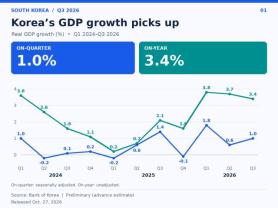
The gross domestic product grew 1.0 percent on quarter and 3.7 percent on year in the July–September period, according to preliminary Bank of Korea (BOK) data released Tuesday. Annualized growth over the first nine months would be 3.6 percent.
“If fourth-quarter growth reaches 1.4 percent or more on quarter, annual growth of 4 percent would be achievable in theory,” said Lee Dong-won, director general of the BOK’s Economic Statistics Department, at a briefing.
Growth near 4 percent would put the economy on a pace last seen in the early 2010s, apart from its 4.1 percent rebound in 2021 from the pandemic recession. South Korea grew 3.7 percent in 2011 and 6.8 percent in 2010 amid stimulus following the global financial crisis.
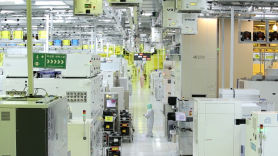
Computer, electronic and optical products accounted for about 60 percent of year-on-year growth, with semiconductors alone contributing roughly half, according to Lee.
Rhee, now a nonresident senior fellow at PIIE, said Korea was “focusing too much on the investment in electricity, the hardware,” arguing that education, regulation and labor flexibility could prove more binding constraints on the development of its AI industry.
Lee Jae-woo, a visiting research fellow at the Korea Economic Research Institute, described the semiconductor boom as potentially “too much of a good thing.” Korea was becoming a two-track economy in which chips thrive while much of the rest struggles to catch up, he said.
The divergence could complicate monetary policy. Chip-driven income and growth strengthen the overall economy, while the burden of tight financial conditions falls more heavily on weaker sectors, Lee said.
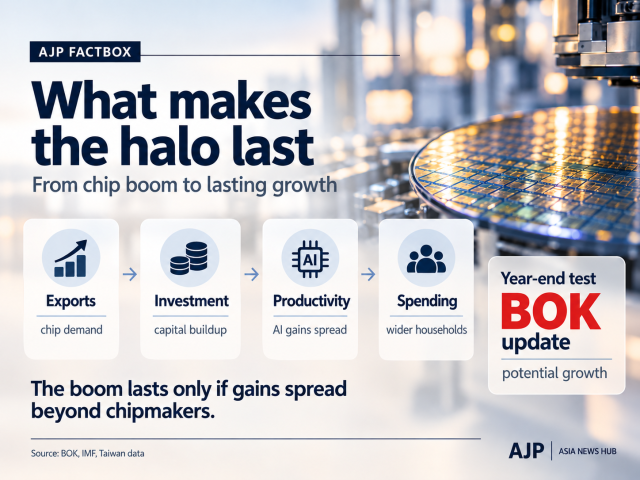
BOK research suggests that widespread AI adoption has yet to deliver comparable productivity gains. About 51.8 percent of Korean workers used generative AI for work in 2025.
Users reduced the time needed to perform tasks by an average of 3.8 percent, equivalent to about 1.5 hours in a 40-hour workweek and implying a potential productivity gain of around 1 percent.
Yet the central bank found essentially no relationship between time saved and actual output growth. It attributed the disconnect partly to limited changes in workflows, organizational structures and the division of tasks between workers and AI.
Ayhan Kose, deputy chief economist of the World Bank Group, said estimates of AI’s effect on productivity remain highly uncertain, ranging from close to zero to around 1 percentage point in existing research.
Sizable gains could help reverse part of a decades-long slowdown in global potential growth, he said. But economies would need investment in infrastructure, human capital, data and connectivity to turn the technology into sustained expansion.
AI could also raise worker productivity and create new tasks in health, education and agriculture, Kose said, although evidence on its eventual employment effects remains mixed.
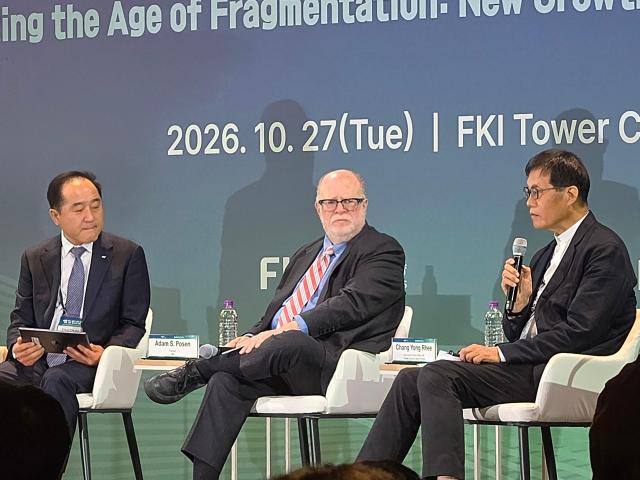
Martin Chorzempa, Dennis Weatherstone Senior Fellow at PIIE, said the country needs the skills to “map AI capabilities to applications in your economy,” rather than treating an all-out race to develop domestic frontier foundation models as the only route to competitiveness.
Developing such large, general-purpose models is extraordinarily costly, he said. Korean companies also need the ability to select suitable models, including open-weight models whose underlying parameters are available for adaptation, and fine-tune them for domestic industries.
Continued competition between U.S. and Chinese developers could benefit Korean users by keeping prices down and widening their choices, Chorzempa said.
He also saw Korea’s investment in computing infrastructure as a source of strategic flexibility: the same data centers can run models developed in either the United States or China.
But that competition carries risks for the industry currently driving Korea’s growth.
Intense price competition could make it harder for AI developers to recover the enormous cost of training frontier models, Chorzempa said. If that weakens incentives to keep building data centers, the slowdown could feed through to demand for Korean memory chips.
Rhee pointed to a further vulnerability. U.S. restrictions on China’s access to advanced semiconductor technology may have benefited Korean chipmakers in the short term, he said. China’s rapid gains in industries with structures similar to Korea’s could nevertheless pose a more fundamental long-term challenge.
Korea’s task is to use the semiconductor windfall to lift productivity across the broader economy before its current advantage narrows. The chip boom is buying time. Turning that time into a more productive AI economy remains unfinished work.

Copyright ⓒ Aju Press All rights reserved.