


Park now also holds a senior government role promoting K-pop. But the immediate uncertainty concerns the would-be buyers, their financing and what they want from the company.
NEXROC Group and SVCV announced plans to acquire 25 to 50 percent of JYP’s shares without detailing how they would finance the purchase or their strategic objectives.
JYP responded late Monday by denying that it had received an acquisition approach.
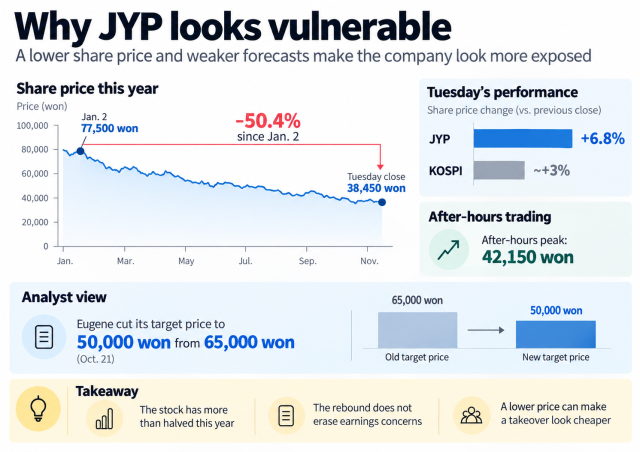
Its shares surged to 42,150 won in after-hours trading before closing Tuesday at 38,450 won, up 6.8 percent and outpacing the KOSPI’s roughly 3 percent advance.
The announcement left investors with two questions: who are the would-be buyers, and why JYP?
NEXROC presents itself as an investment group spanning finance, insurance and consumer businesses. Its website describes SVCV as its fashion, luxury and creative division. A U.S. securities filing identifies NEXROC SVCV, Inc. as an entity incorporated in New York in 2024, with names incorporating both SVCV and NEXROC listed among its previous names.
The financing is less clear. NEXROC’s investor website outlines a $3 billion program but explicitly describes the amount as illustrative. It provides no evidence of approved financing or binding commitments to fund a JYP purchase.
JYP’s position is more readily examined. Its shares have fallen sharply, earnings forecasts have weakened and management is redirecting a major property investment. Those pressures warrant scrutiny, although they do not establish that the company needs a financial rescue.
JYP shares have more than halved from 77,500 won on Jan. 2.

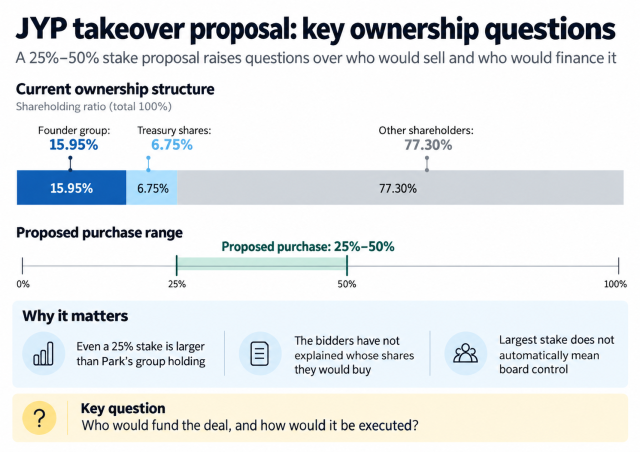
According to company disclosures, Park and related shareholders own a combined 15.95 percent, while treasury shares account for another 6.75 percent.
A purchase of even the lower end of the proposed 25-to-50-percent stake would therefore require shares from holders beyond Park’s group. The bidders have not explained whose shares they intend to buy or how.
Such a stake could give an outside investor substantial influence, but becoming the largest shareholder would not automatically confer control of the board.
Shareholder support, board-election timing and institutional investors’ votes would also matter.
The lower share price reduces the starting cost of an acquisition. The earnings pressures behind that decline, however, would become the buyer’s problem too.
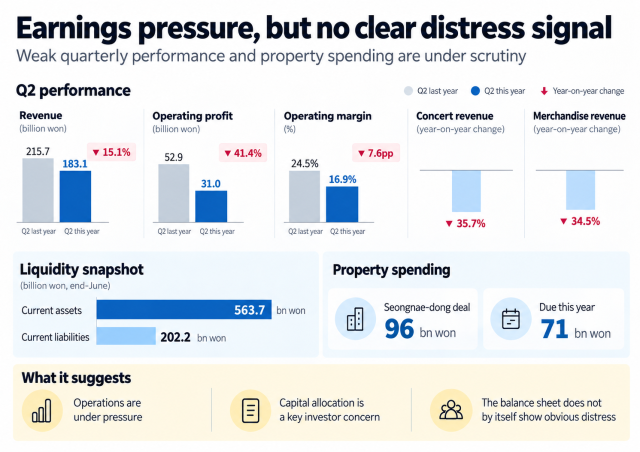
JYP reported second-quarter revenue of 183.1 billion won, down 15.1 percent from a year earlier. Operating profit fell 41.4 percent to 31 billion won, while its operating margin narrowed to 16.9 percent from 24.5 percent.
Concert revenue declined 35.7 percent and merchandise revenue fell 34.5 percent. JYP attributed much of the decline to the high comparison base created by Stray Kids’ large-scale touring and merchandise sales a year earlier.
A touring calendar can explain a weak quarter. The longer-term question is whether other artists can carry more of the business when its biggest earners are less active.
Eugene Securities analyst Lee Hyun-ji cut her target price to 50,000 won from 65,000 won in an Oct. 21 report while retaining a buy recommendation. She forecast a 17.3 percent decline in annual operating profit and stressed the need for younger artists to grow as established acts approach gaps in activity.
She also highlighted the pressure from production costs when album sales per release fall short.
Yuanta Securities reached a similar conclusion in its Aug. 13 assessment: additional releases were not generating enough sales to offset their production burden. The brokerage lowered the earnings multiple used to value JYP to 14.2 times from 16.8 times, applying a discount to SM Entertainment because of weaker prospects for earnings improvement.
There is a route to recovery.
Yuanta pointed to strong sales of Stray Kids’ older releases in Western markets as evidence of an expanding audience. Further touring in those markets, supported by a stronger merchandise strategy, could increase the group’s earnings contribution.
That opportunity carries a familiar limitation. A recovery led principally by Stray Kids would leave JYP exposed to the group’s schedule. Greater contributions from younger artists would make growth more durable.
Management’s spending decisions are another focus.
JYP abandoned its planned headquarters in Seoul’s Godeok district after a dispute over changes to the permitted use of neighboring land. The company said adjacent high-rise development could compromise artist privacy and undermine the project’s design.
The withdrawal was not a retreat from property investment. JYP also agreed to acquire land and buildings in Seongnae-dong for 96 billion won.
The acquisition schedule calls for 71 billion won in payments this year. Meanwhile, the company plans to sell the Godeok site, potentially requiring it to fund the new purchase before recovering money committed to the earlier project.
The overlap raises questions about capital allocation, but is not sufficient evidence of a cash shortage.
JYP’s second-quarter presentation showed 563.7 billion won in current assets against 202.2 billion won in current liabilities at the end of June. Those assets are not all cash, and the figures predate the new property agreement. They nevertheless provide an important counterpoint to any suggestion of financial distress.
Management’s task is to complete the property transition efficiently while continuing to invest in artists and their international businesses.
For the would-be buyers, the more immediate test is to establish who would fund the proposed acquisition and how it would proceed.
Until then, JYP has an announced suitor, but no demonstrated path to a takeover.

Copyright ⓒ Aju Press All rights reserved.
