

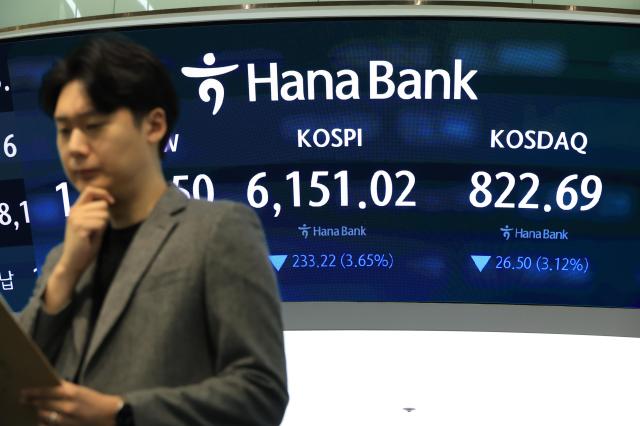
For Korea Inc., one route was the price return swap (PRS), a financial arrangement that allows companies to raise funds while retaining potential gains from the underlying shares. The catch is that they also remain exposed to losses.
Companies receive cash when they transfer shares and pay fees under the agreement. Subsequent price gains or losses are settled according to the contract. Under an agreement requiring full compensation, shares transferred for 10 billion won ($7.55 million) and later sold for 7 billion won would leave the company owing 3 billion won.
Outstanding PRS contracts in South Korea exceeded 20 trillion won as of September, according to Korea Investors Service (KIS).
The attraction is access to funding without surrendering all the potential upside from the shares.
“It gives them an alternative to bank loans, but it is not necessarily cheaper once fees and other costs are included,” said Kang Hyoung-goo, a professor of financial management at Hanyang University.
LG Chem’s deal illustrates how share-price movements can work in a company’s favor.
The chemical maker raised about 2 trillion won through a three-year PRS involving 5.75 million shares in its battery subsidiary, LG Energy Solution, at a reference price of 347,500 won. The agreement was signed in October 2025, according to its regulatory filing.
LG Energy Solution closed Tuesday at 382,000 won, above the reference price, leaving the price component of the transaction in LG Chem’s favor. The eventual financial outcome will depend on fees and actual settlement prices.
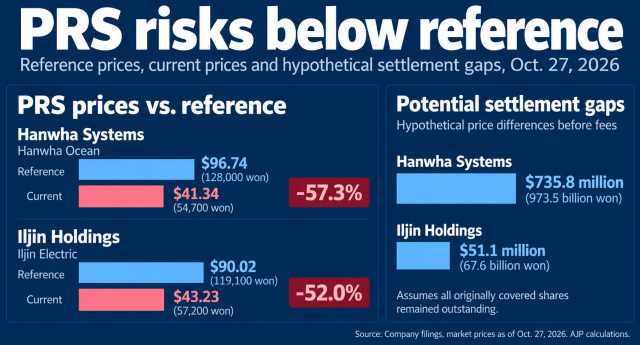
Hanwha Systems raised 1.7 trillion won in April through a PRS involving shares in shipbuilder Hanwha Ocean. Those shares traded at 54,700 won as of 2:12 p.m. Tuesday, 57.3 percent below the reference price of 128,000 won.
The decline leaves the defense electronics company exposed to potential settlement payments ahead of the contract’s April 2027 maturity.
Iljin Holdings faces a similar risk on a 130 billion won contract involving shares in electrical equipment maker Iljin Electric that matures in May 2027. Iljin Electric traded at 57,200 won as of 2:15 p.m. Tuesday, 52.0 percent below the reference price of 119,100 won.
If all shares originally covered by the contracts remained outstanding and were sold at those prices, the price difference would amount to about 973.5 billion won for Hanwha Systems and 67.6 billion won for Iljin Holdings.
Those are hypothetical calculations excluding fees, not estimates of the companies’ remaining obligations. Any shares already sold and settled would change the amounts.
Nor does a maturity date necessarily give a company until then to find the cash.
Hanwha Systems’ April filing provides for settlement when the buyer sells the shares. A sale below the reference price can therefore trigger a payment before the one-year agreement expires.
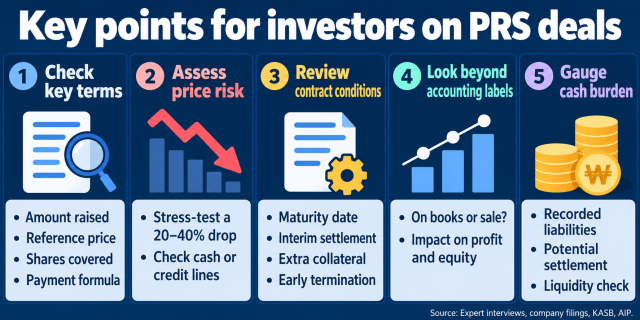
“Companies need to calculate in advance how much cash they may have to pay if share prices fall sharply, keep enough cash available and avoid having contracts mature at the same time,” Kang said.
“They must also check the conditions for interim settlements, additional collateral and early termination.”
Losses can also reach reported earnings before any cash payment is due.
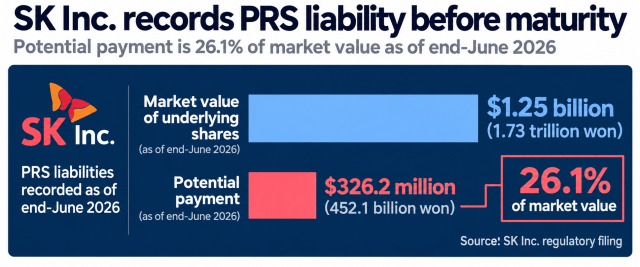
SK Inc. raised 1.25 trillion won in February through a three-year PRS involving shares in its drugmaking subsidiary, SK Biopharmaceuticals. By the end of June, the holding company had recorded a related derivative liability of 326.2 billion won, although maturity was still more than two years away.
That liability is an accounting valuation, not money already paid or a fixed bill due at maturity. Changes in the contract’s value can nevertheless reduce net income before settlement.
How the initial fundraising appears on the balance sheet is a separate question. Transferring legal ownership of shares does not automatically qualify as a sale for accounting purposes.
Kang said International Financial Reporting Standard 9 (IFRS 9), which governs financial instruments, considers who retains the risks and benefits of ownership after the transfer.
“If the company retains substantially all of them, it keeps the shares on its books and records the funds received as a financial liability,” he said.
If the transfer qualifies as a sale, the shares are removed from the company’s books and the remaining PRS contract is accounted for separately as a derivative.
A response published in March 2025 by the Korea Accounting Standards Board (KASB) illustrates why legal ownership alone does not settle the issue. In its example, voting and dividend rights passed to the buyer, but the seller retained the share-price risk. If the shares could not be removed from the seller’s books, the buyer would record a claim against the seller rather than the shares themselves.
The treatment can differ under U.S. accounting standards, which focus on whether control of the shares has passed to the buyer.
“Some transactions can be treated as a sale and a separate derivative even when risk remains,” Kang said. “Not every PRS overseas is treated as borrowing.”
The impact on earnings also depends on how the underlying investment is recorded. For shares held on the books at fair value, a decline can reduce net income or be recorded in other comprehensive income, Kang said.
“Losses recorded in other comprehensive income reduce equity without appearing in net income,” he said.
A company’s reported net profit can therefore remain unaffected by a share-price decline even as its net assets shrink. Changes in the value of a separately recorded PRS derivative, meanwhile, generally affect net income.
“Net income alone is not enough to assess how much cash a company may have to pay under its PRS contracts,” Kang said.
Accounting treatment can be part of a deal’s appeal. A transaction recognized as a sale may allow a company to raise funds without increasing reported borrowings.
“But companies also need to raise funds and manage their shareholdings,” Kang said. “We cannot assume they use PRS solely because of regulatory gaps or accounting benefits.”
In a December 2025 statement, the KASB acknowledged differing interpretations of PRS accounting in practice and said each transaction must be assessed on its specific facts and circumstances.
For investors, the payment obligations can consequently reveal more about the cash risk than the accounting label.
“Investors need to check how much the company raised, the reference share price, the number of shares covered and how payments are calculated,” Kang said. “They should also review fees, maturity dates and any conditions that could require early settlement or additional collateral.”
The next step is to assess whether the company could meet those obligations under a sharp market decline.
“They should then calculate how much the company would have to pay, and when, if share prices fell 20 to 40 percent, and check whether it would have enough cash or committed bank funding to cover those payments,” he said.
Clearer disclosure would make that assessment easier. Kang proposed presenting the funds raised, liabilities recorded, effects on profit and equity, and estimated settlement payments together with an explanation of the accounting treatment.
“The priority is to standardize disclosure of the cash burden when share prices fall and the reasons behind the accounting treatment,” he said.
He also called for clearer guidance to ensure that transactions with similar economic terms are accounted for consistently.
PRS can turn shareholdings into cash while preserving future gains. When prices fall, the obligation to cover the downside remains — whatever label the transaction carries on the balance sheet.

Copyright ⓒ Aju Press All rights reserved.
