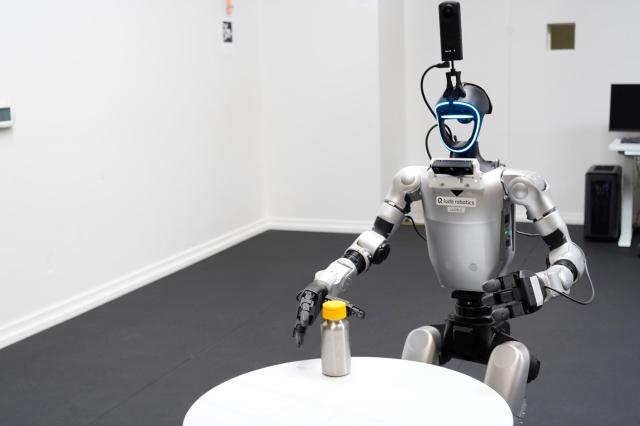
Lee Kang-wook, Krafton's chief AI officer and Ludo's chief technology officer, presented Ludi 0.2 on Oct. 30 at the Bay Area Robotics Symposium at UC Berkeley, building on Ludi 0.1 released in August.
Ludo also formally opened a research hub in Palo Alto, California, that will work alongside its Seoul office.
The new version sharpens the robot's grasp of human feedback, gestures and social cues, and helps it keep track of tasks that shift midstream.
Ludo is also developing Ludi 1.0, a foundation model that would fold perception, dialogue and physical action into a single system.
"We will build on this experience to create AI for robots that communicate and collaborate naturally with people in the real world," said Kim Chang-han, chief executive of both Krafton and Ludo, pointing to nearly two decades of building real-time virtual worlds through games.
Lee previewed the approach at the Physical AI Tech Week in Seoul on Oct. 13, playing a video of a Unitree G1 humanoid running Ludo's agentic system.
The robot fetched a drink and swapped cans mid-reach when told the Pepsi would be better, Korean code at work on a Chinese-built body.
"Many robot foundation models are coming out, but one that can work while talking with people doesn't exist anywhere in the world yet," Lee said at the event.
AJP Takeaways
- Krafton's robotics subsidiary Ludo Robotics unveiled Ludi 0.2, an AI system designed to help robots understand human intent and cooperate with people, at the Bay Area Robotics Symposium at UC Berkeley on Oct. 30, 2026.
- Ludi 0.2 builds on Ludi 0.1, released in August 2026, and improves social intelligence, memory and reasoning, gesture recognition and physical movement.
- Ludo Robotics is developing Ludi 1.0, a foundation model meant to combine perception, dialogue and physical action, and has formally opened a research hub in Palo Alto, California, alongside its Seoul office.

Copyright ⓒ Aju Press All rights reserved.