

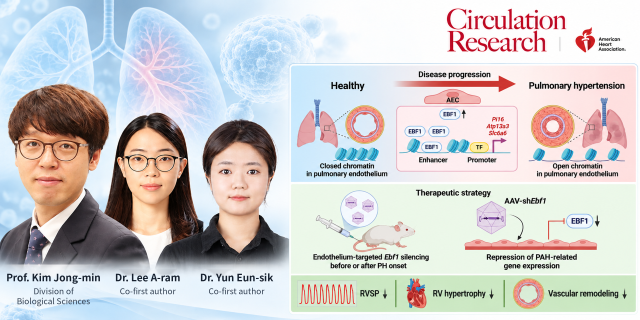
SEOUL, November 02 (AJP) - A gene best known for guiding the development of immune cells also drives a rare and incurable lung artery disease. Researchers in South Korea, the United States and China found that switching it off eased the disease's main signs in rats.
The gene, EBF1, controls a newly identified group of cells lining the lung's arteries that grows as pulmonary arterial hypertension worsens. When the researchers suppressed it, pressure in the right side of the heart fell and the heart muscle thickened less, Sookmyung Women's University said. The improvement held even when the gene was blocked after the disease had already set in.
Pulmonary arterial hypertension (PAH) is a condition in which structural changes in the lung's blood vessels push blood pressure in the pulmonary arteries abnormally high. Those arteries carry blood from the heart to the lungs to pick up oxygen. As their walls thicken and narrow, the right ventricle, the chamber that pumps blood into the lungs, is forced to work harder and can eventually enlarge and fail.
Drugs now used for PAH mainly widen blood vessels and relieve symptoms. The university said treatments that can halt the progression of the disease itself are still needed.
The study brought together a team under Kim Jong-min, a professor in Sookmyung's Division of Biological Sciences, and teams under Jin Suk-won and Park Ji-hwan at the Gwangju Institute of Science and Technology (GIST). Researchers from Yale University and the First Affiliated Hospital of Xi'an Jiaotong University in China also took part.
To follow what happens inside the lung's blood vessels as the disease advances, the team applied single-cell multiome analysis to a rat model of PAH, examining endothelial cells at four stages of the disease. The technique reads, cell by cell, which genes are active and which parts of the DNA are open to be used.
As the disease worsened, a previously unknown group of arterial endothelial cells, the cells that form the inner lining of arteries, increased in number. These cells were marked by distinctive activity in genes including PI16, SLC6A6 and ATP13A3.
The team identified EBF1, short for Early B-cell Factor 1, as the transcription factor steering this change. A transcription factor is a protein that turns other genes on and off. EBF1 had been known mainly for its role in the development and specialization of B cells, the immune cells that make antibodies.
In the study, EBF1 activity rose as PAH progressed, and the gene regulated the activity of other genes linked to the disease. The researchers found similar features in lung tissue and gene activity data from PAH patients. The university said this supports the clinical relevance of the findings.
To test whether EBF1 could serve as a drug target, the team used adeno-associated virus (AAV), a virus that does not cause disease and is widely used to deliver genetic material, to suppress EBF1 selectively in the endothelial cells of the lungs.
In the rats, right ventricular systolic pressure, the peak pressure inside the right ventricle as it contracts, dropped significantly, and enlargement of the right ventricle decreased. Vascular remodeling, the thickening of the lung artery walls, also eased. The rats showed these improvements even when EBF1 was suppressed after PAH had developed.
The results come from rats. The study did not test any treatment in patients, and no therapy targeting EBF1 has been shown to work in people. The university described the work as a foundation for a new treatment strategy that acts directly on diseased changes in the vessel lining instead of only widening blood vessels.
Kim was one of four co-corresponding authors, and Sookmyung researchers Lee A-ram and Yun Eun-sik were among four co-first authors. The paper was published online Oct. 23 in Circulation Research, a cardiovascular journal with an impact factor of 18.0.
[Reference Information]
Journal/Source: Circulation Research (IF 18.0, JCR top 2.24%)
Title: Identification of a Novel EBF1-Expressing Disease-Associated Arterial Subpopulation in Pulmonary Arterial Hypertension
Link/DOI: https://doi.org/10.1161/CIRCRESAHA.125.328069

Copyright ⓒ Aju Press All rights reserved.

