

SEOUL, November 05 (AJP) - A research team at Kookmin University has developed an artificial intelligence model that predicts how a chemical mixture will behave based on the ratio of its ingredients. Until now, getting that answer has usually meant repeated lab testing.
The model, called MEMo, gave more accurate predictions than existing methods for four of five physical properties when tested against more than 860,000 lab measurements, the university said Thursday.
Joung Joon-young, an assistant professor in Kookmin's Department of Chemistry, led the work, which was published in the Chemical Engineering Journal. MEMo stands for Mixture Embedding via Mole Fraction. Mole fraction is the standard chemistry measure of each ingredient's share of the molecules in a blend.
Most chemical products are blends, not single substances. Industrial solvents, battery electrolytes, vehicle fuels, cosmetics and drug formulations all combine several compounds.
A mixture's properties depend on which substances it contains and in what proportions. Those properties do not always change in step with the ratio, so doubling one ingredient does not necessarily double its effect. Measuring every possible combination and ratio in a lab is not practical.
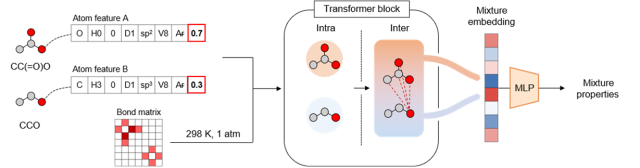
Earlier AI models handled mixtures by learning the features of each molecule separately and then averaging them according to the ratio. Kookmin compared the approach to guessing the taste of a finished dish by sampling each ingredient alone. The method misses how molecules act on one another and how those interactions shift as the proportions change.
MEMo takes in each molecule's mixing partners and their proportions from the first step, when the model begins reading the molecule. The front part of the model learns the features of individual molecules. The back part lets different molecules exchange information so the model can learn how they interact.
As a result, the model can treat the same molecule differently depending on what it is mixed with and in what ratio.
The team built benchmark sets from experimental data held by the U.S. National Institute of Standards and Technology, covering density, speed of sound, vapor pressure, refractive index and surface tension. MEMo beat leading existing methods on four of the five. Kookmin did not say which property it failed to improve.
The gap was widest for mixtures with strong interactions between molecules, such as ionic liquids and salt solutions in water. Ionic liquids are salts that remain liquid at relatively low temperatures. MEMo also performed especially well on mixtures containing molecules it never encountered during training.
A single MEMo model handles pure substances as well as mixtures of two or three components. The team has released its benchmark data and model code publicly for other researchers to use.
The results come from tests against existing measurements. The team has not reported using MEMo to develop an actual product, such as a new electrolyte or solvent.
"The properties of a mixture change depending on 'who' a molecule meets and 'how much,'" Joung said. "The core of this study is getting AI to understand molecules on the same principle."
He said the model can quickly predict the properties of many blends without experiments, and he expects it to "cut the time and cost of materials development" in industries that work with mixtures. He named battery electrolyte design, eco-friendly solvent development and the search for carbon dioxide capture materials as examples.
Kim Ji-hwan, an integrated master's and doctoral student, and undergraduate researcher Kim Chan-joong also took part in the study. Joung joined Kookmin in March 2025 after working as a postdoctoral associate in the Department of Chemical Engineering at the Massachusetts Institute of Technology.

Copyright ⓒ Aju Press All rights reserved.
