

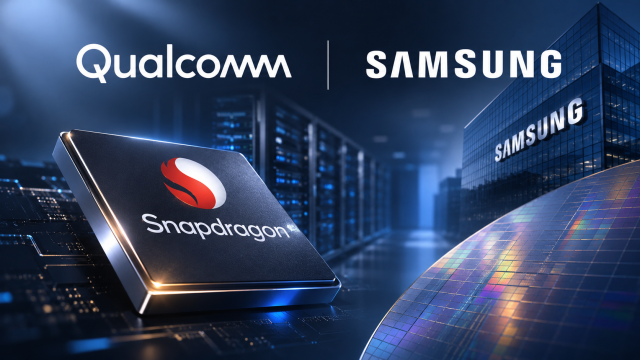
SEOUL, November 05 (AJP) - Qualcomm is redefining itself beyond the phone chips that built its name, pursuing growth in AI data centers and autonomous vehicles in a shift that could give longtime customer Samsung Electronics a larger role as a supplier.
The U.S. chipmaker’s processors power Samsung’s premium Galaxy phones. Its expansion into AI infrastructure could, in turn, create demand for Samsung’s memory chips — although any new supply arrangements remain unconfirmed.
The relationship already runs both ways through Samsung’s contract chipmaking business. Qualcomm’s AI push could broaden that relationship into memory, adding another potential customer for Korean memory fabs.
Qualcomm reported fiscal fourth-quarter revenue of $10.32 billion on Thursday, down 8 percent from a year earlier, as handset chip sales plunged 26 percent to $5.14 billion. The decline overshadowed record automotive chip revenue as the company prepared to scale up its data center business.
Adjusted earnings per share fell 28 percent to $2.17, while adjusted revenue declined 7 percent to $10.44 billion.
Automotive revenue surged 89 percent to a record $1.99 billion, while Internet of Things (IoT) revenue rose 4 percent to $1.89 billion.
The results underscore a shift in Qualcomm’s business as Apple gradually replaces its modems with internally developed technology and rising memory costs weigh on global smartphone demand.
During its earnings conference call, executives said revenue from automotive, IoT and data center businesses was expected to grow more than 60 percent in fiscal 2027, more than offsetting the anticipated decline in Apple-related product revenue.
The company also expects handsets to account for less than half of its semiconductor business revenue in fiscal 2027, marking a milestone in its efforts to reduce dependence on smartphones.
“Fiscal 2027 marks the start of our non-handset revenue inflection, including the ramp of our Data Center business,” CEO Cristiano Amon said in the earnings release.
Qualcomm reiterated its data center revenue targets of $5 billion for fiscal 2027 and $15 billion by fiscal 2029, positioning itself to compete more aggressively in a market dominated by Nvidia and increasingly contested by AMD and custom chip developers.
Executives said most of the projected fiscal 2027 revenue would come from custom silicon programs for two major hyperscale customers — operators of vast cloud and data center networks.
Connectivity products, including optical interconnect technology, are expected to provide another significant revenue stream. By fiscal 2029, Qualcomm expects its data center business to draw more broadly on central processing units and AI accelerators alongside custom silicon and connectivity.
The company highlighted opportunities following its acquisition of Alphawave as increasingly complex AI infrastructure drives demand for faster connections between chips and systems.
Qualcomm expects data center revenue to exceed $650 million in the first quarter of fiscal 2027 and increase throughout the year as customer programs expand.
For Samsung and SK hynix, that expansion represents another potential source of demand for advanced memory products.
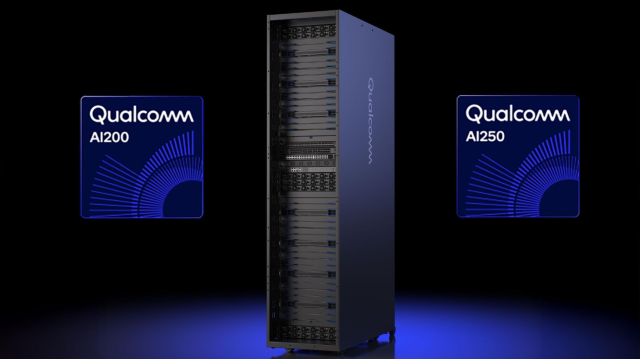
Qualcomm’s AI200 accelerator supports 768 gigabytes of low-power double data rate (LPDDR) memory per card, illustrating how its AI ambitions could expand opportunities beyond the high-bandwidth memory used in many competing accelerators. That creates a possible opening for Korean memory suppliers, though it does not establish which companies will secure the orders.
Even as it diversifies, Qualcomm expects Samsung to remain a major customer for premium smartphone chips.
Asked whether its previously discussed 75 percent supply-share assumption remained applicable to Samsung’s next-generation Galaxy devices, Amon reaffirmed the company’s expectations.
“Absolutely,” he said.
“The baseline was 50 percent. This baseline is no longer 50 percent. It’s north of 70 percent.”
Amon added that Qualcomm was expanding its business with Samsung beyond smartphones into wearable devices and other product categories.
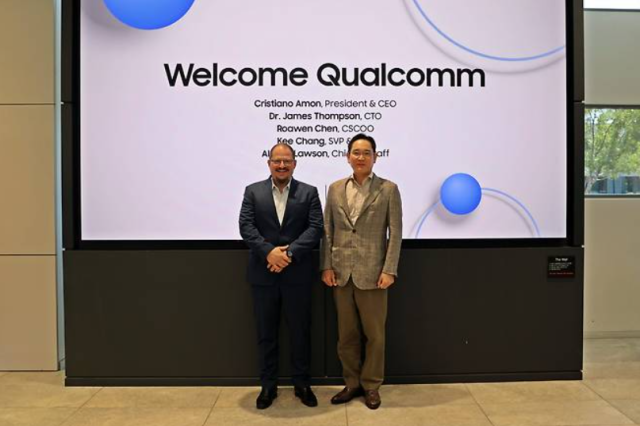
The remarks suggest Qualcomm expects to retain a substantial share of Samsung’s flagship processor business even as the Korean company continues developing its own Exynos chips. Samsung has historically balanced Snapdragon and Exynos processors across different Galaxy models and markets.
The broader smartphone outlook remains difficult.
Executives said global handset demand was expected to remain flat or decline in calendar 2027 following a low-to-mid-teens percentage contraction in 2026. Inventory reductions by smartphone manufacturers amplified the weakness this year, although Qualcomm does not expect a similar drag next year.
Rising semiconductor input costs are another concern. Qualcomm has begun raising product prices to offset those increases, with the full benefit expected in the second half of fiscal 2027.
In automotive chips, Qualcomm attributed its strong performance to the adoption of fifth-generation computing platforms with substantially more semiconductor content than earlier versions. Amon said the transition was turning the company’s pipeline of vehicle design contracts into revenue.
Qualcomm also discussed its newly announced partnership with SpaceX to supply technology for the expansion of Starlink’s wireless network.
The agreement covers semiconductor components for radio systems, including massive MIMO technology that uses large antenna arrays, as well as accelerators and network infrastructure software.
Amon said the financial contribution would begin toward the end of fiscal 2027, with a more meaningful revenue impact expected in fiscal 2028.
For the first quarter of fiscal 2027, Qualcomm forecast revenue of $10.4 billion to $11.2 billion and adjusted earnings per share of $2.15 to $2.35.
The company expects its semiconductor division’s pretax profit margin to range between 20 percent and 22 percent, reflecting investment in data center products and the inclusion of that business in the segment. Executives maintained a longer-term margin target of 30 percent.
Qualcomm’s challenge is to turn its growing presence in AI infrastructure and automotive computing into earnings quickly enough to offset declining Apple-related chip sales. For Samsung, the transition could expand a relationship in which it both buys Qualcomm processors and supplies technology behind them.

Copyright ⓒ Aju Press All rights reserved.