SEOUL, November 05 (AJP) - South Korea has yet to win a Nobel Prize in science whereas neighboring Japan has produced 23 science laureates since 2000, but the growing presence of artificial intelligence in human life may offer new opportunities for a breakthrough.
Seoul National University professor Kim Jang-woo can be one candidate.
He developed a computing architecture that shifts data movement and management tasks from central processing units to data processing units (DPUs), addressing a growing bottleneck in AI data centers.
Kim founded MangoBoost in 2022 to commercialize the technology, which the company says can more than triple data center performance while reducing server CPU usage by more than 50 percent compared with conventional architectures.
He is among the scientists Samsung Electronics has sought out and supported through a research funding program it has maintained for more than a decade.
Samsung said Thursday it has invested a cumulative 1.2 trillion won ($850 million) in 916 research projects since launching its Future Technology Development Program in 2013, involving more than 17,000 researchers across South Korea.
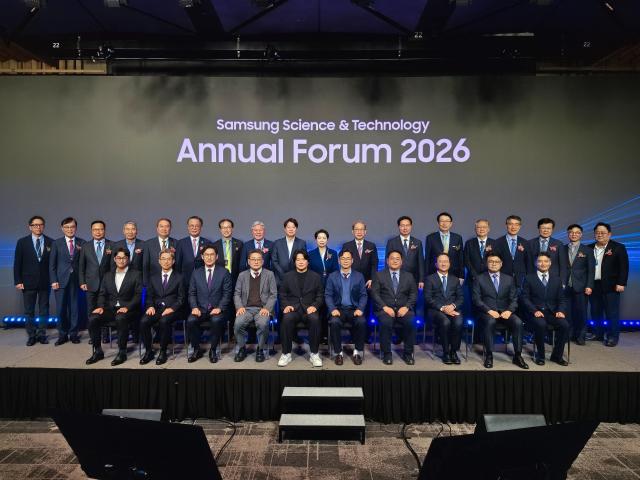
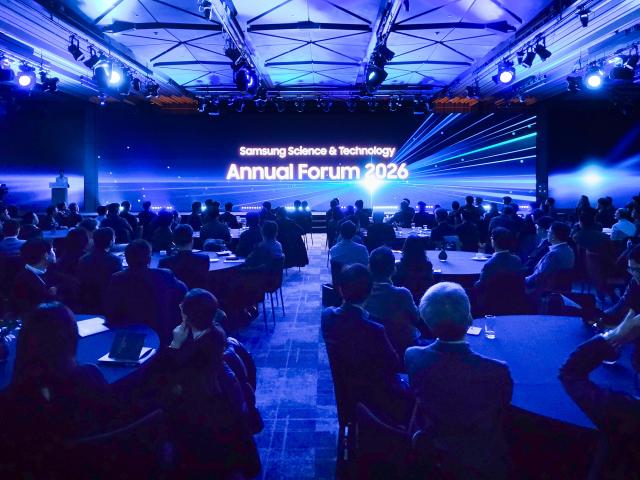
The company highlighted those achievements at its 2026 Annual Forum at the Westin Seoul Parnas in southern Seoul, where it honored 10 outstanding researchers for the first time in the program’s history.
The recipients were selected from 644 completed projects following a four-month evaluation of their scientific contributions, research potential and broader impact on academia and industry.
Among the honorees was Oh Sung-jin, a professor at the University of California, Berkeley, and the Korea Institute for Advanced Study, whose mathematical research has helped advance understanding of instability inside black holes.
Seoul National University professor Choi Jang-wook was recognized for developing materials aimed at improving the performance of water-based batteries, which offer a potentially safer alternative to conventional lithium-ion batteries for large-scale energy storage.
Samsung’s research support has also contributed to the emergence of Protina, an AI-based antibody drug development company founded by Seoul National University professor Yoon Tae-young. The company listed on South Korea’s KOSDAQ market in July 2025.
The examples reflect Samsung’s efforts to extend its research program beyond funding basic science, providing technical mentoring, intellectual property guidance and startup support to help translate academic discoveries into commercial technologies.
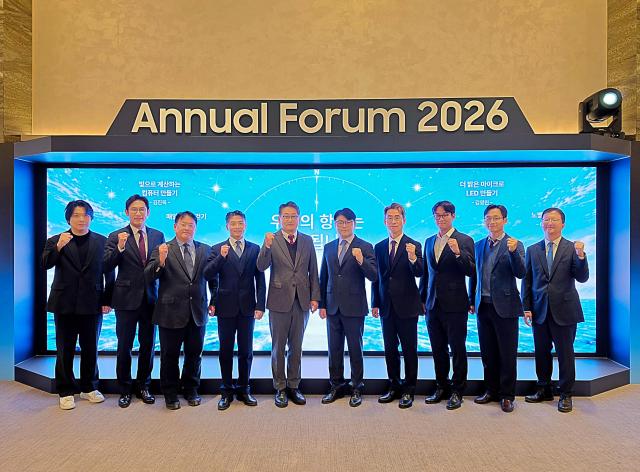
The 10 researchers honored Thursday represent four basic science fields and six materials and information technology disciplines. Samsung said it would provide additional support through technical workshops, industry exchanges and follow-up research opportunities.
“Over the past 14 years, researchers’ creative and ambitious work has accumulated, producing meaningful achievements that are helping advance South Korea’s science and technology,” said Kook Yang, chairman of the Samsung Science and Technology Foundation.
Samsung Advanced Institute of Technology President Park Hong-keun said the program had helped nurture young scientists and support research that extended beyond laboratories into startup creation.
The forum brought together approximately 450 researchers, government officials and industry representatives to discuss developments in fields ranging from mathematics and life sciences to energy storage, computing and AI robotics.

Copyright ⓒ Aju Press All rights reserved.