

"We do not build robots," Deepu Talla, Nvidia's vice president of robotics and edge AI, told NVIDIA AI Day Seoul 2026 at COEX, calling Nvidia a platform company. Its chips train a robot's brain, test it in simulation and run it on the machine, he said.
The bottleneck has been digital twins, or virtual copies of physical sites, Talla said. Building one took tens of engineers and artists several months. AI agents such as OpenAI's GPT-6 Astra, released in September, can now do the job by calling Nvidia's simulation libraries, which he said could make it about 100 times faster.
Car plants rank among the most automated in manufacturing, but their robots were programmed for fixed jobs, Talla said. Many other production lines change constantly. "There's not enough programmers to program these robots," he said.
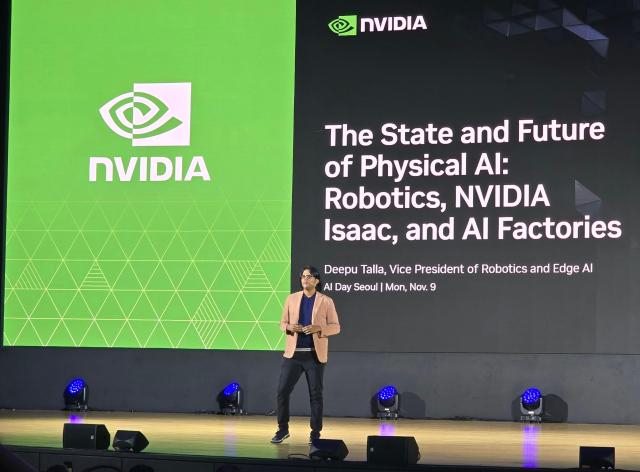
Talla named Doosan, LG Electronics, SK Telecom, SK hynix, and Ludo Robotics among the Korean companies using Nvidia's robotics tools.
"Korea is going to be super crucial to this journey in the next 10 years," he said.
AJP Takeaways
- Nvidia Vice President Deepu Talla said on Nov. 9, 2026, at Nvidia AI Day Seoul 2026 at COEX in Seoul that robots for Korean factories should be trained and tested in digital twins before deployment.
- Talla said AI agents, including OpenAI's GPT-6 Astra released in September 2026, could make building digital twins about 100 times faster. Until recently the job took tens of engineers several months.
- Talla said Nvidia has built a digital twin of a Hyundai Motor Group plant, and that Doosan, LG Electronics, SK Telecom, SK hynix, Ludo Robotics and RLWRLD use Nvidia's robotics tools.

Copyright ⓒ Aju Press All rights reserved.
