
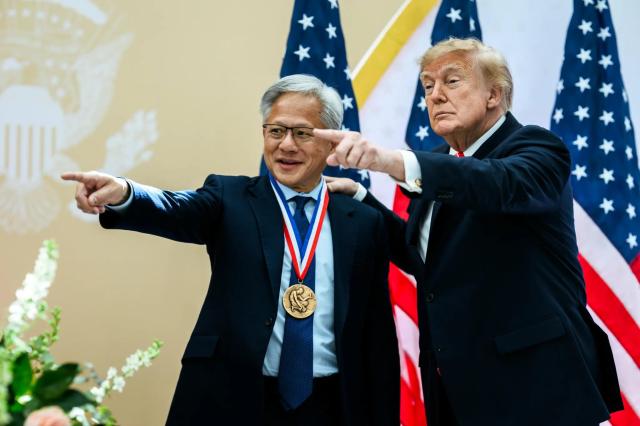
Jensen Huang, the defining figure of the global AI chip industry, is back at Nvidia after an 11-day exit. Wall Street cheered, sending the company’s shares soaring more than 30 percent. The response demonstrated how profoundly the fortunes of global financial markets can turn on the return of a single founder.
His reinstatement, however, raises questions that extend well beyond restoring stability to a company.
National security, the relationship between political power and business, board independence and the responsibilities of a technology leader all demand scrutiny.
The first obligation is to distinguish established facts from allegations. Investigations into whether Huang was targeted by Chinese intelligence are continuing. It has not been established that he participated in illegal technology transfers or disclosed sensitive information. China has also denied the espionage allegations. To treat suspicion as proof of a crime or a national security violation would offend the rule of law.
Unresolved allegations nevertheless require a rigorous assessment of potential security risks. AI chips are strategic assets. They help determine industrial productivity while supporting military, intelligence and cyber capabilities. Controlling where sensitive technology goes, who can access it and how it is used is a core responsibility of government.
Investigations into Nvidia’s exports to China and oversight of overseas customers must therefore proceed without interference. The central questions concern compliance with export controls, the adequacy of government licensing and supervision, and the safeguards against access through third countries. National security standards cannot rise and fall with a company’s market share or stock price.
President Donald Trump’s intervention presents a separate concern. He publicly supported Huang’s return and said his involvement was important. Nvidia’s board acknowledged receiving input from senior U.S. officials during its deliberations.
Government concern about the stability of a strategic industry is understandable. Disruption at Nvidia could have serious consequences for the American AI industry and global financial markets. Monitoring those risks is a legitimate exercise of public responsibility.
Political pressure over a private company’s leadership is another matter. If a president’s preferences take precedence over a board’s independent judgment, the damage could reach two essential foundations of American capital markets: confidence in corporate governance and the predictability of the law.
The United States has long drawn competitive strength from the rule of law, market institutions and managerial autonomy. Government can support technological development. Political direction of individual executive appointments must not become an accepted feature of that support.
Corporate responsibility also warrants closer attention. The chief executive of a global technology company exercises influence far beyond the organization itself. His decisions affect investors’ savings, employees’ livelihoods, competition between nations and the security of strategically important technologies.
That reach does not justify unlimited scrutiny of an executive’s private life. Nor should moral controversy automatically be treated as criminal conduct. The relevant public questions are whether personal relationships create conflicts of interest or security vulnerabilities, and whether the company has effective procedures to identify and manage them.
Those questions require objective investigation.
Nvidia’s independent investigative committee, its national security and export-control committee, and its planned appointment of a chief compliance officer are steps in the right direction. Their credibility will depend on their authority and the board’s willingness to act on their findings.
Directors must assess the evidence independently and explain their conclusions as transparently as legitimate confidentiality requirements allow. Congress and regulators must likewise proceed according to law and evidence, free from partisan calculations.
South Korea has a direct stake in the outcome. Samsung Electronics, SK hynix and Korean AI companies are deeply integrated into the U.S. technology ecosystem. Abrupt, politically driven changes in American export controls or technology policy would introduce further uncertainty into Korea’s industrial planning.
Seoul and Korean businesses therefore need durable strategies for technology, trade and security that can withstand changes in political leadership and corporate personnel. Personal access to an influential politician or executive is an inadequate foundation for long-term industrial security.
A technologically powerful country produces exceptional entrepreneurs. A mature system of government applies the same laws and principles to those entrepreneurs as it does to everyone else.
National security is a public responsibility, not a presidential prerogative to be invoked selectively. A rising share price grants no exemption from corporate accountability. Huang’s return will ultimately test whether America’s institutions can uphold the principles on which its technological leadership depends.
Copyright ⓒ Aju Press All rights reserved.
Related News
-
 Trump orders death penalty push for child killers
SEOUL, November 24 (AJP) - Child murderers and rapists and human traffickers who kill their victims will face federal death penalty prosecutions under a presidential directive U.S. President Donald Trump announced Monday at the Justice Department. The directive also calls for executions to be carried out quickly after jury verdicts. It requires that tenants who commit violent crimes be evicted from public housing more easily. Trump said Rep. Brandon Gill, a Texas Republican, has introduced a bill to write the measures into law. The bill would also seek death sentences for people who kill law enforcement officers and for illegal immigrants who commit murder. Trump aimed his remarks at California Gov. Gavin Newsom, a potential Democratic presidential contender, who commuted the sentences of all 548 inmates on the state's death row to life without parole. Trump called Newsom's commutations "one of the most shocking acts of injustice our country has ever seen." Tags: Donald Trump, U.S.A, Murder, Death Penalty, Sentence, Democrats
-
 Jensen Huang reinstated and Trump claims he was behind it
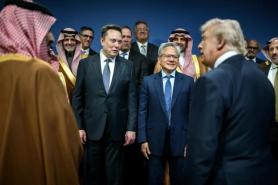
Elon Musk and Jensen Huang seen with President Donald Trump in a Saudi investment forum in 2025. (Courtesy of the White House) SEOUL, November 24 (AJP) -SEOUL, November 24 (AJP) — U.S. President Donald Trump personally intervened to secure the reinstatement of Jensen Huang as Nvidia's chief executive on Monday, reversing the AI chip giant's leadership decision just 11 days after Huang resigned amid an extramarital affair scandal and national security concerns. Trump enlisted Vice President JD Vance over the weekend to speak with Huang and Nvidia's board and provide assurances that Huang posed no national security risk and was not facing criminal charges related to suspected chip smuggling to China, The New York Times reported, citing two people familiar with the matter. "I believe my intervention was very important," Trump told CNBC on Monday. He said he had spoken directly and indirectly with Nvidia's board and discussed Huang's return with senior administration officials, including Vance and Treasury Secretary Scott Bessent. Nvidia announced that its board unanimously voted to reinstate Huang as president and CEO with immediate effect after receiving input from senior levels of the U.S. government. The decision reversed the board's position last week that Huang would not return to lead the company. Nvidia board chair Harvey Jones's reversal is particularly striking because he had explicitly ruled out Huang's return during the company's third-quarter earnings call on November 17. "The Nvidia board unanimously accepted his resignation and does not intend to reinstate Jensen as CEO," Jones told analysts at the time. But less than a week later Jones on Monday said "The Board believes Jensen is the right person to lead NVIDIA," adding that his reinstatement served the interests of shareholders, employees, partners and customers. Jones said the board had regained confidence in Huang following discussions with him and input from senior U.S. government officials, which convinced directors that his return posed no national security risk. "I am honored to return to NVIDIA and lead one of the most consequential technology companies in the world at the beginning of a new industrial revolution,” said Jensen Huang, according to the board statement. “I take this responsibility with the greatest humility and renewed commitment. I want to thank the NVIDIA Board for its confidence and deliberation through this process. I am especially grateful to Harvey Jones for his leadership as Chair, and to Colette Kress and our executive staff for leading NVIDIA during this period." "I am also deeply thankful to our employees, shareholders, leaders across the industry and partners around the world for their extraordinary support. Above all, I am grateful for the love and support of my family. I can’t wait to get back to work.” Huang resigned on November 12 following revelations of extramarital affairs, including one with a Chinese businesswoman suspected of ties to Beijing's intelligence services. U.S. authorities are also investigating possible illegal shipments of advanced Nvidia chips to China involving a company associated with the woman. His reinstatement stopped global AI rout, with Nvidia shares surging more than 30 percent on Monday and other AI semiconductor stocks posting double-digit gains. The Nasdaq Composite jumped more than 6 percent in afternoon trading. Wall Street's dramatic rebound following Jensen Huang's return to Nvidia could reverse the tide in South Korea's battered stock market on Tuesday, after the KOSPI suffered another 3 percent plunge to its lowest closing level in more than 10 months. The KOSPI closed Monday down 161.42 points, or 3.31 percent, at 4,708.54, its lowest finish since January 13. The index briefly sank below 4,600 during the session as selling intensified in semiconductor and other AI-related stocks. The tech-heavy KOSDAQ lost 1.58 percent to close at 635.45. Tags: Donald Trump, Nvidia, Jensen Huang, Nvidia stock surge, AI stocks rally, Nasdaq, SK hynix, Micron Technology, Donald Trump, semiconductor stocks, Wall Street recovery, KOSPI, KOSDAQ
-
 Trump-Kim meeting in Shenzhen flops at the last minute: WSJ
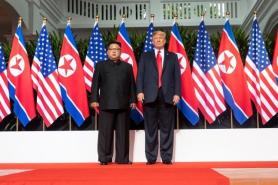
U.S. President Donald Trump and North Korean leader Kim Jong-un pose for photos during their summit in Singapore on June 12, 2018. Courtesy of the White House SEOUL, November 22 (AJP) - The United States and North Korea explored a last-minute meeting between President Donald Trump and North Korean leader Kim Jong-un during Trump’s trip to Asia, but Kim set terms Washington could not accept, The Wall Street Journal reported Saturday. The Journal cited people familiar with the discussions and did not specify Kim’s demands. A Trump administration official disputed the account, telling the newspaper that the administration had made no effort to arrange a meeting. U.S. officials considered a declaration formally ending the Korean War and a statement that would leave open the question of North Korea’s nuclear status without calling on Pyongyang to give up its weapons, the Journal reported. In return, Washington would seek limits on North Korean nuclear and missile tests. U.S. officials also discussed opening liaison offices. Trump pointed to his schedule when asked Thursday why he and Kim had not met. He was returning to Washington from the Asia-Pacific Economic Cooperation summit in Shenzhen, China. “The relationship is there, but we didn’t meet,” Trump told NBC News correspondent Gabe Gutierrez. “We’ll have that meeting at some point.” Trump had tried to reach Kim by phone last year and wrote to him when his calls went unanswered, the Journal reported. A group acting at the White House’s direction handed the letter to a North Korean diplomat outside Pyongyang’s U.N. mission in Manhattan. The diplomat later tossed it, still unopened, in front of a U.S. representative at a U.N. meeting, according to the report. At their first summit, in Singapore in 2018, Kim pledged to work toward the complete denuclearization of the Korean Peninsula. A second summit in Hanoi in February 2019 ended without a deal. The two leaders last met four months later at Panmunjom, the truce village on the inter-Korean border. Kim told a ruling Workers’ Party congress in February that better relations were possible if Washington respected North Korea’s nuclear status and dropped what he called its policy of confrontation. The Stockholm International Peace Research Institute estimated that North Korea had about 60 nuclear warheads in January 2026, up from its estimate of 20 to 30 in January 2019.