

Journalist

Joonha Yoo유준하
joonhayoo94@ajupress.com
ReporterCOEX Sejong Center for the Performing Arts & Music, Culture, Entertainment, Automotive
Joonha Yoo is a bilingual journalist at AJU Press (AJP), covering music, culture, entertainment and Korea’s automotive industry.
Raised in Fort Collins, Colorado, he often writes from the scene, bringing firsthand detail to stories ranging
from BTS comeback concerts to unique cultural events that catch the world's eye. "I write from the scene, not from the sidelines."
Raised in Fort Collins, Colorado, he often writes from the scene, bringing firsthand detail to stories ranging
from BTS comeback concerts to unique cultural events that catch the world's eye. "I write from the scene, not from the sidelines."
Latest by Joonha Yoo
-
 Cheap currencies bring two neighbors closer than ever SEOUL, August 04 (AJP) - Cheap currencies, short flights and a growing fascination with each other's culture are bringing South Koreans and Japanese closer than at any time in decades, quietly reshaping one of Asia's most complicated relationships one weekend trip at a time. For 23-year-old South Korean college student Kim Yi-hyun, the favorite destination over the past year has been Japan. "As a student, I don't have much money," Kim said. "Japan is close, affordable and has so many things I like." Across the Korea Strait, 33-year-old Tokyo resident Takuya Emonato has been making the journey in the opposite direction. He has visited Seoul, Busan and Jeju and frequently travels to South Korea with his girlfriend for its nightlife, cosmetics and food. They are already planning another trip this winter for a ski holiday. "Korea is fun, joyful and very lively," Emonato said. "A lot of places stay open late, and the cosmetics scene is crazy. My girlfriend goes wild." Historical grievances have long defined relations between South Korea and Japan. Colonial-era disputes, wartime history and competing claims over the Dokdo islets still periodically inflame politics, while sporting contests often rekindle old rivalries. Yet those tensions are increasingly absent from the travel experiences of younger generations, who are crossing the Korea Strait in record numbers. Several forces have converged this year. Weak exchange rates have made travel more affordable on both sides, while higher fuel costs have pushed up long-haul airfares. At the same time, Japan's shopping, food and anime culture and South Korea's K-pop, beauty products and nightlife have given young travelers more reasons than ever to cross the narrow stretch of sea separating the two countries. To a growing share of younger people, the neighboring country is becoming less defined by politics and history than by restaurants, concerts, cosmetics, character stores and weekend getaways. A Korea-Japan public opinion survey released Aug. 3 by the East Asia Institute and the International House of Japan found that 54.3 percent of South Koreans held a favorable view of Japan, the highest level since the survey began in 2013 and up from 52.4 percent a year earlier. Japanese favorability toward South Korea remained lower but rose much more sharply, climbing 10.5 percentage points from 24.8 percent to 35.3 percent. The survey covered 3,099 adults in the two countries between July 17 and 21. The figures do not show equal levels of affection. Only about one in three Japanese respondents viewed South Korea favorably. What stands out is that sentiment improved simultaneously on both sides. A separate survey by Hankook Ilbo and Japan's Yomiuri Shimbun found that respondents aged 18 to 29 held the most favorable views of the other country in both nations, suggesting younger generations are driving much of the change. The same poll also found relatively unfavorable views of South Korea among supporters of Japan's emerging right-wing parties, underscoring that the improvement is neither universal nor immune to political tensions. The shift in sentiment has coincided with a tourism boom. South Koreans made 5.68 million visits to Japan in the first half of 2026, up 18.6 percent from a year earlier and the largest number among all foreign visitors, according to the Japan National Tourism Organization. Travel in the opposite direction is also rising. South Korea welcomed about 940,000 Japanese visitors in the first quarter, up 20.2 percent from a year earlier, according to the Ministry of Culture, Sports and Tourism. Currency has helped fuel the trend, particularly for South Koreans. The cost of 100 yen briefly fell below 890 won in late July, reinforcing Japan's appeal as an inexpensive destination just a short flight away. But exchange rates alone cannot explain why travelers keep returning. Lee Hoon, a professor at Hanyang University's Graduate School of International Tourism, said travelers generally choose destinations in two stages. Affordability, safety and cleanliness determine whether a country is considered a realistic destination, while food, culture, entertainment and distinctive neighborhoods determine whether people actually want to visit. "Exchange rates and travel costs create the basis for choosing a country people can afford to visit," Lee said. "But a destination needs cultural content and tourism appeal to become somewhere people genuinely want to go." Geography reinforces both factors. Neighboring countries naturally generate large tourism flows because they are easier and cheaper to reach, Lee said, pointing to travel among the United States, Canada and Mexico. The recent acceleration between South Korea and Japan, however, is also being driven by younger travelers and growing Japanese interest in Korean culture. BTS is one part of that attraction, Lee said, but only one element of a broader ecosystem that includes Korean music, food, cosmetics, television dramas and digital entertainment. Both countries' reputations for safety, efficient public transportation and digital convenience have also made travel easier and more appealing for young visitors. Kim initially chose Japan because it was close and affordable, but she kept returning for its character stores, food and sense of safety. Although she had heard reports of Korean tourists facing hostility, she said she had never experienced it herself. Restaurant staff often handed her Korean-language menus after realizing where she was from, making her feel welcome. Emonato recalled a similar experience in South Korea. During one visit, his phone battery died while he was trying to find a railway station. A stranger walking in the opposite direction stopped, walked him to the station and recommended other places to visit along the way. "I don't think he helped me because I spoke English," Emonato said. "I think he was just genuinely kind." He also said he felt comfortable walking around Seoul late at night with his girlfriend because of the city's busy streets and visible police presence. For South Koreans, Japan's appeal extends beyond sightseeing to character goods, anime merchandise, model kits and the vast selection at retailers such as Don Quijote, which has no real equivalent in South Korea. For Japanese consumers, South Korea has become synonymous with beauty products and digital entertainment. Korean cosmetics accounted for 30.8 percent of Japan's imported cosmetics market in 2025, keeping South Korea in first place for a fourth consecutive year after overtaking France in 2022, according to the Japan Cosmetic Importers' Association. Korean brands captured 43.3 percent of Japan's imported skincare market. Japan is also South Korea's largest overseas market for webtoons, accounting for 49.5 percent of exports, ahead of North America at 21 percent and Greater China at 13 percent, according to the Korea Creative Content Agency. The numbers do not prove that tourism alone has improved public sentiment, nor do warmer opinion polls erase historical and territorial disputes that can quickly return to the center of bilateral relations. But they do point to a quieter transformation beneath official diplomacy. Increasingly, young South Koreans and Japanese are discovering each other not through history textbooks or political rhetoric, but through weekend flights, cosmetics counters, anime shops, K-pop concerts, neighborhood restaurants and ordinary acts of kindness. Sometimes the shortest distance between two countries is not measured in kilometers, but in curiosity. 2026-08-04 17:23:24
 -
 A Twosome Place gains ground as Starbucks struggles with 'Tank Day' controversy SEOUL, August 4 (AJP) - South Korea's oversaturated coffee market is showing signs of a potential seismic shift, as Starbucks, the long-dominant market leader, has taken a hit to sales and reputation following its so-called "Tank Day" controversy, while rivals such as A Twosome Place have gained ground in recent months. A Twosome Place recorded an estimated 117.05 billion won in card payment transactions in July, according to Mobile Index, a data platform operated by IGAWorks, while Starbucks Korea posted 110.06 billion won during the same period, a gap of about 7 billion won. The figures are based on estimates rather than audited sales, but they offer a snapshot of changing consumer spending patterns across South Korea's major coffee chains. A Twosome Place first overtook Starbucks Korea in monthly card payments in May, marking the first such reversal in the three years of available data, and has remained ahead every month since. From May to July, A Twosome Place saw cumulative estimated card payment transactions of 361.38 billion won, compared with 331.64 billion won for Starbucks Korea, a gap of roughly 30 billion won. The shift followed intense backlash over a May 18 promotion for Starbucks Korea's "Tank" tumbler line. The date marks the anniversary of the 1980 Gwangju pro-democracy uprising, when South Korea's military government violently suppressed demonstrations. Critics said the campaign's language and timing were insensitive to victims of state violence and to the family of Park Jong-chul, a student activist whose 1987 torture death helped galvanize the country's democracy movement. Starbucks Korea halted the promotion and issued an apology. Shinsegae Group Chairman Chung Yong-jin, whose E-Mart affiliate operates Starbucks Korea, dismissed SCK Company CEO Son Jung-hyun and ordered disciplinary measures against the executive who oversaw the campaign, as well as other staff involved. Chung later issued a public apology over the controversy. The gap narrowed in July. Starbucks Korea's estimated payments rose 9.6 percent from June, while A Twosome Place's fell 3 percent, suggesting the shift in consumer spending may not be settled. The data also suggest that the controversy may have accelerated a trend that was already building before May, as A Twosome Place and low-cost chains gained ground. A Twosome Place has topped 100 billion won in monthly estimated payments for 15 consecutive months as of July. Mega MGC Coffee, one of South Korea's fast-growing low-cost chains, reached 98.21 billion won in July, closing in on the 100 billion won mark, up 1.6 percent from June. Paik's Coffee recorded 24.5 billion won, roughly flat from the previous month. The numbers point to a more crowded coffee market, where Starbucks Korea is no longer competing only with premium rivals like A Twosome Place, but also with lower-priced chains that have expanded rapidly through smaller-format stores and cheaper drinks. For Starbucks, the question is whether July's rebound will continue. For its rivals, the past three months have offered a rare opening in a market long defined by Starbucks' brand power. 2026-08-04 11:27:07
 -
 KOSPI slips as chipmakers fall; KOSDAQ surges 5% SEOUL, August 04 (AJP) - Korean shares diverged sharply Tuesday morning, with the benchmark KOSPI slipping as heavyweight semiconductor and automobile stocks declined, while the tech-heavy KOSDAQ surged 5 percent on institutional buying and gains in biotechnology and optical communications shares. As of 10:30 a.m., the KOSPI stood at 6,217.20, down 0.6 percent from the previous session. The index moved between an intraday high of 6,389.40 and a low of 6,080.30. Retail investors bought 426 billion won ($299 million) worth of shares, while foreign investors purchased 226.6 billion won. Institutions sold 706.2 billion won. Samsung Electronics fell 2.3 percent to 234,000 won, while SK hynix declined 2.7 percent to 1,524,000 won. SK hynix said it and U.S. storage company SanDisk had unveiled the first standard specifications for high-bandwidth flash, or HBF, at the Future of Memory and Storage 2026 conference in California. The standard supports eight- and 16-layer NAND structures with capacities of up to 512 gigabytes and data-transfer speeds ranging from about 0.4 terabytes to 3 terabytes per second. It uses the Universal Chiplet Interconnect Express interface to connect with processors including graphics and central processing units. Automobile stocks also weakened. Hyundai Motor fell 3.2 percent to 380,500 won, while Hyundai Mobis dropped 4.5 percent to 471,500 won. Naver surged 9.9 percent to 228,000 won amid reports that the company was preparing to establish a new operator for an artificial intelligence factory and had outlined the business structure for the first phase of a 200-megawatt project. SK Eternix jumped 22 percent to 56,800 won, while SK Telecom climbed 12.2 percent to 92,000 won. The KOSDAQ stood at 773.96 at 10:30 a.m., up 5 percent. The index traded between an intraday high of 774.93 and a low of 748.20. Institutions bought 254.4 billion won worth of KOSDAQ shares. Retail investors sold 85.5 billion won, while foreign investors offloaded 166.1 billion won. Internet and catalog retailing shares rose 10.21 percent. Silicon2 advanced 12.03 percent, while Gradient gained 3.59 percent. Biotechnology stocks climbed 9.4 percent. AbClon surged 23.23 percent and Rznomics rose 22.2 percent. Optical communications shares gained 9 percent, with Raicom jumping 28.6 percent and RF Materials advancing 20.8 percent. Immuno-oncology stocks rose 8.1 percent. Qriant surged 29.9 percent, while AbClon gained more than 23 percent. Among other KOSDAQ stocks, Taihan Fiberoptics rose 8.5 percent to 10,040 won and Winix gained 7 percent to 6,270 won. ICH dropped 9.7 percent to 906 won, while Deepnoid fell 3.3 percent to 1,546 won. U.S. stocks closed sharply higher overnight. The Dow Jones Industrial Average rose 1.32 percent to a record 53,178.41, while the S&P 500 gained 1.48 percent to 7,600.50. The Nasdaq Composite climbed 2.13 percent to 25,913.90. U.S. Treasury yields declined, with the two-year yield falling 5.4 basis points to 4.237 percent and the 10-year yield dropping 5.9 basis points to 4.676 percent. Oil prices rebounded modestly during Asian trading after sharp overnight losses triggered by renewed hopes for a diplomatic easing between the United States and Iran. Expectations that talks could lead to the reopening of the Strait of Hormuz reduced concerns over disruptions to global crude shipments. Supply conditions also improved as Kazakhstan resumed exports through the Caspian Pipeline Consortium and Turkey and Iraq extended a major pipeline agreement. West Texas Intermediate crude had settled 5.11 percent lower at $80.34 a barrel, while Brent crude rose 0.7 percent to $84.36 in the previous session. WTI rose 0.7 percent to $80.90 during Asian trading Tuesday morning. The Korean won strengthened by 6.6 won, or 0.5 percent, to 1,424.2 won against the U.S. dollar. Moreover, Japan’s Nikkei 225 fell 0.9 percent to 63,206.08. China’s Shanghai Composite edged up 0.04 percent to 3,811.30, while Hong Kong’s Hang Seng Index was nearly unchanged, rising 0.01 percent to 26,012.10. 2026-08-04 11:20:30
 -
 AI becomes K-drama ingredient as soaring costs reshape filmmaking SEOUL, August 03 (AJP) - A recent K-drama hit, Agent Kim: Reactivated, had all the ingredients of a blockbuster action sequence — North Korean agents, a former security-service commando, gangsters, explosions and a high-speed chase through a snow-covered tunnel ending in a plunge into icy water. None of it was filmed. The roughly three-minute sequence that fooled audience as an expensive location shoot was generated entirely with artificial intelligence. Described by its creators as the first full sequence in a Korean commercial drama produced with generative AI rather than live-action photography, the scene has become a test case for an industry confronting soaring production costs, shrinking advertising revenue and increasingly tighter production schedules. The experiment also reached far beyond South Korea. Agent Kim: Reactivated debuted at No. 1 on Netflix's global non-English TV chart with 10.5 million views and retained the top spot the following week with 9.1 million. The figures do not show whether audiences embraced the AI-generated sequence itself, but they placed the experiment inside one of Korea's most widely watched television exports. Its significance lies less in whether AI can produce spectacular images than in why it was used. The sequence was initially planned as a conventional shoot but was deemed impractical because of the locations, action scenes and visual effects it required, according to Ryu Jae-hwan, deputy head of Morpheus Studio, the AI production company behind it. Hong Sung-chang, chief executive of the drama's production company Studio S, said producing the sequence with AI reduced costs by more than 60 percent compared with filming it conventionally. The savings mattered, Hong said, but so did preserving scenes that otherwise would have been abandoned because they were too dangerous, too expensive or simply impossible to shoot. That distinction illustrates the role AI is beginning to occupy in Korean film and television. It is not replacing the industry's highest-end visual-effects work. Instead, it is filling the widening gap between what directors want to show and what producers can afford to film. The Agent Kim sequence was not created at the push of a button. Morpheus Studio spent about a month developing visual concepts and another two months producing the footage. The team generated roughly 1,000 still images and more than 2,000 video clips before selecting 289 shots for the final sequence. Human judgment remained central throughout the process — from designing costumes and locations to selecting shots, editing the sequence and correcting color. The production therefore challenges the assumption that generative AI simply removes labor from filmmaking. It may reduce the need for physical sets, location shoots, stunt work and some conventional visual effects, but it replaces them with a new workflow built around repeated generation, evaluation and refinement. Traditional VFX, however, still offers greater control. "With sufficient time and production resources, there is no visual element we cannot create," said Kim Gyu-min, a spokesperson for Dexter Studios, one of South Korea's leading visual-effects companies. The amount of work varies dramatically depending on the shot, Kim said. Adding a single flying object to filmed footage bears little resemblance to constructing an entire computer-generated battle scene. The more complex and detailed the image, the more artists and production time are required. Lighting illustrates the difference. VFX artists must reproduce the direction and intensity of light, along with shadows, reflections and atmospheric effects, so that computer-generated objects blend seamlessly into filmed environments. Dexter treats lighting as a separate stage in its production pipeline, Kim said. Daylight scenes are particularly demanding because of the sharp contrast between illuminated and shaded surfaces. A film director, who had not viewed the Agent Kim sequence but discussed generative AI more broadly, also questioned whether AI-generated footage could consistently blend into a longer dramatic production. An AI clip may appear realistic on its own, the director said, but every sequence must match the color, camera movement, characters and physical environment of the scenes before and after it. Viewers are especially sensitive to inconsistencies in brightness and shadow, making daylight CG and VFX particularly unforgiving. The technical capability of Korean VFX companies is rarely the limiting factor; production time and budgets often determine the final quality. Yet VFX companies are not resisting the technology. They are increasingly incorporating it. Dexter already uses AI for repetitive post-production tasks, including removing visible stunt wires. Work that artists once completed manually frame by frame can increasingly be automated, allowing them to devote more time to complex shots that still require human judgment. AI is also opening possibilities for sequences that would otherwise require extensive sets, location shoots and large production crews, Kim said. It may not yet match the finish of a scene produced through conventional filming and post-production, but it can provide a practical alternative when traditional methods are no longer financially viable. The emerging production model is therefore more likely to combine AI with conventional VFX than force a choice between them. AI accelerates visual experimentation and automates routine tasks, while traditional VFX provides the precision needed to control and integrate the final result. The pressure to adopt those tools is particularly acute for broadcasters. EBS President Kim Yu-yeol said total television advertising revenue has fallen from about 2.1 trillion won ($1.5 billion) two decades ago to roughly 550 billion won last year. During the same period, the production cost of a single drama episode rose from between 50 million won and 100 million won to between 2 billion won and 3 billion won. In one AI animation experiment, Kim said, EBS reduced production costs to one-fortieth of those required under conventional methods. For broadcasters facing shrinking advertising income and sharply rising production costs, AI is no longer merely an experimental technology. It is increasingly becoming a survival tool. EBS has expanded AI-assisted programming, including the terrestrial drama Resurrection Class, while KBS has developed an AI television studio that automates camera tracking and plans to extend the system to news, interview and educational programming. The economic and creative arguments are not mutually exclusive. Lower production costs can preserve scenes that otherwise would be cut, turning cost savings into greater creative ambition. But the technology also introduces new risks. Ryu said Morpheus Studio discovered that one AI model unintentionally generated the face of a real actor with no connection to the production. The team subsequently verified AI-generated characters through image searches to reduce the risk of using recognizable faces without consent. The episode raises unresolved questions about how actors' likenesses enter AI training data and who bears responsibility when AI-generated characters resemble real people. Audience acceptance also remains uncertain. A December 2025 Hankook Research survey of 1,000 adults found that 49 percent felt uncomfortable with advertising or entertainment containing AI-generated images or video. The figure rose to 71 percent among respondents aged 18 to 29. At the same time, 81 percent viewed the spread of AI-generated content as a natural consequence of technological progress. The findings suggest audiences may regard AI's expansion as inevitable while remaining cautious about how it is used and disclosed. The Netflix rankings and domestic television ratings for Agent Kim: Reactivated cannot determine whether viewers embraced its AI-generated sequence. It remains unclear how many even knew how it had been created. What the production does establish is that generative AI has moved beyond demonstration videos and isolated experiments. It has entered mainstream television production, reached a global audience and delivered a sequence that producers say would have been prohibitively expensive to film conventionally. For now, AI cannot offer the same precision and consistency as established visual-effects techniques across every type of scene. Nor does it eliminate the need for artists, editors or creative judgment. Its first major role in Korean television may instead prove more pragmatic: not replacing images the industry already knows how to create, but making possible the ones it can no longer afford to shoot. 2026-08-03 17:53:14
 -
 aespa to launch world tour with global cinema livestream from Seoul SEOUL, August 03 (AJP) - K-pop girl group aespa will kick off its new world tour this week, with the opening concert simultaneously screened in movie theaters across 11 regions worldwide. SM Entertainment said Monday that the first show of "2026-27 aespa LIVE TOUR – SYNK : COMPLaeXITY" on Aug. 7 will be broadcast live in 146 cinemas across 11 markets, including South Korea, allowing fans around the world to watch the group's world tour opener in real time. The second night's performance on Aug. 8 will instead be livestreamed globally through Beyond LIVE and Weverse. The two concerts will take place at Gocheok Sky Dome, marking aespa's first standalone performances at the venue and the opening of a tour that will visit 25 cities across Asia, North America, South America and Europe. In Korea, four theaters operated by Megabox, one of the country's three major multiplex chains, alongside CGV and Lotte Cinema, will participate in the live-viewing event. Three of them will become the first cinemas in the country to present a concert using AI-powered immersive audio technology, pairing spatial audio with 4K projection to deliver a more immersive viewing experience. The rollout reflects a broader trend in K-pop, with agencies increasingly turning to theatrical live viewings to reach fans unable to attend concerts in person. Groups including BTS, SEVENTEEN and IVE have all adopted the format as demand for large-scale concert broadcasts has continued to grow. The SYNK : COMPLaeXITY tour follows aespa's 2024-25 SYNK : PARALLEL LINE world tour and comes after the release of the group's second studio album, "LEMONADE," in May. The album debuted at No. 9 on the Billboard 200, becoming aespa's third top-10 entry on the U.S. albums chart. 2026-08-03 17:38:07
 -
 South Korean soprano Sumi Jo receives Maria Callas SEOUL, August 03 (AJP) - South Korean soprano Sumi Jo has received the 12th Premio Internazionale Maria Callas, becoming the first Asian artist to receive the Italian honor in the year she marks the 40th anniversary of her international debut. PRM, Jo's publicity agency, said Monday that she accepted the award in Verona on Sunday, where organizers hold the annual ceremony each Aug. 2, the anniversary of Maria Callas' debut at the Arena di Verona in 1947. The prize recognizes artists who have made lasting contributions to opera and classical music, and previous recipients include director Franco Zeffirelli and baritone Leo Nucci. In a statement, Jo said the timing made the honor especially meaningful because she received the award exactly 79 years after Callas made her own Verona debut in the same city. She described it as one of the most meaningful moments of her career. The award comes during a milestone year for Jo, one of South Korea's most internationally acclaimed classical musicians. She launched her international career after winning Italy's Carlo Alberto Cappelli International Singing Competition in 1986 and has since appeared at many of the world's leading opera houses, including the Metropolitan Opera, La Scala, the Royal Opera House and the Vienna State Opera. This year, she has marked the anniversary with the release of the commemorative album "Continuum" and the second Sumi Jo International Singing Competition, held in France in July. She is also preparing for an international tour later this year. Jo will return to Korean audiences with a concert celebrating the 40th anniversary of her international career at the Seoul Arts Center on Sept. 4. 2026-08-03 17:37:32
 -
 South Koreans warmer toward Japan than ever SEOUL, August 03 (AJP) - South Koreans have never viewed Japan more favorably, while Japanese attitudes toward South Korea also improved sharply, with public sentiment between the two neighbors reaching its warmest level on record despite unresolved historical disputes, a joint annual survey showed Monday. South Koreans' favorable view of Japan rose to a record 54.3 percent, up from 52.4 percent a year earlier, according to the 13th annual survey jointly conducted by the East Asia Institute (EAI) in Seoul and the International House of Japan (IHJ). The findings were released at a joint press conference in central Seoul. The figure has climbed steadily since bottoming out at 12.3 percent in 2020 and has remained above the 50 percent mark for a second consecutive year — the highest level recorded since the survey began. Unfavorable views stood at 38.5 percent, while 7.2 percent of respondents said they held a neutral view. The results suggest that people-to-people exchanges have become a stronger driver of bilateral perceptions than diplomatic tensions. Among South Koreans with favorable impressions of Japan, 66.9 percent cited the country's orderly society and courteous public culture as the main reason, while 43.9 percent pointed to Japanese food, shopping and tourism. Researchers said the continued surge in two-way travel has played a central role in improving perceptions. Historical issues nevertheless remained the biggest obstacle to warmer ties. Among respondents with unfavorable views of Japan, 74.9 percent cited what they considered Japan's insufficient reflection on its wartime past. Another 46.9 percent pointed to the territorial dispute over the Dokdo islets, while 42.0 percent cited unresolved issues surrounding wartime forced labor and military sexual slavery. The improvement in public sentiment was also reflected in broader assessments of bilateral relations. The share of South Koreans describing current Korea-Japan relations as "good" nearly doubled to 20.6 percent from 10.6 percent a year earlier. A majority, 59.1 percent, described relations as "average," while 20.6 percent said they remained "bad." Japanese respondents also reported significantly warmer attitudes toward South Korea. The proportion holding favorable views rose 10.5 percentage points to 35.3 percent, while unfavorable opinions fell to 44.1 percent from 51.0 percent a year earlier. Researchers attributed the improvement to the sustained popularity of Korean culture, food and tourism in Japan, as well as a more favorable view of President Lee Jae Myung following the resumption of shuttle diplomacy between Seoul and Tokyo. The survey was conducted online between July 17 and 21 among 3,099 adults aged 18 and older, including 1,547 respondents in South Korea and 1,552 in Japan. 2026-08-03 16:14:08
 -
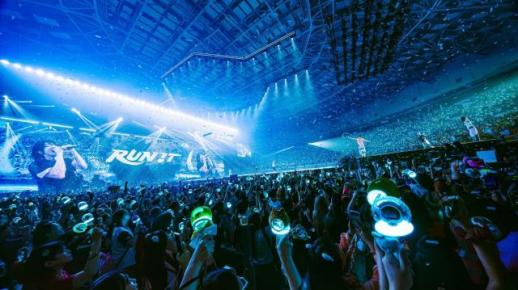 Stray Kids kicks off RUN IT world tour with five sold-out Seoul concerts SEOUL, August 03 (AJP) - K-pop boy group Stray Kids successfully wrapped up it's five sold-out concerts in Seoul, officially kicking off its "RUN IT" world tour and giving fans an early preview of music from its upcoming mini album, "THIS & THAT," JYP Entertainment said Monday. The JYP Entertainment group performed at Seoul's KSPO Dome on July 25-26, July 29 and Aug. 1-2, drawing capacity crowds across all five dates. The Seoul concerts marked the opening leg of RUN IT, which is scheduled to continue across Asia with stops in Japan, Hong Kong, Taiwan, Thailand and Singapore through March 2027. Across the five shows, Stray Kids revisited its musical journey, opening with the 2017 pre-debut track "Hellevator" and debut single "District 9" before moving through later hits including "God's Menu," "Thunderous," "S-Class" and "Chk Chk Boom." A 59-meter panoramic LED screen, live band arrangements and expanded stage production formed the centerpiece of the performances. The group also introduced two unreleased songs from "THIS & THAT" — "I Do" and "After You" — ahead of the mini album's release on Aug. 7. During the final Seoul concert, Stray Kids surprised fans by unveiling the first music video teaser for the title track. During the encore, the members said the concert was designed to reflect the journey Stray Kids has shared with its fans. "Because of STAY, we've found the energy to keep running forward" the group said throughout the concert. The Seoul run also included a surprise celebration marking the birthday of the group's official fan club, STAY, during the Aug. 1 performance. The concerts come during another active year for Stray Kids. In June, the group became the first K-pop act to headline New York's Governors Ball Music Festival and is scheduled to headline Rock in Rio in Brazil on Sept. 11. Their first mini album of 2026, "THIS & THAT," will be released at 1 p.m. (0400 GMT) on Aug. 7. 2026-08-03 11:35:02
 -
 NCT 127 launches interactive 'CALL 127' campaign ahead of new album SEOUL, August 03 (AJP) - K-pop boy group NCT 127 has launched an interactive promotional campaign ahead of its seventh studio album, "BLINGY," built around the idea that fans are the ones calling the group into action, SM Entertainment said Monday. SM Entertainment opened the CALL 127 website at midnight Monday as the centerpiece of the campaign leading up to the album's Aug. 24 release. Styled as a command center, the site allows visitors to browse teaser materials while following a storyline that casts NCT 127 as a team responding to calls across Seoul. A signature feature lets users press a "CALL 127" button to hear voice messages from the members, creating the impression of direct communication with the group. The website also includes behind-the-scenes images from the teaser shoot and will serve as a hub for online and offline promotional events throughout the comeback. The campaign expanded Monday with the release of the first three episodes of a trailer series on NCT 127's official YouTube channel. The videos follow Haechan, Jaehyun and Yuta as mysterious signals begin interrupting their everyday routines, setting up a storyline that will continue throughout the promotional campaign. The concept ties into what SM describes as the album's "One Team" theme, emphasizing the connection between the members and their fans through an ongoing narrative rather than standalone teaser content. "BLINGY" will be released at 6 p.m. (0900 GMT) on Aug. 24 across major streaming platforms. The nine-track album marks NCT 127's first full-length release since "WALK" in 2024 and arrives as the group celebrates the 10th anniversary of its debut this year. Since debuting in 2016, NCT 127 has established itself as one of SM Entertainment's flagship acts with songs including "Cherry Bomb," "Kick It," "Sticker" and "Fact Check." Following the album's release, the group will launch its fifth world tour, "NEO CITY – THE REDLINE," beginning with three concerts at Seoul's KSPO Dome from Sept. 18 to 20 before continuing across Asia. 2026-08-03 11:34:50
 -
 Cortis teams with Juicy J for 'Motion' ahead of Lollapalooza debut SEOUL, July 31 (AJP) - K-pop rookie boy group Cortis has enlisted Academy Award-winning rapper Juicy J for its latest digital single, "Motion," as the rookie group prepares for its debut appearance at Lollapalooza Chicago this weekend. BigHit Music said Friday that the track was released at 1 p.m. KST. Drawing inspiration from the Memphis hip-hop sound that emerged in the U.S. South during the 1990s, "Motion" reinterprets the genre through the group's own musical identity. All members of Cortis participated in writing and composing the song, while Juicy J appears as a featured artist. A founding member of Three 6 Mafia, the Memphis rapper won an Academy Award for "It's Hard out Here for a Pimp" from the film Hustle & Flow and has collaborated with artists including Katy Perry, Megan Thee Stallion and Travis Scott. Cortis said the project grew out of a relationship established before its debut. "Working with Juicy J wasn't simply about bringing together two artists," the members said. "It was built on mutual respect and a shared understanding of each other's music, and it's a song we've wanted to share for a long time." Following its performance at Lollapalooza Chicago, Cortis will return to Seoul to celebrate the first anniversary of its debut with concerts at Korea University's Hwajeong Gymnasium on Aug. 22 and 23. 2026-07-31 16:45:52