

Journalist
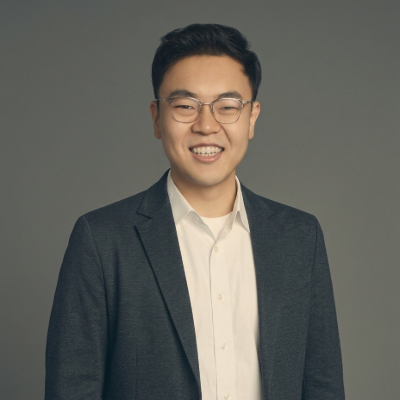
Joonha Yoo유준하
joonhayoo94@ajupress.com
ReporterCOEX Sejong Center for the Performing Arts & Music, Culture, Entertainment, Automotive
Joonha Yoo is a bilingual journalist at AJU Press (AJP), covering music, culture, entertainment and Korea’s automotive industry.
Raised in Fort Collins, Colorado, he often writes from the scene, bringing firsthand detail to stories ranging
from BTS comeback concerts to unique cultural events that catch the world's eye. "I write from the scene, not from the sidelines."
Raised in Fort Collins, Colorado, he often writes from the scene, bringing firsthand detail to stories ranging
from BTS comeback concerts to unique cultural events that catch the world's eye. "I write from the scene, not from the sidelines."
Latest by Joonha Yoo
-
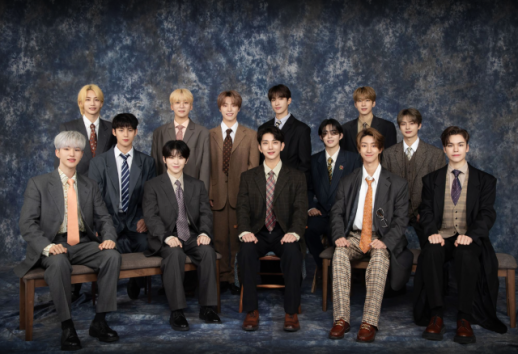 K-pop acts sweep top four spots in Asia's concert revenue rankings SEOUL, October 19 (AJP) - K-pop acts swept the top four spots in Asia's concert revenue rankings, led by boy band SEVENTEEN, which raked in US$97.4 million in ticket sales, according to U.S. concert industry publication Pollstar. SEVENTEEN sold 661,088 tickets during the 12-month period from August 2025 through July 2026, topping Pollstar's Asia Focus Top Touring Artists chart. Girl group TWICE ranked second with $76.2 million, followed by TOMORROW X TOGETHER (TXT) with $53 million and BTS with $49.1 million. The four groups collectively generated about $275.7 million in concert revenue across Asia, highlighting K-pop's growing dominance in the region's live entertainment market. Western performers trailed their South Korean counterparts. Lady Gaga ranked fifth with $44.4 million, followed by American rapper Travis Scott with $37.9 million. Chinese pop star G.E.M. placed seventh with $31.7 million, while BLACKPINK and ENHYPEN took eighth and ninth with $29.2 million and $21.6 million, respectively. SEVENTEEN's rise was driven partly by its "NEW_" world tour, which began in September 2025 and included stadium performances in Hong Kong, Singapore, South Korea and Thailand. The 13-member group, which debuted under talent mill HYBE's subsidiary Pledis Entertainment in 2015, sold out four shows at Hong Kong's 50,000-seat Kai Tak Stadium. They moved up from second place in the previous year's rankings, when British rock band Coldplay held the top spot. K-pop's commercial strength extended beyond individual artists. HYBE, which manages BTS, SEVENTEEN and TXT, ranked first among concert promoters in Asia with $248 million in reported revenue, ahead of global concert giant Live Nation's $209.8 million and Japan's Creativeman Productions' $103.7 million. The figures highlight the expanding role of South Korean entertainment companies in a regional concert market that has traditionally relied heavily on international touring acts. Pollstar attributed Asia's growth to increasing demand for live performances, investment in large-scale venues and stronger regional touring networks. Adam Wilkes, president and CEO of AEG Presents Europe and Asia-Pacific, said the region was becoming increasingly influential in the global concert industry as Asian performers attracted audiences beyond their home markets. "Asia is no longer waiting to be integrated into someone else's touring model," Wilkes told Pollstar. "The region is building a live ecosystem on its own terms." 2026-10-19 17:50:13
 -
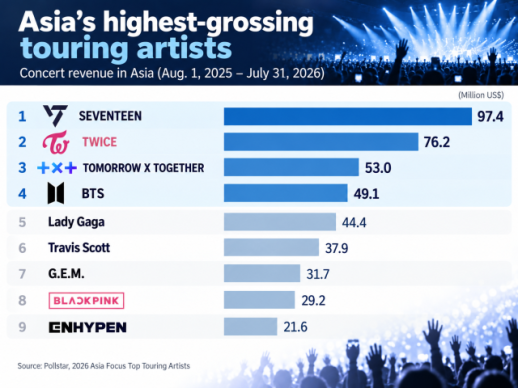 AJP Factbox: K-pop sweeps Asia concert revenue rankings K-pop artists claimed six of the top nine spots in Asia's concert revenue rankings, according to U.S. concert industry publication Pollstar. SEVENTEEN topped the chart with $97.4 million in revenue, followed by TWICE with $76.2 million, TOMORROW X TOGETHER with $53 million and BTS with $49.1 million. The four groups generated a combined $275.7 million in reported concert revenue between August 2025 and July 2026, ahead of Western stars including Lady Gaga and Travis Scott. 2026-10-19 17:41:55
 -
 South Korean stocks rebound as battery, biotech shares lead recovery SEOUL, October 19 (AJP) - South Korean stocks extended their rebound for a second consecutive session on Monday, supported by institutional buying and gains in battery and biotechnology shares, which helped the market recover from a sharp drop at the open. The benchmark KOSPI rose 1.76 percent to close at 5,768.01, after opening 3.17 percent lower at 5,488.41. The index reversed its early losses and finished at its intraday high. Institutional investors bought 575.6 billion won (US$432.3 million) worth of shares, while retail investors sold 1.11 trillion won worth of shares. Foreign investors followed the retail investors and offloaded 18.7 billion won. The rebound came despite steep losses on Wall Street last Friday, when concerns over the profitability of massive artificial intelligence (AI)-related investment weighed on technology shares. The Nasdaq Composite fell 2.15 percent Friday, while the Philadelphia Semiconductor Index extended its losing streak to eight sessions, putting additional pressure on Asian chipmakers. South Korean stocks, however, attracted bargain hunters after the KOSPI plunged more than 14 percent last week. Throughout the session, Samsung Electronics gained 1.86 percent to 219,500 won, while SK hynix rose 1.1 percent to 1,286,000 won, as investors returned to semiconductor shares following last week's sharp selloff. The relatively modest gains in the country's two largest memory chipmakers, compared with battery and biotechnology stocks, appeared to reflect lingering uncertainty over AI spending and whether heavy investment in data centers would generate sufficient returns. Investors are also watching upcoming earnings from major U.S. technology companies for signs of sustained AI capital expenditure and stronger cash flow. Battery makers led the broader recovery, with Samsung SDI surging 10.75 percent to 587,000 won and LG Energy Solution jumping 5.96 percent to 427,000 won. The rally came amid expectations that South Korean battery manufacturers might have a shot at growing demand for energy storage systems (ESS) in the U.S. A Taiwanese technology publication reported that Chinese energy storage companies were pulling back from the U.S. market because mounting regulatory restrictions and tariffs, potentially creating opportunities for South Korean suppliers. Biotechnology shares also posted strong gains. Samsung Biologics surged 7.78 percent to 1,399,000 won, while Celltrion advanced 1.6 percent to 197,000 won. Elsewhere on the KOSPI, Hyundai Motor climbed 3.85 percent to 324,000 won, while Doosan Enerbility gained 2.94 percent to 66,500 won. Samsung Electro-Mechanics bucked the broader advance, slipping 0.08 percent to 1,187,000 won. Following the recovery of KOSPI, the tech-heavy KOSDAQ also rose 1.78 percent, to finish at 808.89, recovering the 800-point mark after opening sharply lower at 773.06. The index reached an intraday high of 808.92. Retail investors bought 64.7 billion won worth of shares, as institutions followed with the purchase of 69.2 billion won. Foreign investors sold a net 148.2 billion won. Battery-related stocks also pushed gains on the KOSDAQ, with EcoPro surging 10.1 percent to 89,500 won and EcoPro BM jumping 7.4 percent to 114,800 won. Biotechnology shares joined the rally. HLB gained 2.9 percent to 42,850 won, while Alteogen rose 1.92 percent to 238,500 won. Jusung Engineering advanced 1 percent to 212,500 won, while Curiox Biosystems edged up 0.4 percent to 68,300 won. By contrast, semiconductor-related stocks remained under pressure. Leeno Industrial slipped 0.9 percent to 70,200 won, while FADU fell 2.8 percent to 55,600 won and Doosan Tesna declined 2.62 percent to 111,500 won. Throughout the Asia, China's Shanghai Composite gained 0.4 percent to 3,730.9, while Hong Kong's Hang Seng Index rose 0.52 percent to 24,186.8. Japan's Nikkei 225 moved in the opposite direction, falling 0.6 percent to 64,916.7. The South Korean won strengthened 0.48 percent to 1,331.6 won per dollar. Oil prices retreated, giving back some of last week's gains despite continuing supply concerns stemming from conflicts in the Middle East and Eastern Europe. West Texas Intermediate crude fell 1.79 percent to $99.62 a barrel, while Brent crude dropped 2.42 percent to $107.18. The decline came even as tensions remained elevated around the Strait of Hormuz, where three oil tankers were reportedly damaged over the weekend. Ukrainian drone attacks on Russian oil facilities also raised concerns over potential supply disruptions. 2026-10-19 17:41:03
 -
 Hanbok Culture Week opens across 410 venues in Korea SEOUL, October 19 (AJP) - South Korea kicked off its annual Hanbok Culture Week on Monday, with exhibitions, performances and hands-on programs planned across more than 410 venues in the country and overseas, the Culture Ministry said. The weeklong event runs through Sunday and marks the ninth edition of the campaign, which promotes hanbok, Korea's traditional clothing, and encourages people to wear it in everyday life. Programs will be held at sites including the National Museum of Korea and Gyeongbok Palace. The main ceremony will take place Wednesday, designated Hanbok Day, at the National Museum of Korea in Seoul. Five individuals and organizations will receive Culture Ministry awards, followed by a fashion show and performances. Singer Kim Yuna of rock band Jaurim will open the celebratory program, while five hanbok brands will take part in the fashion show. A traditional performing arts group will close the event with pungmul percussion, lion dancing and a large-flag performance. Gyeongbok Palace will host a campaign on how to wear traditional hanbok properly, while regional programs in Gangneung, Jeonju, Busan, North Gyeongsang and South Jeolla will feature activities tied to local culture, including accessory-making and natural-dye exhibitions. Visitors wearing hanbok can also receive discounts at participating attractions. Lotte World is offering a 50 percent discount and Seoul Sky 35 percent through Oct. 31, while the National Gugak Center will offer a 50 percent discount on its Saturday performance this week. Hanbok programs are also being held in Canada, Japan and Denmark, including clothing experiences and etiquette programs aimed at introducing Korean traditional culture to overseas audiences. 2026-10-19 17:00:25
 -
 TVXQ's Max Changmin to roll out first solo album SEOUL, October 19 (AJP) - K-pop boy band TVXQ's member Max Changmin will release his first solo album in nearly five years Monday, returning with a six-track EP that he helped produce, SM Entertainment said. His third mini-album, "All Of My Life," will be released at 6 p.m., four years and nine months after his previous solo album. The title track of the same name is a pop-rock song built around Changmin's vocals, with lyrics about continuing forward through difficult moments. Changmin said he took a more active role in the new album than on his previous releases, participating in decisions ranging from the sound of the songs to the direction of the title track's music video. He also wrote the lyrics for the track "Yeah We Go," drawing inspiration from athletes pushing themselves through the final moments of competition. A music video for "All Of My Life" will be released alongside the album. 2026-10-19 15:48:41
 -
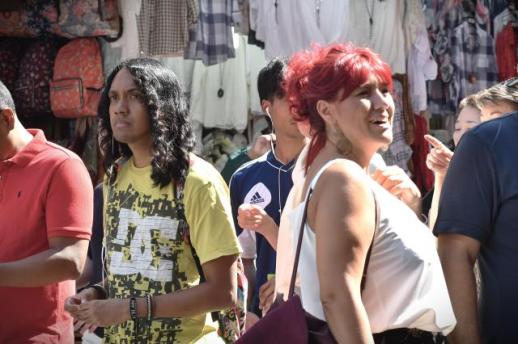 Record tourist arrivals bring rising complaints in South Korea SEOUL, October 19 (AJP) -Tourism complaints in South Korea have surged alongside record foreign arrivals, with persistent overcharging adding to concerns about the country’s welcome for overseas visitors. The Korea Tourism Organization received 1,753 tourism complaints from January through July, already surpassing the 1,744 filed during all of last year. Foreign nationals submitted 84.3 percent of the total. South Korea welcomed 15.05 million foreign visitors in the first eight months of this year, up 21.6 percent from 12.38 million a year earlier. August alone brought 2.25 million visitors, an increase of 23.3 percent. Both the monthly and cumulative figures were the highest on record. Accommodation drew the most complaints at 500, followed by shopping at 376. Airport and airline services accounted for 186 complaints, taxis for 182 and hotels for 146. The increase comes as Seoul struggles to curb taxi overcharging involving foreign passengers, with few reports leading to penalties. Data obtained by Rep. Mo Kyung-jong from the Seoul Metropolitan Government showed 6,481 reports of excessive taxi fares involving foreign tourists from 2021 through August this year. Only 204 cases, or 3.1 percent, resulted in administrative sanctions. Most were closed without further action or ended with warnings and guidance. Seoul also offers a reward of 500,000 won for reports of taxi overcharging against foreign visitors that lead to administrative action. Yet no reward applications or payments were recorded during the period. 2026-10-19 15:48:22
 -
 AJP Factbox: Samsung remains Asia's top brand in 2026 For Samsung, the 2026 survey showed that its brand strength remained unmatched across Asia. Samsung ranked No. 1 for a third straight year, ahead of Apple, Nike, adidas and Toyota, while also taking the top spot in Thailand and Malaysia. Other Korean brands also placed in the top 100, with LG at No. 18, Hyundai at No. 29 and Lotte at No. 65. 2026-10-16 15:52:48
 -
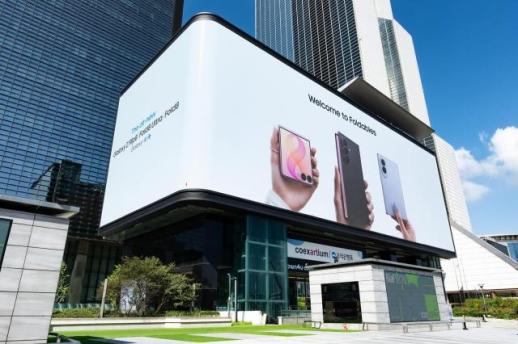 Samsung tops Asia brand ranking for third straight year SEOUL, October 16 (AJP) - Samsung ranked as Asia's most valuable corporate brand for a third straight year, holding off Apple and Nike in Nikkei Research's latest regional survey. Samsung placed first among 200 brands assessed across eight Asian markets, while Apple rose to second from fourth and Nike held third place. Adidas slipped to fourth, while Toyota climbed three spots to fifth. The Asia ranking covers China, Taiwan, Thailand, India, Viet Nam, Indonesia, Malaysia and the Philippines. Nikkei Research said the survey measures brand strength and how much a brand influences purchasing and other decisions. Samsung ranked first in Thailand and Malaysia this year and second in India, Viet Nam and Indonesia. Its number of No. 1 markets fell from five last year. Other South Korean brands also placed in the top 100. LG ranked 18th, Hyundai 29th and Lotte 65th. Toyota was the highest-ranked Japanese brand at No. 5, followed by Honda at No. 6 and Sony at No. 7. Other named brands such as Microsoft, Mercedes-Benz and BMW completed the top 10. Nikkei Research launched the Global Brand Survey in 2024 and evaluates corporate brands using measures including awareness, engagement and a brand's contribution to consumer decision-making. 2026-10-16 15:52:28
 -
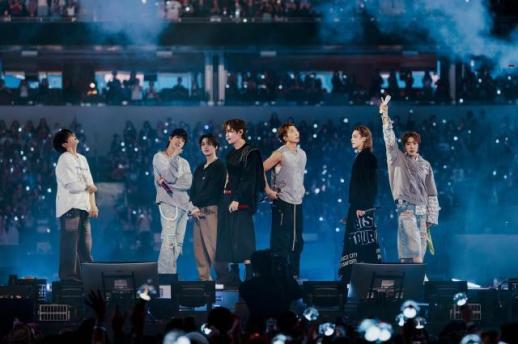 BTS become first group to top 10 billion Spotify streams in a year SEOUL, October 16 (AJP) - K-pop juggernaut BTS became the first group in the world to surpass 10 billion Spotify streams in a single year, their agency BigHit Music said on Friday. The septet's combined streams for their songs and other music videos this year have more than doubled from 4.5 billion in 2025. Their fifth studio album "ARIRANG," released in March, has generated more than 5 billion streams alone, making it Spotify's most-streamed album of the year. The 10 billion-stream milestone had previously been reached by solo artists including American singer-songwriters Taylor Swift and Ariana Grande and Puerto Rican rapper Bad Bunny, but never by a group. BTS' daily streams jumped from about 23 million before the release of "ARIRANG" to around 130 million on March 20. All 14 tracks from the album occupied the top 14 spots on Spotify's Daily Top Songs Global chart that day. The title track "SWIM" drew about 14 million streams on its first day, the highest single-day total for a song released on Spotify this year. BTS also won Artist of the Year at the 2026 MTV Video Music Awards Japan. The main ceremony will be held at Tokyo Dome in Japan on Oct. 29. 2026-10-16 15:44:27
 -
 Korea targets ADHD drug misuse ahead of college entrance exam SEOUL, October 16 (AJP) -South Korea will tighten checks on prescriptions and illegal sales of the ADHD drug methylphenidate ahead of next month's college entrance exam, the Ministry of Food and Drug Safety said Friday. Methylphenidate prescriptions reached 58.05 million pills in the first half of this year, up 12.1 percent from a year earlier. People aged 19 or younger accounted for 28.81 million, or nearly half of the total. The Ministry of Food and Drug Safety will inspect medical institutions from Oct. 19 through Nov. 18, the day before the College Scholastic Ability Test, focusing on clinics visited by young patients receiving large amounts of the drug. The inspections will look for excessive prescribing, failures to report transactions involving controlled substances and discrepancies between reported and actual inventories. Cases considered medically unjustified after expert review may be referred for investigation. The ministry will also monitor social media and online communities for illegal sales promoted with phrases such as "study drug" or "concentration drug." It had identified 1,882 illegal sales and brokerage posts through September. Methylphenidate is a psychotropic drug used to treat attention-deficit/hyperactivity disorder. The ministry has separately run a public campaign stressing that the medication is not a drug that makes students study better. "Buying ADHD medication online without a prescription or taking medication prescribed to a family member or acquaintance are both violations of the narcotics law," an MFDS official said. 2026-10-16 11:10:35