

Journalist
Joonha Yoo유준하
joonhayoo94@ajupress.com
ReporterCOEX Sejong Center for the Performing Arts & Music, Culture, Entertainment, Automotive
Joonha Yoo is a bilingual journalist at AJU Press (AJP), covering music, culture, entertainment and Korea’s automotive industry.
Raised in Fort Collins, Colorado, he often writes from the scene, bringing firsthand detail to stories ranging
from BTS comeback concerts to unique cultural events that catch the world's eye. "I write from the scene, not from the sidelines."
Raised in Fort Collins, Colorado, he often writes from the scene, bringing firsthand detail to stories ranging
from BTS comeback concerts to unique cultural events that catch the world's eye. "I write from the scene, not from the sidelines."
Latest by Joonha Yoo
-
 RIIZE's Anton to launch Spotify exclusive podcast SEOUL, October 15 (AJP) - K-pop boy group RIIZE's member Anton will launch a six episode podcast exclusively on Spotify next week, SM Entertainment said Thursday. The podcast, titled "TON-AIR," will debut at noon of Oct. 20, with new episodes to be released every other Tuesday. Anton will use music as the central theme of the program, responding to listeners' stories and recommending songs based on each episode's topic. He also created the podcast's signature theme music, according to the agency. RIIZE, is scheduled to release their latest single on Oct. 26. 2026-10-15 18:03:34
 -
 Korea launches AI content alliance SEOUL, October 15 (AJP) - South Korea launched a 214-member alliance Thursday to identify artificial intelligence technologies for the content industry and feed them into future government R&D programs. The alliance brings together experts from 190 companies and institutions, along with individual creators, across four areas. Starting with games, video and media, music and performance, and story based content. Its recommendations will help shape new R&D projects planned for 2028. The Culture Ministry said the group will focus on technical problems faced by content companies and creators and turn those needs into specific research priorities. Participants include Nexon Korea, CJ ENM, Kakao Entertainment and SBS, along with universities and research institutes. The first alliance will operate through December, with a separate strategy group reviewing proposals based on market potential, urgency and technical feasibility. "The needs of the cultural field and creators' imagination should guide the direction of AI technology development," Culture Minister Choi Hwi-young said. 2026-10-15 18:02:01
 -
 KOSPI plunges over 7% as chip rout triggers trading halts SEOUL, October 15 (AJP) - South Korean stocks plunged more than 7 percent on Thursday, triggering circuit breakers in both the KOSPI and KOSDAQ. The benchmark KOSPI tumbled 7.57 percent to close at 5,554.22, marking its steepest decline since July 28. The index extended its losing streak to seven consecutive sessions, shedding 21 percent over the period. The selloff came as U.S. inflation concerns and renewed doubts about the profitability of artificial intelligence (AI)-led investment battered semiconductor shares, particularly Samsung Electronics and SK hynix. The KOSPI opened 5.59 percent lower at 5,673.01 and plunged as much as 9.29 percent to an intraday low of 5,450.81 before recovering some losses late in the session. It finished at its lowest closing level since April 7. Foreign investors sold 3.63 trillion won (US$2.7 billion) worth of KOSPI shares, extending their selling streak to eight consecutive sessions. Retail investors bought 1.29 trillion won, while institutions purchased 1.69 trillion won throughout Thursday's session. The losses were concentrated in the country's two largest chipmakers Samsung Electronics and SK hynix as investors reassessed the profitability of massive AI infrastructure investment amid rising borrowing costs. The selloff followed the release of U.S. consumer price data overnight showing that inflation rose faster than expected in September. Consumer prices increased 3.7 percent from a year earlier, exceeding the market forecast of 3.6 percent. Core inflation also came in above expectations at 2.6 percent. The figures revived concerns that the Federal Reserve could raise interest rates again, potentially increasing financing costs for technology companies investing heavily in AI infrastructure. Questions over the sustainability of AI spending also intensified after research firm Gartner warned of a widening gap between projected infrastructure investment and the revenue needed to justify it. The concerns weighed on U.S. technology stocks overnight. The Nasdaq Composite fell 1.88 percent, while the Philadelphia Semiconductor Index dropped 4.30 percent, extending its losing streak to six sessions. Samsung Electronics closed 9.48 percent lower at 210,000 won after briefly falling to 204,500 won. SK hynix plunged 11.06 percent to 1,262,000 won, having touched an intraday low of 1,238,000 won. The two companies, whose combined market capitalization accounts for nearly half of the KOSPI, amplified the index's decline as investors retreated from memory chipmakers that had benefited from the AI boom. Other technology stocks also suffered heavy losses. Samsung Electro-Mechanics, a major electronic components supplier, plunged 15.36 percent, while SK Square, the largest shareholder of SK hynix, dropped 10.21 percent. The weakness extended to automakers, battery manufacturers and industrial companies. Hyundai Motor fell alongside Samsung SDI and Doosan Enerbility as selling pressure spread beyond the semiconductor sector. Some defensive stocks bucked the downturn. Samsung Biologics gained 5.50 percent, while Celltrion advanced 1.28 percent and Hana Financial Group rose 0.66 percent. By sector, electrical and electronics shares dropped 10.13 percent, while medical and precision equipment stocks fell 8.87 percent. Pharmaceutical shares rose 2.65 percent and food and beverage stocks gained 2.05 percent. The severe decline triggered a sell-side trading curb shortly after the opening bell, temporarily suspending program sell orders. As the index's losses exceeded 8 percent in afternoon trading, a circuit breaker was activated at around 12:30 p.m., halting all KOSPI trading for 20 minutes. The market turmoil prompted the Financial Services Commission to hold an emergency meeting Thursday afternoon. Financial authorities urged caution over excessive borrowing and leveraged investment amid heightened volatility. The junior KOSDAQ also suffered a sharp decline, falling 7.65 percent or 63.06 points to close at 760.82. It dropped below the 800 mark at the opening and extended its losing streak to six sessions. The KOSDAQ opened at 784.45 and fell as low as 745.43, a decline of 9.52 percent before paring some losses toward the close. A sell-side trading curb was activated shortly after the market opened, followed by a circuit breaker at around 12:20 p.m. as losses exceeded 8 percent. Trading was suspended for 20 minutes, marking the first such halt since July 29. Unlike the KOSPI, where foreign selling dominated, overseas investors bought 217.7 billion won worth of KOSDAQ shares. Retail investors sold 66.7 billion won, while institutions unloaded 163.2 billion won. Semiconductor equipment and battery-related companies were among the hardest hit. Jusung Engineering, a semiconductor equipment manufacturer, plunged 14.97 percent, while EcoPro BM, a producer of cathode materials for rechargeable batteries, lost 9.10 percent. Its parent company EcoPro also declined sharply. Biotechnology and robotics stocks remained under pressure. Alteogen, a developer of drug-delivery technologies, fell 4.90 percent, while Rainbow Robotics, a manufacturer of industrial and collaborative robots, dropped 9.44 percent. The South Korean won weakened against the dollar, with the exchange rate reaching 1,344.6 won per dollar at around 3:30 p.m. Asian markets also retreated, despite their losses were smaller than South Korea. Japan's Nikkei 225 fell 4.90 percent to 64,425.95, while China's Shanghai Composite declined about 1.6 percent to 3,707.48. Taiwan's benchmark index dropped 3.41 percent. Investors are closely watching upcoming U.S. economic data, the Federal Reserve's policy meeting later this month and quarterly earnings from major technology companies for clues to whether the selloff will deepen. 2026-10-15 17:13:56
 -
 Incheon stabbing puts Korea's drug-violence link under scrutiny SEOUL, October 14 (AJP) - A daylight knife attack that injured eight people at a shopping complex in Incheon has renewed concern over South Korea’s drug problem as the number of drug offenders has stayed above 20,000 for three consecutive years despite expanded enforcement and rehabilitation efforts. The 59-year-old suspect in Tuesday’s attack was carrying a large quantity of medication, but a preliminary drug screening came back negative. Police have not established that drugs played any role, and on Wednesday they assigned three criminal profilers to examine his motive. "Depending on the type of drug, a person may become aggressive or violent, while others can cause hallucinations, anxiety or sleep disorders,” said Lee Bum-jin, a professor at Ajou University’s College of Pharmacy and a longtime drug prevention researcher. Lee said certain psychoactive substances disrupt the brain’s neurotransmitter systems, including dopamine, potentially impairing judgment, self-control and behavior. Prolonged use can lead to dependence, he said. Some substances may also trigger hallucinations, paranoia and other psychological disturbances that impair a person’s ability to read situations and control impulses. The concerns come as South Korea grapples with a drug problem that has grown substantially in recent years. According to the Supreme Prosecutors’ Office, 23,403 drug offenders were apprehended in 2025, up 1.7 percent from 23,022 a year earlier. That was nearly 30 percent above the 18,050 recorded in 2020, though still below the record 27,611 in 2023. The number dipped to 16,153 in 2021, rose to 18,395 in 2022 and then jumped more than 50 percent in 2023. It has stayed above 20,000 since. The figures count people apprehended, not the total number of drug users, and they are shaped by changes in policing and detection. Younger people make up a large share. In 2025, 14,573 offenders, or 62.3 percent, were in their 30s or younger. Teenage offenders rose 3.9 percent to 674 from 649 in 2024. Online distribution has become another challenge. Police apprehended 5,341 people for online drug offenses in 2025, up 25 percent from 4,274 a year earlier and more than double the 2,545 recorded in 2021. Online offenders made up about 40 percent of all drug offenders apprehended by police in 2025, up from 24 percent four years earlier. The shift reflects the growing role of social media, encrypted messaging apps and other digital channels, where deals can be arranged without face-to-face contact. Forensic data also point to a broader mix of substances in circulation. The National Forensic Service recorded 140,775 drug-related testing items in 2025, a record and about 10 percent above the previous peak in 2023. The total included 78,432 items involving seized materials, 35,993 involving hair and 26,350 involving urine. Methamphetamine, known in Korea as philopon, accounted for 52.7 percent of seized-material results, while new psychoactive substances accounted for 31.5 percent. Among the newer substances, synthetic cannabinoids made up 15.1 percent and ketamine 10.6 percent. The agency also reported 364 synthetic cannabinoid findings involving teenagers. Some of the substances were sold as liquids in cartridges resembling ordinary e-cigarettes, raising concern about how easily young people can obtain them. Researchers have also examined whether repeated use raises the risk of violence. A 2014 Australian study published in the journal Addiction followed 278 people with methamphetamine dependence, comparing their behavior during periods of use and nonuse. The odds of violent behavior were 2.8 times higher in months when participants used methamphetamine on one to 15 days than in months when they did not use it. For those using it on 16 days or more, the odds were 9.5 times higher. Psychotic symptoms were associated with an additional doubling of the odds of violence, while heavy drinking was linked to a 3.1-fold increase. The study defined violent behavior as severe hostility involving assault or property damage, not homicide. Its findings cannot be applied directly to South Korea’s general population. Lee said drug-related behavioral changes are especially hard to manage once dependence impairs judgment and self-control. “When someone is addicted, their ability to control themselves or make judgments can become severely impaired,” he said. But a link between drug use and aggression does not mean every drug user becomes violent. Nor do South Korea’s headline drug crime figures show whether murders or assaults involving intoxication are rising. Annual offender statistics track drug use, possession, trafficking and smuggling. They do not identify how many violent crimes were caused or aggravated by intoxication. The Incheon case shows how hard that distinction is to draw. Investigators have yet to link the violence to intoxication. Experts point out many offenders are struggling with dependence, sometimes alongside unemployment, family conflict or other social difficulties. “If we simply arrest them and put them in prison, they may come out and repeat the same behavior because their addiction has not been treated,” Lee said. South Korea has expanded its prevention and rehabilitation efforts in recent years. Under the government’s 2026 drug control implementation plan, participation in treatment and rehabilitation programs among drug-use offenders rose in 2025, reaching 18.7 percent and 24.0 percent, respectively. The government also said it provided drug prevention education to about 2.08 million people in 2025. Its latest measures include tighter monitoring of online drug deals, expanded screening of international mail and improved treatment and rehabilitation services. 2026-10-14 17:54:49
 -
 AJP Factbox: Netflix Korea posts record revenue in 2025 For Netflix in South Korea, 2025 showed how rapidly the business has grown while most of its revenue continued to flow to its U.S. parent. Netflix Services Korea generated a record 1.054 trillion won ($787 million) in revenue, but 853.9 billion won, or 81 percent, was paid to the parent company. That left the Korean unit with 20.3 billion won in operating profit, equivalent to an operating margin of just 1.9 percent. 2026-10-14 15:17:59
 -
 Netflix Korea posts record revenue amid heavy payments to U.S. parent SEOUL, October 14 (AJP) - Netflix's Korean unit posted more than 1 trillion won in annual sales for the first time last year, with 81 percent of the revenue paid to its U.S. parent, according to an analysis released Wednesday. Netflix Korea recorded 1.0542 trillion won ($786.4 million) in sales in 2025, up 17.2 percent from 899.7 billion won a year earlier. Of the total, 853.9 billion won was paid to Netflix Inc. for subscription membership purchases and other group fees. The Korean branch posted an operating profit of 20.3 billion won, giving it an operating margin of 1.9 percent. The figures were compiled by Rep. Han Joonho of the Democratic Party using audited financial statements. Sales have risen about 67 percent from 631.7 billion won in 2021. Over the five years through 2025, the company generated 4.1822 trillion won in sales and paid 3.4133 trillion won, or 81.6 percent, to its parent and affiliated companies. Netflix also maintained a wide lead over local streaming platforms. A government survey of 8,320 people showed that 46.7 percent used Netflix's subscription service, whereas 13 percent used Tving and 4.1 percent went with Wavve. Domestic platforms suffered a harsh year in 2025 as Tving posted an operating loss of 69.8 billion won, and Wavve reported a loss of 12.2 billion won. "Netflix has become a service that nearly half of the public pays to watch, but eight out of every 10 won in its 1 trillion won in domestic sales was paid to headquarters, leaving the Korean unit with just 20.3 billion won in operating profit," Han said. He also called for changes in how Korean producers are compensated for successful content. "K-content made Netflix the No. 1 platform in Korea, but producers receive margins of only about 3 to 10 percent of production costs regardless of how successful a title becomes," adding "Additional compensation tied to a show's performance should follow its growing influence." 2026-10-14 15:17:37
 -
 MMA2026 adds aespa, IVE to lineup SEOUL, October 14 (AJP) - The Melon Music Awards has finalized a 26-act lineup featuring aespa, IVE and a reunited I.O.I for its first two-day event in November, Kakao Entertainment said Wednesday. The annual K-pop awards ceremony will take place at Gocheok Sky Dome in Seoul on Nov. 14 and 15, with 14 acts performing on the first day and 12 on the second. The 11 newly announced performers include I.O.I, aespa, IVE, CORTIS, KiiiKiii, Dragon Pony, HANA, IDID, AEN, TUIDE and hrtz.wav. I.O.I, which reunited after approximately nine years, will perform on Nov. 14 alongside aespa, Japanese girl group HANA, NCT DREAM, ATEEZ, RIIZE and TWS. The second day will feature IVE, CORTIS and KiiiKiii alongside NCT 127, NCT WISH, ILLIT and other acts. MMA music award is expanding to two days event for the first time. The event will also introduce a "Global TOP 10" award linked to Melon's Global-K Chart, which combines music consumption data from South Korea, China and Japan. Among the newly added performers, aespa released its second full-length album "LEMONADE" in May, reaching No. 9 on the Billboard 200, according to Kakao Entertainment. IVE is preparing to release its new mini-album "LOOKS CAN KILL" on Oct. 26, following a pre-release track scheduled for Oct. 19. CORTIS has maintained a place among the top three on Melon's monthly chart with its song "REDRED" for four consecutive months, the company said. Kakao Entertainment said the expanded event will also feature an online fan community where international audiences can post messages supporting participating artists. This year's ceremony will be held under the theme "K-POP CONNECT: The New Pulse." 2026-10-14 14:17:32
 -
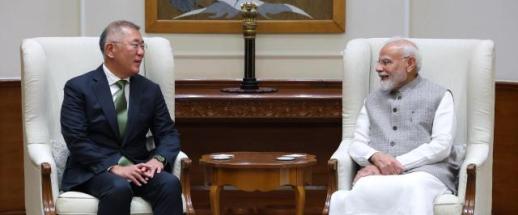 Hyundai Motor to invest $15.5 billion in India through 2032 SEOUL, October 14 (AJP) - Hyundai Motor group will invest $15.5 billion in India through 2032 to expand production, research and supply chains, the South Korean automaking conglomerate said Tuesday. The seven year plan includes $700 million for R&D facilities and a new investment company that will coordinate spending on future technologies, local suppliers and new businesses. Executive Chair Euisun Chung outlined the plan during a meeting with Indian Prime Minister Narendra Modi in New Delhi on Monday. Hyundai and Kia currently have combined annual production capacity of more than 1.4 million vehicles in India through plants in Chennai, Pune and Anantapur. The group plans to further expand its production base as demand grows. Hyundai also aims to raise its local parts sourcing ratio to more than 90 percent by 2030. The group is expanding cooperation with Indian companies in areas including EV charging, vehicle financing and recycling. It has also developed an electric three-wheeler prototype with India's TVS Motor, with commercialization targeted for the end of next year. Hyundai entered India in 1996. The country has since become one of the group's key manufacturing and export bases. 2026-10-14 09:53:04
 -
 Korea's business dynasties put overseas study on the family syllabus SEOUL, October 08 (AJP) - Samsung Electronics expects to have achieved what no other technology company has managed over the last three months, earning more than $80 billion in operating profit. SK hynix's $26.5 billion issue in July was the largest foreign ADR debut in U.S. history and Hyundai cars have long become a familiar presence on roads around the world. Beyond their Korean origins, these corporate giants share another defining feature. Founding families remain at the center of businesses that have grown into global powers under successive generations. But what comes next for the dynasties behind the brands? Samsung Electronics Chairman Jay Y. Lee drew a line in 2020 when he pledged not to pass management control to his children. “I will not hand over management rights to my children,” he said. His only son has nevertheless become more visible. Lee Ji-ho, a Navy interpreter officer, appeared in photographs published by South Korea’s military newspaper last month interpreting at a meeting between senior Korean and U.S. naval officers. Born in the United States, he relinquished U.S. citizenship to serve as a Korean officer. His future remains open. Across Korea’s business families, however, one part of the younger generation’s upbringing has become almost routine — an overseas education. A study released Wednesday by corporate research firm CEO Score found that nearly 94 percent of fourth- and fifth-generation members surveyed had studied abroad, compared with just 5.9 percent of first-generation founders. The findings trace a striking transformation within the chaebol, South Korea’s family-controlled conglomerates. Some founders built industrial empires with little formal schooling. Their descendants increasingly begin university life in New York, California or other foreign destinations. CEO Score examined 350 members of controlling families across 89 major business groups whose educational backgrounds could be verified. Overseas study experience rose from two of 34 founders to 76 of 112 second-generation members and 122 of 155 in the third generation. Among the fourth and fifth generations, 46 of 49 had studied abroad. The change concerns not only where they study, but when they leave. Of those 46 younger family members, 33 began their undergraduate education overseas. Earlier generations more commonly earned a Korean bachelor’s degree before heading abroad for an MBA or other postgraduate qualification. Hyundai’s history makes the generational leap particularly vivid. Founder Chung Ju-yung, born into a farming family in 1915, had only an elementary education before building an empire spanning construction, cars and ships. His son Chung Mong-koo attended Hanyang University in Seoul. Grandson Euisun Chung, now Hyundai Motor Group’s executive chair, studied business administration at Korea University before earning an MBA at the University of San Francisco. In three generations, the family’s educational journey stretched from an elementary classroom to business schools on both sides of the Pacific. Samsung followed an international path much earlier, with Japan figuring prominently before American universities became the favored destination. Founder Lee Byung-chul attended Waseda University in Tokyo in the 1930s but left without completing his degree. His son Lee Kun-hee also studied at Waseda before continuing his education in the United States. Jay Y. Lee took a different route. He studied East Asian history at Seoul National University, earned a master’s degree at Japan’s Keio University and completed doctoral coursework at Harvard Business School without obtaining a doctorate. At LG, former Chairman Koo Bon-moo attended Yonsei University in Seoul before completing his undergraduate education at Ashland University in Ohio and pursuing graduate studies at Cleveland State University. His successor, Koo Kwang-mo, earned his bachelor’s degree at the Rochester Institute of Technology in New York. Together, their histories show how the educational starting point has shifted. Overseas study has increasingly become the foundation of a family member’s university education rather than a qualification added later. Across the CEO Score sample, Columbia University was the most frequently attended foreign institution, with 22 family members, followed by New York University with 18, Cornell with 16, Stanford with 15 and Harvard with 14. The figures span generations and include undergraduate and postgraduate study. Within Korea, Korea University led with 54, followed by Seoul National University with 50 and Yonsei University with 35. Some foreign campuses have become recurring destinations within individual families. Four fourth-generation GS family members completed Stanford MBA programs, while five members of the Doosan family attended MBA programs at NYU. Cornell appears repeatedly in the Amorepacific family. Chairman Suh Kyung-bae’s elder daughter Suh Min-jung studied economics there, while her younger sister Suh Ho-jung studied hotel administration. Chung Hae-chan, the eldest son of Shinsegae’s Chung Yong-jin, also studied hotel administration at Cornell. More in the younger members of the corporate dynasties bear ambitions beyond the C-suite. Annie Moon, a member of the K-pop group ALLDAY PROJECT, has taken her family connections in a different direction. She is the daughter of Shinsegae Chairwoman Chung Yoo-kyung and granddaughter of Lee Myung-hee, whose father founded Samsung. Annie debuted with the group in 2025 and graduated from Columbia in May 2026 after studying art history and visual arts. Her education fits the family pattern but her career so far has taken her onto the stage. That distinction leaves the next chapter of Korea’s corporate dynasties open. The founders built businesses that reached beyond Korea. Their descendants are receiving an education that does the same, whether their ambitions lead them back to the family boardroom or elsewhere. The founders left their descendants companies with global ambitions. For the younger generations, an international education now usually comes before the decision about what to do with that inheritance. 2026-10-08 17:54:58
 -
 Hot Stock: Hanmi shares reverse sharply after obesity drug approval SEOUL, October 08 (AJP) - Shares of Hanmi Pharm and its holding company Hanmi Science fell sharply in late-morning trading Thursday, reversing gains sparked by regulatory approval of Korea's first domestically developed GLP-1 obesity drug. Hanmi Science dropped 7.23 percent to 53,900 won after climbing as high as 68,200 won earlier in the session. The stock had surged 13.94 percent in after-hours trading Wednesday to 66,200 won following news of the approval. Hanmi Pharm fell 9.7 percent to 482,500 won, near its intraday low of 482,000 won, after reaching as high as 565,000 won. The Ministry of Food and Drug Safety approved Hanmi Pharm's "EPPE," or efpeglenatide, on Wednesday. The once-weekly GLP-1 treatment is the first obesity drug in the class developed entirely by a Korean pharmaceutical company, according to Hanmi Pharm. The company said it handled the drug's development from candidate discovery through clinical trials, manufacturing and commercialization. EPPE uses Hanmi's proprietary long-acting drug platform, LAPSCOVERY, and will be manufactured at its Pyeongtaek biopharmaceutical plant. A 40-week interim Phase 3 analysis involving 448 Korean patients showed an average weight reduction of 9.75 percent. Nearly half of treated patients lost at least 10 percent of their body weight, while 19.86 percent lost at least 15 percent, the company said. Efpeglenatide was licensed to Sanofi in 2015 before the rights were returned to Hanmi in 2020. Hanmi continued development on its own and is also seeking to expand the drug into diabetes treatment. Hanmi is preparing to launch EPPE in Korea later this year. The company has not yet disclosed its final price. 2026-10-08 13:08:21