

Journalist
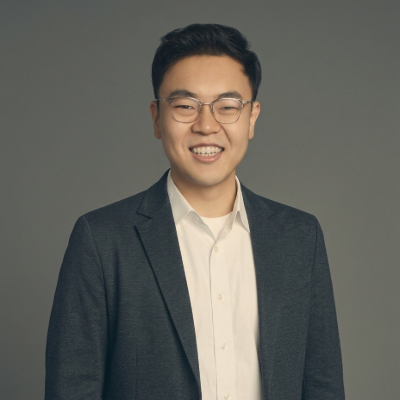
Joonha Yoo유준하
joonhayoo94@ajupress.com
ReporterCOEX Sejong Center for the Performing Arts & Music, Culture, Entertainment, Automotive
Joonha Yoo is a bilingual journalist at AJU Press (AJP), covering music, culture, entertainment and Korea’s automotive industry.
Raised in Fort Collins, Colorado, he often writes from the scene, bringing firsthand detail to stories ranging
from BTS comeback concerts to unique cultural events that catch the world's eye. "I write from the scene, not from the sidelines."
Raised in Fort Collins, Colorado, he often writes from the scene, bringing firsthand detail to stories ranging
from BTS comeback concerts to unique cultural events that catch the world's eye. "I write from the scene, not from the sidelines."
Latest by Joonha Yoo
-
 Korean stocks slip despite spectacular Samsung Q3 SEOUL, October 08 (AJP) -South Korean stocks edged lower Thursday morning as foreign and institutional selling continued to retreat despite stellar third-quarter earnings guidance from Samsung Electronics and LG Energy Solution. The benchmark KOSPI fell 0.2 percent to 6,793.26 as of 10:30 a.m. (0130 GMT) after trading between 6,731.75 and 6,810.83. Foreign investors sold 635.7 billion won ($475.2 million) worth of shares, while institutions unloaded 300.7 billion won. Retail investors bought 704.6 billion won, helping limit the decline. Samsung Electronics slipped 0.2 percent to 268,000 won despite reporting its highest quarterly operating profit on record on still-robust demand for memory chips powering artificial intelligence. The company estimated third-quarter operating profit at 107.4 trillion won, up 782.5 percent from a year earlier. Revenue jumped 126.6 percent to 195 trillion won, according to its preliminary earnings guidance released Thursday. Samsung's shares nevertheless declined, suggesting that much of the earnings optimism had already been reflected in its recent gains. Rival SK hynix moved in the opposite direction, rising 1.7 percent to 1,752,000 won. Battery makers outperformed the broader market after LG Energy Solution reported stronger-than-expected third-quarter earnings. LG Energy Solution climbed 5.5 percent to 412,500 won after estimating operating profit at 756 billion won, up 25.7 percent from a year earlier. Revenue rose 59 percent to about 9.6 trillion won, marking a quarterly record. The earnings improvement was supported by growing demand for energy storage systems (ESS), particularly in North America, as the company sought to offset slower growth in the electric vehicle market. The operating profit included 416.9 billion won in U.S. manufacturing tax credits. Excluding those incentives, the company posted an operating profit of 339.1 billion won. The results also benefited from compensation related to an automaker's unmet purchase commitments. Samsung SDI gained 5 percent to 589,000 won, extending the rally across battery-related stocks. Elsewhere on the KOSPI, Hyundai Motor fell 2.9 percent to 326,250 won, while Doosan Enerbility declined 4.5 percent to 76,900 won. LG Electronics slipped 3.13 percent to 201,500 won after reporting preliminary third-quarter operating profit of 781.8 billion won on revenue of 23.83 trillion won. Both figures increased from a year earlier but fell short of market expectations. Naver lost 2.2 percent to 184,700 won. Attention also turned to Hanmi Pharmaceutical after its obesity treatment Eppe received regulatory approval Wednesday, becoming the first domestically developed GLP-1 obesity drug approved in South Korea. The once-weekly injection, known chemically as efpeglenatide, will compete with Novo Nordisk's Wegovy and Eli Lilly's Mounjaro. Hanmi said the drug achieved an average weight reduction of 9.75 percent over 40 weeks in a phase 3 clinical trial involving 448 Korean patients. The company plans to launch the treatment as early as this month. Electric products led sector gains, rising 4.5 percent, while battery production and sodium-ion battery themes advanced 4.5 percent and 4.7 percent, respectively. The tech-heavy KOSDAQ edged down 0.1 percent to 897.62, after trading between 883.85 and 903.12. Foreign investors sold 56.1 billion won as institutions unloaded 17.5 billion won, while retail investors bought 74.6 billion won. Biotechnology shares were among the biggest decliners on the KOSDAQ. Peptron plunged 29.9 percent to 91,700 won, while Alteogen fell 6.4 percent to 240,500 won. Samchundang Pharm dropped 3.7 percent to 232,000 won, while HLB slipped 0.8 percent to 45,500 won. By contrast, Jusung Engineering jumped 10.4 percent to 273,250 won, while EcoPro gained 1.9 percent to 93,600 won. Elsewhere on the index, Taihan Fiberoptics fell 4.1 percent to 17,210 won and OE Solutions dropped 4.8 percent to 4,960 won. LED equipment stocks led thematic gains, rising 5.7 percent, while display equipment and components advanced 2.5 percent. Throughout Asia, Japan's Nikkei 225 fell 0.7 percent to 69,563.75, while Hong Kong's Hang Seng Index slipped 0.2 percent to 24,079.81. China's Shanghai Composite bucked the regional decline, rising 0.3 percent to 3,851.67. The Korean won strengthened 0.3 percent to 1,337.7 won per dollar. Oil prices rose amid renewed concerns over Middle Eastern supply disruptions. West Texas Intermediate crude gained 1.4 percent to $89.50 a barrel, while Brent crude advanced 1.6 percent to $101.80. 2026-10-08 11:13:51
 -
 Korea joins 14 economies addressing China-led overcapacity SEOUL, October 08 (AJP) -South Korea has joined the United States, the European Union and other major economies in a new initiative to tackle industrial overcapacity as Chinese electric vehicle makers rapidly expand overseas, capturing a growing share of markets outside China. The Industry Ministry said Thursday that 15 participants had agreed to establish five sector-specific platforms covering automobiles and electric vehicles, batteries, chemicals, foundational semiconductors and solar panels. The announcement coincided with data showing that BYD, Geely and Chery together accounted for 22.8 percent of electric vehicle deliveries outside China in the first eight months of this year, up from 15.3 percent a year earlier. According to energy market tracker SNE Research, deliveries of battery electric and plug-in hybrid vehicles outside China rose 28.9 percent to 6.223 million units between January and August. The three Chinese groups all outpaced that growth, while Volkswagen, Tesla and Hyundai Motor Group lost market share despite higher deliveries. BYD’s deliveries jumped 76.5 percent to 733,000 vehicles, placing it third and narrowing its gap with second-ranked Tesla to about 30,000 units. Its market share rose 3.2 percentage points to 11.8 percent, just 0.5 percentage point behind Tesla. The Chinese automaker has expanded its sales networks and local production in Europe, Southeast Asia and South America. Its European deliveries rose 76.5 percent to 246,000 vehicles, while deliveries in Asia excluding China increased 54.7 percent. Geely’s deliveries climbed 61.8 percent to 420,000 vehicles, while Chery’s surged 310.1 percent to 268,000. Hyundai Motor Group retained fourth place with 499,000 deliveries, up 20.9 percent. Its market share nevertheless fell to 8.0 percent from 8.5 percent as a 23.4 percent decline in North American deliveries offset some of its growth in Europe and Asia outside China. The regional divide was pronounced. EV deliveries in Asia excluding China surged 77.0 percent, while North American deliveries fell 24.9 percent. U.S. deliveries dropped 31.4 percent following the expiration of tax credits. Europe remained the largest market outside China, with deliveries rising 29.0 percent to 3.31 million vehicles. Against that backdrop, the new international platforms will examine excess industrial capacity, assess its effects on industries and markets and discuss possible responses. The agreement was announced Wednesday on the sidelines of the OECD Trade Committee in Paris after a broader effort at the G20 trade ministers’ meeting in Milwaukee from Sept. 30 to Oct. 1 failed to produce consensus on a common course of action. Alongside South Korea, the United States, the EU and Japan, participants include Argentina, Australia, Canada, France, Germany, India, Italy, Mexico, Poland, Türkiye and Britain. The participants said structural overcapacity can distort prices and production, discourage market-based investment and weaken competition. They called on countries to end non-market policies and practices that sustain excess production. South Korea has advocated addressing the issue through market principles, rules-based trade remedies and international cooperation. Officials plan to meet at the technical level before December to establish operating rules, share non-confidential data and identify information gaps. The platforms will also be open to countries outside the OECD. The joint statement did not identify China or any other country as the source of excess capacity. 2026-10-08 11:10:12
 -
 K-drama, K-pop — and now Hangeul joins the K-wave SEOUL, October 07 (AJP) - A decade ago, learning Korean was a way to catch the nuances of K-drama dialogue and song lyrics. Today, foreigners are learning it to enter universities, build careers and make a life in Korea. Few can dispute the global ascent of Korean pop culture as K-everything fills social media feeds. All three seasons of Netflix’s “Squid Game” occupy the top three spots on the platform’s all-time ranking of non-English television series. Its first season drew 265.2 million views in its first 91 days, followed by 192.6 million for Season 2 and 145.8 million for Season 3. Korean pop music has traveled just as far. “APT.,” by BLACKPINK’s Rosé and Bruno Mars, was the third most-streamed song worldwide on Spotify in 2025. The ever-expanding global reach has introduced millions to Korean through lyrics, subtitles and online fan communities. For some, an affection nurtured on screen is becoming a life beyond it. Digby Kartney, a 33-year-old American living in Gwangju, traces his path to Korea back to K-pop and Korean dramas. Kartney bred interest in Korean culture while growing up in the United States and now works as an English teacher. “I might have started to become interested in Korea through Korean music or dramas, but that interest grew into something big enough that I ended up moving to Korea to make a living,” Kartney told AJP. He found his current job through the Seoul Foreign Portal, a city-run website providing information for foreign residents. His experience points to a shift worth considering ahead of Hangeul Day on Oct. 9 - Korean may be a language people discover through entertainment, but it is increasingly one they study for education, employment and a longer-term future in the country. The holiday celebrates Hangeul, the Korean writing system created under King Sejong in the 15th century. From subtitles to classrooms Recent figures suggest that motivations for learning Korean are becoming increasingly practical. A 2025 survey by the King Sejong Institute Foundation found that 50.9 percent of 1,323 foreigners with experience learning Korean cited preparation for study or academic programs in Korea as a reason. Another 37 percent cited career development. The foundation’s King Sejong Institutes enrolled a record 239,020 students worldwide in 2025, about 28,000 more than a year earlier. The expansion is also visible on Korean university campuses. International enrollment in South Korean higher education institutions reached 253,434 in 2025, up from 91,332 in 2015, according to government statistics — nearly tripling in a decade. The total included 120,150 undergraduates, 41,278 master’s students and 17,762 doctoral students. Another 58,764 were enrolled in language-training programs. For Kang Yoon-do, a 35-year-old university international affairs officer, the change has been gradual but noticeable. He traces part of the early surge in interest to Psy’s “Gangnam Style,” followed by the global rise of BTS and the spread of Korean films and dramas through streaming platforms such as Netflix. But his conversations with students today often center less on entertainment and more on what comes next. “When I counsel students, a very large number of them say they want to find a job in Korea,” Kang said. “In the past, someone might have come simply because they liked Korean content and wanted to study the language. Now I see more people formally learning Korean because they want to live here and make a living.” Asian students still make up most of the foreign students Kang encounters, although he has noticed a broader mix of nationalities on campus. National figures reflect that pattern. Chinese students accounted for 30.2 percent of Korea’s international student population in 2025, while Vietnamese students represented 20.7 percent. Uzbekistan, Mongolia and Nepal were also among the largest countries of origin. The shift extends beyond the arrival of more Western fans. It concerns what learners across nationalities expect the language to offer as an initial interest develops into plans for education and work. A language for what comes next Yoo Seong-ho, a professor of Korean language and literature at Hanyang University, said K-pop, cinema, television dramas and literature helped create the initial demand for Korean. But cultural popularity alone no longer fully explains why people keep studying it. “Korean cultural content certainly had an impact, but Korea’s overall standing has also risen,” Yoo said. As more foreigners study, work and establish lives in Korea, the language has gained practical value, he said. “Watching dramas or films may be the beginning,” Yoo said. “But few people continue studying a language just for that. They study it because of their future and their careers.” Those opportunities also extend beyond Korea. Some learners return home to become Korean-language teachers or translators, or to work in other Korea-related fields, Yoo said. “Korean has become a kind of gateway,” he said. What lies beyond that gateway, however, depends on more than language proficiency. Yang Jin-young, a 30-year-old human resources employee at Coupang, said foreign applicants form part of the company’s recruitment pool, although requirements differ by position. Basic Korean communication may be sufficient for some logistics positions, Yang said. For IT and professional roles, recruitment generally focuses on job qualifications rather than nationality, age or gender. Coupang also recruits foreign professionals under visa categories including D-7 for intra-company transferees and E-7 for designated professional activities, according to Yang. Speaking Korean does not guarantee employment. A software engineer, logistics worker and corporate manager face different requirements, and language skills are one part of a broader set of qualifications. Still, the growing numbers of language learners and international students suggest that Korean is acquiring a place in ambitions that reach well beyond the next episode or album. For years, global charts measured how far Korean culture had traveled. Increasingly, classrooms and workplaces reveal what happens after it arrives. But for many, the K-wave has carried them from following Korean lives on screen to building one of their own. 2026-10-07 17:43:50
 -
 Busan's 'Bukangi' confirmed as 3-meter female dusky shark SEOUL, October 07 (AJP) - A shark that has drawn more than 1 million visitors to Busan's North Port has been identified as a roughly 3-meter female dusky shark, a species classified as endangered on the global conservation list, fisheries authorities said Tuesday. The National Institute of Fisheries Science confirmed the species after examining close-up footage of the shark, nicknamed "Bukangi," and finding a ridge between its two dorsal fins, a feature that distinguishes the dusky shark from a closely related species. Its sex was determined from reproductive features on its underside. Bukangi was first spotted in an artificial waterway at the North Port waterfront park on Sept. 18 and has remained there despite two attempts by authorities to guide it back to open water. Officials have since removed a barrier net and are waiting for the shark to leave on its own while monitoring its condition. The shark has meanwhile turned the waterfront into an unlikely tourist attraction. A total of 1.016 million people had visited the park by 6 p.m. Monday, compared with about 2,000 visitors on a typical day before the shark appeared. As many as 140,000 people visited on Sept. 26, while another 89,000 came on each of the final two days of the Oct. 3-5 holiday period. Dusky sharks can grow to about 4.2 meters and are found in tropical, subtropical and temperate waters worldwide. They generally favor water temperatures between 18 and 26 degrees Celsius and migrate over long distances as temperatures change, according to the institute. The International Union for Conservation of Nature lists the species as Endangered as the decreasing rate in population and its slow growth considering the amount of reproduction. Fisheries authorities said they will continue monitoring Bukangi's swimming behavior and health and work with Busan officials if signs of distress emerge. 2026-10-07 13:47:18
 -
 KOSPI falls as foreign selling outweighs Wall Street rally SEOUL, October 07 (AJP) - South Korean stocks fell Wednesday morning as heavy foreign selling outweighed overnight gains on Wall Street, while Samsung Electronics and SK hynix moved in opposite directions. The benchmark KOSPI fell 0.9 percent to 6,883.09 as of 10:30 a.m. (0130 GMT), after trading between 6,861.56 and 6,977.77. Foreign investors sold a net 940.2 billion won worth of shares, while institutions unloaded 144 billion won. Retail investors bought a net 856.8 billion won. Samsung Electronics rose 0.74 percent to 273,500 won ahead of its preliminary third-quarter earnings announcement Thursday. Brokerages also expect memory prices to keep rising. KB Securities said in an Oct. 1 report that Samsung's average selling price for high-bandwidth memory (HBM) could more than double next year from this year's level, helped by a growing share of higher-priced HBM4 products. HBM stacks memory chips vertically so they can feed data quickly to artificial intelligence processors. HBM4 is the sixth generation of the technology. The brokerage expects HBM4 to account for about 80 percent of Samsung's HBM sales next year, up from 40 percent this year. Meritz Securities expects memory supply to tighten as manufacturers shift production toward HBM and server DRAM, the main memory used in data center servers. The brokerage said that shift would push up prices for mobile memory from the first quarter of next year. SK hynix moved in the opposite direction, falling 1.13 percent to 1,753,000 won. The drop came even as U.S. chip stocks rallied overnight. Major AI and semiconductor shares, including Nvidia and AMD, advanced on Wall Street. The S&P 500 rose 0.58 percent Tuesday to 7,818.93, while the Nasdaq Composite gained 0.45 percent to a record close of 27,599.79. The Dow Jones Industrial Average added 0.49 percent. U.S. stocks were supported by easing Treasury yields, expectations for strong third-quarter corporate earnings and continued optimism over AI. The U.S. 10-year Treasury yield eased to around 5.28 percent after climbing as high as 5.349 percent in the previous session, reducing some pressure on growth stocks. Elsewhere on the KOSPI, Hyundai Motor fell 2.4 percent to 340,500 won and LG Electronics lost 2.6 percent to 226,500 won. POSCO Future M slumped 4.7 percent to 195,000 won, while Samsung Electro-Mechanics slipped 0.8 percent to 1,660,000 won. Gaon Cable fell 2.9 percent, while Doosan Enerbility edged up 0.12 percent to 81,600 won. The tech-heavy KOSDAQ fell 1.2 percent to 909.09, after trading between 905.29 and 921.73. Foreign investors sold a net 201.3 billion won as institutions unloaded 57.4 billion won, while retail investors bought a net 281.5 billion won. Chip-related stocks were among the biggest decliners on the KOSDAQ. Jeju Semiconductor tumbled 7.2 percent to 87,000 won, while Jusung Engineering fell 3.8 percent to 268,000 won. Elsewhere on the index, Taihan Fiberoptics slipped 1.5 percent to 18,270 won, HLB fell 1.8 percent to 46,500 won, Samchundang Pharm edged down 0.6 percent to 239,500 won and EcoPro fell 1.6 percent to 93,800 won. By contrast, SungHo Electronics rose 2.7 percent to 33,250 won, while OE Solutions jumped 7.2 percent to 5,370 won. Elsewhere in Asia, Japan's Nikkei 225 slipped 0.43 percent to 70,381.15 and Hong Kong's Hang Seng Index fell 0.6 percent to 24,128.79. China's Shanghai Composite bucked the regional weakness, rising 0.3 percent to 3,842.19. The Korean won strengthened 0.04 percent to 1,339.4 won per dollar. Oil prices rebounded, with West Texas Intermediate crude rising 1.01 percent to $90.35 a barrel and Brent crude gaining 0.96 percent to $101.55. 2026-10-07 11:29:46
 -
 Shinsegae invests $1 billion in Paramount-Warner deal SEOUL, October 07 (AJP) - Shinsegae Group is investing $1 billion in the acquisition of Warner Bros. Discovery by Paramount Skydance. The deal marks a major push by the South Korean retail group into the global entertainment business. The investment, worth about 1.36 trillion won, will be made through an offshore investment vehicle that will acquire shares issued in connection with the transaction. Shinsegae said the move is aimed at combining global entertainment content with its retail, property and leisure businesses. The equity investment deepens a relationship that began with the two groups’ partnership on the Hwaseong theme park project. Shinsegae last year announced plans to work with Paramount on a 4.57 trillion won development spanning about 4.2 million square meters, with a Paramount-branded theme park as its centerpiece. Paramount completed its acquisition of Warner Bros. Discovery on Tuesday, bringing the two companies under a combined group renamed Skydance Corp. The company now brings together film and television businesses including Paramount, Warner Bros. along with streaming services Paramount+ and HBO Max. Shinsegae said it plans to explore the use of franchises including Paramount's "Mission: Impossible," "Star Trek" and "Top Gun," as well as Warner Bros. properties such as "Harry Potter" and "Game of Thrones," across its offline businesses. One potential venue is Starbay City, a large-scale development planned in Hwaseong, south of Seoul, where Shinsegae is preparing a theme park. The group had already been working with Paramount on the project and said Warner Bros. content could broaden the attraction's entertainment offering. Shinsegae also sees potential to introduce entertainment-based attractions and themed spaces at its Starfield shopping complexes and to explore partnerships linking HBO Max and Paramount+ with membership programs operated by its retail affiliates. The group said the investment could eventually lead to cooperation on Korean original content and other projects targeting the broader Asian entertainment market. 2026-10-07 10:11:19
 -
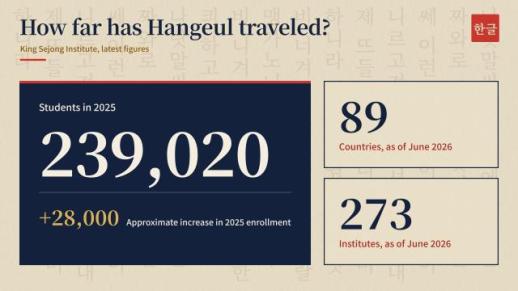 AJP FAQ : How far has Hangeul traveled ? One measure of the international spread of Korean-language learning is the King Sejong Institute network, a government-backed system that provides Korean language and culture classes overseas. The network had expanded to 273 institutes in 89 countries as of June 2026. Enrollment reached a record 239,020 students in 2025, roughly 28,000 more than a year earlier. The growth has accompanied broader international interest in Korean culture, including music, television, film and food. But the figures should not be read as the total number of Korean learners worldwide: they cover only students enrolled through King Sejong Institutes and exclude universities, schools, private academies and independent learners. This also measures the spread of Korean-language education, rather than Hangeul alone. Hangeul is the writing system; Korean is the language being taught. 2026-10-06 17:42:49
 -
 AJP FAQ : How was Hangeul created ? Before Hangeul, Koreans primarily relied on Chinese characters for written communication. Because the system did not match the structure of spoken Korean and was difficult for ordinary people to master, King Sejong sought a writing system that could be learned more easily. He completed the new script in 1443. Some Confucian officials, including Choe Manri, opposed it, arguing that Korea should continue using the Chinese literary tradition. Despite the resistance, Hunminjeongeum was promulgated in 1446 together with explanatory material describing how the letters worked. The original system contained 28 letters, 17 consonants and 11 vowels. Modern Hangeul uses 24 basic letters. Several basic consonant forms were designed with reference to the speech organs used to produce their sounds, while the original vowel system drew on symbols representing heaven, earth and humans. 2026-10-06 17:42:01
 -
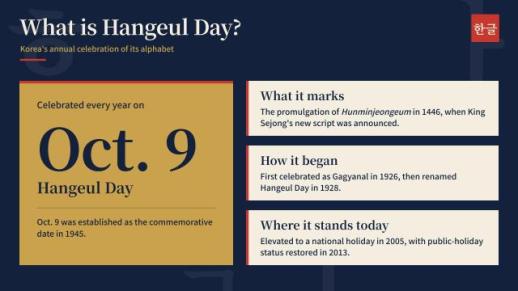 AJP FAQ : What is Hangeul Day ? Hangeul Day, observed every Oct. 9 in South Korea, commemorates the creation and promulgation of Hangeul, the writing system used for the Korean language. King Sejong completed the new script in 1443, and Hunminjeongeum, the document introducing and explaining it, was promulgated in 1446. The modern observance began in 1926 as Gagyanal, or “Gagya Day,” and was renamed Hangeul Day two years later. Oct. 9 became the commemorative date after Korea’s liberation in 1945. Hangeul Day was designated one of Korea’s national celebration days in 2005, and its status as a public holiday was restored in 2013. The date marks the promulgation of Hunminjeongeum, rather than a precisely documented day on which Hangeul itself was invented. 2026-10-06 17:41:39
 -
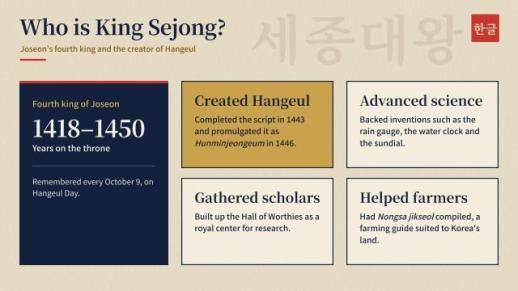 AJP FAQ: Who is King Sejong ? King Sejong, who ruled Joseon from 1418 to 1450, is best known for overseeing the creation of Hangeul, but his reign was also marked by efforts to expand scientific knowledge and make practical information more accessible. His government supported work on astronomical instruments, clocks and rainfall measurement, while scholars compiled Nongsa jikseol, an agricultural manual based on farming conditions in Korea. Sejong also strengthened the Hall of Worthies, a royal research institution whose scholars worked on language, history, science and state affairs. Hangeul remains his most enduring legacy. The script was intended to give people who could not master classical Chinese a more accessible way to read and write their own language. 2026-10-06 17:40:59