
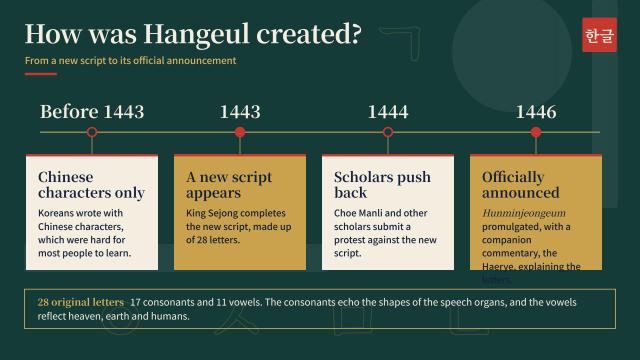
Before Hangeul, Koreans primarily relied on Chinese characters for written communication. Because the system did not match the structure of spoken Korean and was difficult for ordinary people to master, King Sejong sought a writing system that could be learned more easily.
He completed the new script in 1443. Some Confucian officials, including Choe Manri, opposed it, arguing that Korea should continue using the Chinese literary tradition. Despite the resistance, Hunminjeongeum was promulgated in 1446 together with explanatory material describing how the letters worked.
The original system contained 28 letters, 17 consonants and 11 vowels. Modern Hangeul uses 24 basic letters. Several basic consonant forms were designed with reference to the speech organs used to produce their sounds, while the original vowel system drew on symbols representing heaven, earth and humans.
Joonha Yoo is a bilingual journalist at AJU Press (AJP), covering music, culture, entertainment and Korea’s automotive industry.
Raised in Fort Collins, Colorado, he often writes from the scene, bringing firsthand detail to stories ranging
from BTS comeback concerts to unique cultural events that catch the world's eye.
Copyright ⓒ Aju Press All rights reserved.
Related News
-
 Tax and labor reforms pose new hurdles for Korean firms in India
Yoo Ji-hye, managing partner at Buddtree Management Group, speaks about India's tax and labor regulations during a workshop hosted by the Korea-India Future Association (KIFA) at the Seoul Club in Seoul on Nov. 27, 2026. AJP Kim Hee-su SEOUL, November 28 (AJP) - Sweeping changes in tax and labor regulations pose as challenges to Korean Inc. doing business in India as well as the goal to double bilateral trade to $50 billion by 2030. Legal experts and corporate executives gathered at the Seoul Club on Friday for a workshop hosted by the Korea-India Future Association (KIFA) to discuss regulatory risks and difficulties Korean companies face in their Indian operations. The event followed up on South Korea's Ministry of Foreign Affairs' meeting with major Korean companies, including Hyundai Motor, Samsung Electronics and POSCO, on business challenges in India. India has introduced three major regulatory reforms since September last year, overhauling its goods and services tax (GST) system and labor laws, and introducing a new income tax law in April this year. Unlike South Korea, which applies a standard value-added tax rate of 10 percent, India has multiple GST rates, with most business-to-business manufacturing and service transactions subject to an 18 percent rate and certain products taxed at up to 40 percent. "In South Korea, the value-added tax rate is 10 percent, whereas in India it is generally 18 percent," a director at Daeyoung ONE, a Korean automotive parts manufacturer that supplies headlamp components to Hyundai Motor and Kia who attended the workshop, told AJP. Depending on the type of transaction, businesses may also face additional taxes and charges, including the Social Welfare Surcharge, Agriculture Infrastructure and Development Cess, and stamp duty. Shin Bong-kil, chairman of the Korea-India Future Association (KIFA) and former South Korean ambassador to India, delivers welcoming remarks at a workshop at the Seoul Club in Seoul on Nov. 27, 2026. AJP Kim Hee-su "The penalties for noncompliance can also be quite severe," he said. Yoo Ji-hye, managing partner at Buddtree Management Group, a consulting firm specializing in Korean investment in India, said unpaid taxes, penalties and interest can accumulate over several years, while GST-related litigation can take between three and 10 years. "In many cases, tax assessments arise because companies have failed to properly understand or comply with Indian laws," Yoo said. Another major concern is India's labor reform, which consolidated 29 existing labor laws into four codes in November last year. The changes could increase mandatory employment-related costs by 3 to 15 percent, depending on companies' existing pay structures, according to Buddtree. This is largely due to changes in how wages are calculated for retirement benefits and social security contributions. The new rules also restrict the use of outsourced workers in core business activities, posing a challenge for manufacturers that rely heavily on such labor. "In some factories, contract workers account for as much as 90 percent of the workforce," Yoo said. Korean companies are also facing tax disputes over employees dispatched from their headquarters. Indian authorities have sought to impose an 18 percent GST on certain personnel arrangements, viewing them as services provided by overseas parent companies rather than ordinary employment. For example, a company with five expatriates each earning an annual salary of 100 million won could face an additional tax bill of 90 million won a year, excluding penalties and interest, Yoo explained. Others are restructuring their employment arrangements, increasingly hiring personnel directly through their Indian subsidiaries rather than dispatching them from Korean headquarters, according to Yoo. Participants attend a workshop on corporate compliance in India, hosted by the Korea-India Future Association (KIFA), at the Seoul Club in Seoul on Nov. 27, 2026. AJP Kim Hee-su Despite the challenges, experts stressed that India remains an attractive investment destination. Jang Jae-won, managing partner at Buddtree, said Korean companies have increasingly pursued joint ventures with Indian partners over the past decade, combining Korean technology with Indian capital, manufacturing facilities and distribution networks. Competition among Indian states to attract Korean investment is also intensifying. Tamil Nadu, home to major manufacturing facilities operated by Hyundai Motor and Samsung Electronics, recently established a dedicated Korea desk within its investment promotion agency, according to Jang. Yoo advised Korean companies to address tax disputes at the earliest possible stage, before they escalate into lengthy legal battles. She warned that as Indian government agencies share more information, a corporate tax issue could lead to further investigations into GST and foreign exchange transactions. She also urged Korean headquarters to conduct monthly compliance checks on their Indian subsidiaries and maintain detailed records of transactions, even when local managers or expatriate employees are replaced. "Tax authorities may ask you to submit 20 documents within three days. If you haven't prepared them in advance, it is nearly impossible to put them together within that time," Yoo said.
-
 Kazakhstan backs 9 Korean projects worth $2.8 billion
Edited and compiled by AJP. Graphics AI-assisted. SEOUL, November 27 (AJP) - Kazakhstan's state investment agency is supporting nine South Korean projects as the country shifts its investment drive from attracting more foreign money to turning that money into working factories. The projects are worth a combined $2.8 billion, according to an investment review the Kazakh government provided to AJP through its embassy in Seoul. They are supported by Kazakh Invest National Company, which guides foreign investors from first negotiations through commissioning. South Korea's share comes to about 4 percent of the value of the agency's portfolio of 166 projects worth $69.5 billion, which is expected to create more than 59,000 jobs. China leads the portfolio by number of projects with 33 worth $25.9 billion, followed by Türkiye with 29 worth $4.4 billion and the United States with 15 worth $6.2 billion. South Korea ranks fourth, ahead of Qatar, whose eight projects are worth $12 billion, and Russia, with five worth $5.8 billion. Of the 166 projects, 58 worth $20.5 billion are under way and 108 worth $49 billion are still being developed. Agriculture and food processing has the most projects, 41 worth $5.3 billion. Mining and metallurgy has 20 worth $23.4 billion, and energy has 17 worth $19.4 billion. In September, Kazakhstan announced agreements with South Korean partners in gas processing, petrochemical expansion, power generation and rare-earth processing technologies. Hyundai Engineering, Samsung E&A, Doosan Enerbility and POSCO Holdings were among the companies involved. Kia opened a $310 million vehicle plant in Kostanay in October 2025 that can build up to 70,000 vehicles a year. This year, Kazakhstan held business forums and investment roundtables in Seoul and in Chennai, India. President Kassym-Jomart Tokayev said in his State of the Nation Address that investment should be judged by the number and quality of new production facilities brought into operation and by their real contribution to the economy. Manufacturing's share of foreign direct investment (FDI) in Kazakhstan rose from 14.2 percent in 2019 to 21.3 percent in 2025, government figures show. Over the same period, investment in the chemical industry grew 12.6-fold, from $98.8 million to $1.2 billion, and investment in communications grew 12.4-fold, from $105 million to $1.3 billion. Finance and insurance drew $4.2 billion, up from $1 billion. Kazakhstan led the Eurasian Economic Union, a Russia-led trade bloc that also includes Armenia, Belarus and Kyrgyzstan, in plans for new projects. Announced greenfield projects in the country, which build new facilities or operations from the ground up, were worth about $24 billion in 2025, up 34 percent from a year earlier. The figure came to 93 percent of the value of all greenfield projects announced across the bloc, according to the Eurasian Economic Union Investment Report 2026 by the United Nations Conference on Trade and Development (UNCTAD). The report was published Oct. 25 at the World Investment Forum in Doha. The same report recorded negative net FDI inflows of $860 million for Kazakhstan in 2025. Net figures subtract money leaving a country from money coming in, and UNCTAD said negative flows can reflect repayments or divestments alongside new projects. Gross inflows, which count only money coming in, totaled $20.5 billion in 2025, according to the Kazakh government. The government said Kazakhstan has drawn nearly $500 billion in FDI since independence in 1991, including $155 billion over the past seven years. That figure counts every dollar invested over 35 years. FDI stock, a narrower measure, is the value of foreign investment still held in a country at a given point, after investors have withdrawn capital, repaid loans or sold holdings. Kazakhstan's FDI stock stood at $156.4 billion at the end of 2025, roughly two-thirds of the Central Asian total. According to the National Bank of Kazakhstan, gross inflows reached $9.4 billion in the first half of 2026 and $29.8 billion since the start of 2025. That is nearly 30 percent of the goal in the country's investment policy concept, which calls for at least $100 billion in FDI from 2025 to 2030. Outside oil and gas extraction and metallurgy, FDI rose 12.3 percent, while investment in manufacturing other than metallurgy grew nearly 40 percent. Non-metallurgical industries' share of manufacturing FDI climbed from 56.8 percent to 91.9 percent. Foreign investment in food, beverage and tobacco production rose nearly fivefold in the first quarter of 2026 to $405 million. Investment in construction, warehousing and logistics infrastructure grew more than fivefold. Kazakhstan's traditional investors include Russia, China, the United States, the Netherlands, Switzerland and France, and money from the Gulf and Asia is growing alongside them. Investment from the United Arab Emirates rose from $158.2 million in 2019 to $1.6 billion in 2025. Qatar invested $1.3 billion and Singapore $1.4 billion. In the first quarter, investment from the United States climbed to $485.3 million, investment from Switzerland grew 2.3-fold and investment from Singapore rose 70.4 percent. The government expects around 45 projects with foreign participation to start operating in 2026, and 32 already have. They include a soft drink plant in Almaty Region, a combined heat and power plant in Kyzylorda Region and a mining equipment service center in Karaganda. Construction is under way on 33 more, from wind farms to cable production, and work on more than 40 others is due to begin by year-end. Projects worth more than 32 billion tenge ($69.7 million) can sign an investment agreement with the government, a tool introduced in 2021. Each agreement sets out commitments for both sides and fixes key conditions for the life of the project. Kazakhstan has signed 72 of them, including 31 this year. It signed 30 in 2025, up from a handful a year in 2022 and 2023. Seven of this year's agreements cover pharmaceutical projects worth roughly 287.5 billion tenge ($626.6 million), including four new plants that will produce 356 medicines locally. Kazakhstan imports more than 80 percent of its medicines, and President Tokayev has tasked the government with raising domestic production to half the market. President Tokayev declared 2026 the Year of Digitalization and Artificial Intelligence, and the government has made digital infrastructure a priority for foreign investment. In the northeastern city of Ekibastuz, it is developing Data Center Valley, an international cluster for data centers, cloud services and AI infrastructure. In June, Kazakhstan signed a $10 billion package of agreements with U.S.-based AI infrastructure company Firebird and chipmaker NVIDIA, according to the prime minister's office. The package envisions a computing cluster with up to 100,000 next-generation graphics processing units, the chips used to train and run AI models. NVIDIA co-founder Jensen Huang has also visited Astana. Two supercomputers came online in Kazakhstan this year, and a third is due by year-end. Kazakhtelecom and AzerTelecom International have finished laying a fiber-optic cable along the bed of the Caspian Sea. The $600 million Ertis Hydrometallurgical Plant, under construction in Pavlodar Region, will let Kazakhstan refine pure gold at home. An agreement was also signed this year for a metallurgical coke plant in Karaganda Region that will produce 1 million tons a year. More than 100 agricultural projects are under way, from farms to advanced processing. Fufeng Group, Dalian Hesheng Holdings, Lihua Group and Tiryaki Agro are building processing clusters. Carlsberg has opened a beverage plant, PepsiCo is preparing to launch a snack factory and Mars is building a pet food facility. The ninth Kazakhstan Global Investment Roundtable, held Oct. 22 in Shymkent under the theme "From Stability to Growth: Kazakhstan's New Investment Cycle," drew more than 500 investors and business representatives from over 40 countries. The roundtable moved to the country's regions this year. Executives from The Boeing Company, the Islamic Development Bank, Masdar, Sarens Kazakhstan and Lasselsberger Group spoke at its plenary session. Participants signed 22 documents worth $4.8 billion. Investment agreements covered a $730 million, 1,000-megawatt wind farm with energy storage in Kostanay Region and a $150 million glass container plant in Aktobe. Memorandums were signed for a $500 million, 250-megawatt data center in Data Center Valley and the $650 million Kazakhstan International Medical City. Many of Kazakhstan's investment deals are signed during President Tokayev's foreign visits and talks. Summit-level meetings led to projects by Stadler in 2021, Alstom in 2022 and Wabtec in 2025, and Stadler Rail now builds new-generation passenger carriages in Astana. President Tokayev's working visit to Shanghai this year produced more than 88 commercial documents worth over $15 billion. They include a supercomputing cluster with Huawei, optical components for Data Center Valley to be made by Kazakhtelecom and Hengtong Group, lithium-ion battery production, wind farms of up to 1 gigawatt, a terminal at Kuryk port and a container hub in Aktau. President Tokayev has said more than 400 bilateral documents have been signed since the start of the year. About 85 percent of freight shipped from China to Europe passes through Kazakhstan. Construction of the Aral-Caspian railway began in August and is expected to cut roughly 1,000 kilometers from the Trans-Caspian route, which carries goods between China and Europe across the Caspian Sea. The Bakhty-Ayagoz line, due to open in 2027, will add 20 million tons of freight capacity toward China. S&P Global Ratings raised Kazakhstan's sovereign credit rating to BBB with a stable outlook in August, the first time the country has held that rating since 2016. Moody's affirmed its Baa1 rating with a stable outlook in September. Kazakhstan also climbed 17 places to 53rd in the Global Investment Risk and Resilience Index. Foreign investors can use the English common law framework of the Astana International Financial Centre, and Kazakhstan is introducing an Altyn Visa regime for them. The Prosecutor General serves as investment ombudsman. Kazakhstan also plans to set up an Investment Court in the city of Alatau to hear commercial disputes under the English common law model.
-
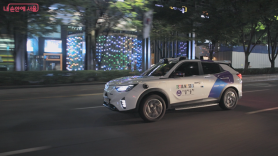 Tesla's next Korean frontier: robotaxis?
An autonomous taxi travels along a street in Seoul at night. Courtesy of the Seoul Metropolitan Government. SEOUL, November 27 (AJP) - South Korea has been running a fleet of self-driving taxis over the last two years — albeit restricted to seven hours late at night on weekdays in Gangnam, with human drivers behind the wheel. Now, a potential competitor has arrived. Tesla has begun deploying its Cybercab, a two-seat electric vehicle designed without a steering wheel or pedals, in its U.S. robotaxi fleet. Samples arrived in Anseong, Gyeonggi Province, on Nov. 12. Tesla has stayed atop Korea's import market throughout the year since February. In June, Elon Musk celebrated Tesla's feat in Korea - the Model Y topping South Korea’s monthly vehicle sales in May — ahead of domestic models, not just other electric vehicles. The figures cited in the post put Model Y sales at 8,762, ahead of the Kia Sorento’s 7,836 and Hyundai Grandeur’s 5,183. Tesla’s total sales reached 10,866 that month, exceeding BMW and Mercedes-Benz combined. Whether Tesla can translate that showroom success into a driverless taxi business is another question. The U.S. automaker has yet to announce plans to launch the Cybercab in South Korea. But its arrival raises questions about the competitiveness of domestic autonomous driving companies and whether foreign-made vehicles would face the same regulatory requirements as those developed locally. “So far, we understand that Tesla has not expressed an intention to apply for a permit for the Cybercab. I have not heard of any overseas expansion plans for the vehicle,” Park Jung-hyuk, director of the autonomous driving policy division at the Ministry of Land, Infrastructure and Transport, told AJP on Friday. Inside of a self driving taxi in Gangnam district Seoul. AJP Joonha Yoo Self-driving in the slow-motion lane Seoul launched its autonomous taxi service on Sept. 26, 2024, with three vehicles operating in designated areas of Gangnam and Seocho. The service initially offered free rides to familiarize passengers with autonomous driving technology and verify its safety in urban traffic. The city recorded 7,754 rides through the end of February this year, reporting no accidents attributable to autonomous driving technology during the period. The fleet expanded to seven vehicles in March before the service became fee-based on April 6. Another expansion on Aug. 20 brought the total to 19. According to the Seoul Metropolitan Government, the service recorded 15,140 cumulative rides through July 31, including 6,176 paid trips. Passengers can book vehicles through the Kakao T application between 10 p.m. and 5 a.m. on weekdays within a designated area covering 20.4 square kilometers. Fares range from 4,800 won to 6,700 won, depending on the time of travel, without additional charges based on distance or travel time. Autonomous driving developer SWM operates 13 vehicles based on KG Mobility’s Korando e-Motion and Torres EVX, while Kakao Mobility operates six modified Kia EV6 vehicles. A screen inside an autonomous taxi in Seoul displays surrounding vehicles, lane markings and the planned driving path in real time, as a safety driver sits behind the wheel. AJP Joonha Yoo The vehicles use cameras and other sensors to identify pedestrians, surrounding traffic and obstacles. Technologies such as radar and LiDAR measure distances and generate three-dimensional representations of the driving environment. Kakao Mobility said in August that it had spent five months developing an urban driving AI planner based on end-to-end technology, in which an integrated artificial intelligence model handles functions ranging from environmental perception to vehicle control. The company has also developed algorithms to respond to unpredictable situations, including jaywalking, illegally parked vehicles and motorcycles, and has been collecting daytime driving data since June. The city is preparing to introduce three additional vehicles targeting Level 4 autonomy in Sangam, western Seoul, in December. Level 4 allows a vehicle to drive without human intervention within specified operating conditions. “Initially, the driver’s seat will be left empty, but a safety manager will sit in the front passenger seat because of safety considerations,” an official from the Seoul Metropolitan Government’s future transportation division told AJP. “As the technology develops, we will gradually expand toward fully unmanned operations.” Tesla's Cybercab, a two-seat autonomous electric vehicle designed without a steering wheel or pedals, is on display with its butterfly doors open. Courtesy of Tesla. Tesla’s head start in scale and data Unlike the modified production vehicles operating in Seoul, the Cybercab was developed specifically for driverless transportation, combining Tesla’s camera-based autonomous driving technology with a dedicated vehicle platform. Tesla’s third-quarter earnings report said its overall robotaxi service had accumulated nearly 2 million miles, or 3.2 million kilometers, of unsupervised driving by the end of September. Its service in Austin, Texas, operates 18 hours a day. The company’s established presence in South Korea also provides a growing base of vehicles using its driving software. According to data submitted for an October parliamentary audit, 238,968 Tesla vehicles were registered in the country as of the end of September. Of those, 53,477 were capable of using Tesla’s Full Self-Driving (FSD) software. Some 30,303 vehicles had used the system, accumulating 91.8 million kilometers of driving on Korean roads. The FSD system currently available in South Korea requires active human supervision and is distinct from fully driverless robotaxi technology. Tesla’s integrated manufacturing and software business also differs from the operating structure of Seoul’s autonomous taxi program, which relies on modified vehicles and central government funding. An onboard display inside an autonomous taxi in Seoul shows surrounding vehicles, lane markings, traffic signals and sensor status on Nov. 18, 2026. AJP Joonha Yoo Different regulatory hurdles Park said vehicles that have already satisfied automotive safety certification requirements can obtain temporary operating permits relatively easily after being equipped with autonomous driving systems. “It is relatively easy for vehicles that have already been self-certified to operate. The vehicles currently operating in Gangnam are based on certified production vehicles that have been modified,” he said. Vehicles such as the Cybercab, which lack conventional driving controls, would require separate consideration under South Korea’s automotive safety framework. The government currently provides safety exemptions for uncertified vehicles undergoing research, experimentation and technology demonstrations. However, foreign companies seeking to import commercially developed vehicles may find it more difficult to qualify. “For domestic vehicles, the purpose is research and experimentation. But if a foreign vehicle is brought into the country after its research and experimentation have already been completed, the purpose of granting an exemption becomes less clear,” Park said. “The government grants exemptions to allow vehicles that do not meet existing standards to undergo demonstrations. It is not easy to grant such exemptions to foreign vehicles.” South Korea’s autonomous vehicle commercialization law nevertheless provides a performance certification framework covering both domestically manufactured and imported vehicles. On Nov. 13, the transport ministry introduced detailed certification regulations, including a general requirement for operating records covering at least 180 days and 10,000 kilometers. Separate approval is required to verify a vehicle’s suitability for the road, weather and communications conditions of its intended operating area. A Seoul city official said vehicle safety certification falls under the jurisdiction of the central government, while local authorities issue passenger transportation permits. “For vehicles without a driver’s seat, safety standards different from those applicable to existing vehicles are necessary. Those standards are currently being discussed and revised at the central government level,” the official said. A screenshot of Chinese autonomous driving company Pony.ai's official website shows a robotaxi equipped with roof-mounted sensors. Captured from Pony.ai's website. Chinese competitors already testing Korean roads While Tesla has no confirmed plans to introduce its robotaxi service in South Korea, Chinese autonomous driving technology is already being tested in Seoul. In August, South Korean autonomous driving company FutureLink announced a partnership with Chinese robotaxi developer Pony.ai to introduce 200 next-generation autonomous taxis, targeting fully unmanned operations by 2028. FutureLink has been testing modified Hyundai Kona Electric vehicles equipped with Pony.ai technology in Gangnam since last year. “Chinese vehicles are already operating under temporary permits. There are about 10 of them, but Seoul has not granted them permits for paid transportation services,” Park said. He said he understood that security concerns, including the potential transfer of driving information overseas, were among the issues being considered. The government is preparing additional regulations governing autonomous vehicle data, cybersecurity and remote monitoring. “We are preparing to make it mandatory for autonomous driving service providers to locate their servers in South Korea and store their data domestically,” Park said. Under a regulatory reform plan announced on Oct. 23, the government aims to prepare legislative amendments in the first half of 2027, followed by detailed data security standards in the second half. Government push for commercialization Seoul acknowledged in an August policy announcement that South Korea remained focused on small-scale demonstrations while the United States and China were pursuing large-scale commercialization of driverless robotaxis. The city aims to expand its autonomous taxi fleet in Gangnam and Sangam to 50 vehicles by 2027. Further expansion will involve consultations with the existing taxi industry. On Oct. 1, Seoul signed an agreement with Hyundai Motor and the Seoul Bus Transportation Association to establish an industrial ecosystem for Level 4 autonomous buses. The initiative calls for dedicated vehicle development, standardized sensors and AI training data, and the sharing of driving information with domestic technology companies. The city plans to conduct technology development and demonstrations in 2027 and 2028, begin large-scale deployment in 2029 and introduce 500 autonomous city buses by 2030. The transport ministry is also pursuing a citywide autonomous driving demonstration project in Gwangju involving Hyundai Motor, Autonomous A2Z and RideFlux. The project calls for 200 autonomous vehicles, with the first scheduled to begin operating on Nov. 30 and 120 expected to be deployed by the end of this year. The ministry plans to expand similar demonstration projects to other local governments from 2027, targeting more than 1,000 autonomous vehicles participating in trials nationwide by 2030.